As I'm writing this, the thermometer outside reads a chilly 49 degrees Fahrenheit. Yes, the Autumn is upon us and it will be dragging along its sidekick Old Man Winter. For us motorcyclists up north, we're living on borrowed time.
In no time at all, the batteries will be removed from the bikes (and the Corvette) and placed in the basement to ride out the winter. I'll stare mournfully at my covered bikes as I warm up the snowblower. I'll check the weather on a daily basis with the hope of a warmish day to do some riding only to find none. The sky will be a perpetual shade of gray. Winter is a time of longing - for sun, warmth and riding.
In the meantime, though, there's still plenty of riding to do.
Early Autumn offers some of the best riding of the year. The heat and humidity of summer is replaced with much cooler temperatures and beautiful scenery as the trees change color. It's nice not being drenched with sweat when coming home from a ride. Another plus is riding quickly through a pile of leaves and watching them in your mirrors as they get blown around, just like in the movies. That makes you feel fast.
But with all the pluses of Autumn riding, there's still the cold wind of Winter blowing down your back. The knowledge that the one good riding day can be followed by a week of rain and cold can make Autumn riding depressing and bittersweet. The onset of Winter is making me antsy and wanting to do more riding. I know I don't have much riding time left and I should enjoy the time as much as possible.
And that's what I intend to do - enjoy the time left as much as possible. With that thought in mind, I'm going riding.
Not now, though; it's dark. I'll ride in the morning.
Thursday, September 15, 2011

Sunday, August 7, 2011
200 miles later
It's time for a 200 mile update on life with my new (to me) Moto Guzzi V11 Sport.
To quickly recap, I was looking for a lightweight corner-carving motard and ended up buying a 500 lb Guzzi. You figure it out.
Going back and forth between the Guzzi and my Bonneville reveals that besides being air-cooled, twin-cylinder motorcycles, they are worlds apart. My Bonneville is smooth, comfortable and reliable. The Guzzi is loud, uncomfortable and rough. It's like riding the motorcycling equivalent of a muscle car. It even sounds like one!
The engine is big and makes a lot of noise. Not just noise from the Ferracci pipes, but noise from the valvetrain, the timing gears and pretty much everywhere else. The growl from the pipes is very addicting, though, and it's hard to resist giving it a handful of throttle.
The two big cylinders moving up and down create a lot of vibration, too. Not just at idle, where your butt moves side-to-side with the power pulses, but while you're riding, as well. At 3,500 rpm, a buzzing vibration moves through the bars, instantly numbing your hands and blurring the objects in the mirrors. However, the vibration does go away as the revs climb. Hmm, that sounds like a good excuse for more throttle!
In the last 200 miles, I've also had a few issues. First, the odometer quit working. If I fiddled with the trip reset knob, the odometer would work for a few miles and then stop again. Once, it started spinning backward, which was weird. The manufacturer for the gauges was switched from Veglia to ITI in 2003 because of reliability issues with the Veglia units. It doesn't sound like much was solved with the switch. Anyway, I applied a liberal amount of WD-40 to the odometer gears and it's working fine now.
Second, the transmission has a mind of its own. It will shift normally for 20 or 30 miles and then decide it doesn't want to go into third or fourth gear, requiring me to tap down on the shifter and then up to engage the gear. It may also decide to take lunch and leave me in a false neutral. This bike was advertised as having a six-speed gearbox but I think it has 11 speeds - six forward gears and five neutrals. After much shifter adjusting and a generous application of WD-40, it seems to be working as designed now. When this transmission debuted in 1999, Moto Guzzi claimed it was their smoothest transmission ever. It really makes me wonder how bad the old ones were.
And finally, the riding position is murder. Italian bikes are notorious for tormenting their riders with punishing riding positions and this Guzzi is no different. Your legs are crammed into this tiny space while your arms are stretched out to the max, leaving your butt sticking up as if you're preparing for a prostate exam. Undignified is a good way to describe how you look while riding. Uncomfortable is a good way to describe how the riding position feels.
However, all of these niggles and issues disappear when you point the bike down a twisty ribbon of asphalt.
On a twisty backroad, the bike just comes alive. The riding position becomes comfortable and natural. Right on cue, the engine delivers its torque exactly when you need it: on exit from the corner. Big Brembo brakes bring the Guzzi's massive bulk to a stop with easily-modulated quickness. Suddenly, everything about this bike starts to makes sense. I was wrong when I called it a two-wheeled muscle car. It's really a two-wheeled AMG Mercedes - seemingly too big and heavy to be magic on a backroad but yet it is.
With its long wheelbase, the Guzzi is just so stable at speed. You can fly down winding roads without any hint of twitching or instability. It also hides its weight well, making easy transitions from left- to right-hand bends with just a bit of countersteer and some nudging from your hips. At 500-plus lbs, it will never be confused for a lithe supersport or an all-out superbike. It does just fine on the roads of the real world and, really, that's more important. This bike will never be on a track so I'll gladly trade a few seconds there for real-world stability.
Piloting my Bonneville down a winding road is exercise. You're constantly fighting the tall front tire and the heavy wheels. On the same winding road, the Guzzi is in its natural habitat, doing what it was built to do. It leans over gracefully into the corners and then a big lump of V-twin torque fires you right out of them. It really is magic.
Now that I'm starting to get a feel for the bike and its eccentricities (the rightward lurch upon throttle application never gets old), I can start messing with the adjustable suspension. I moved everything back to the factory settings and it seems a bit stiff. I'll start getting more in depth with those adjustments in the next 200 miles.
Right now, though, I need some higher clip-ons. Oh, my aching biceps...
To quickly recap, I was looking for a lightweight corner-carving motard and ended up buying a 500 lb Guzzi. You figure it out.
Going back and forth between the Guzzi and my Bonneville reveals that besides being air-cooled, twin-cylinder motorcycles, they are worlds apart. My Bonneville is smooth, comfortable and reliable. The Guzzi is loud, uncomfortable and rough. It's like riding the motorcycling equivalent of a muscle car. It even sounds like one!
The engine is big and makes a lot of noise. Not just noise from the Ferracci pipes, but noise from the valvetrain, the timing gears and pretty much everywhere else. The growl from the pipes is very addicting, though, and it's hard to resist giving it a handful of throttle.
The two big cylinders moving up and down create a lot of vibration, too. Not just at idle, where your butt moves side-to-side with the power pulses, but while you're riding, as well. At 3,500 rpm, a buzzing vibration moves through the bars, instantly numbing your hands and blurring the objects in the mirrors. However, the vibration does go away as the revs climb. Hmm, that sounds like a good excuse for more throttle!
In the last 200 miles, I've also had a few issues. First, the odometer quit working. If I fiddled with the trip reset knob, the odometer would work for a few miles and then stop again. Once, it started spinning backward, which was weird. The manufacturer for the gauges was switched from Veglia to ITI in 2003 because of reliability issues with the Veglia units. It doesn't sound like much was solved with the switch. Anyway, I applied a liberal amount of WD-40 to the odometer gears and it's working fine now.
Second, the transmission has a mind of its own. It will shift normally for 20 or 30 miles and then decide it doesn't want to go into third or fourth gear, requiring me to tap down on the shifter and then up to engage the gear. It may also decide to take lunch and leave me in a false neutral. This bike was advertised as having a six-speed gearbox but I think it has 11 speeds - six forward gears and five neutrals. After much shifter adjusting and a generous application of WD-40, it seems to be working as designed now. When this transmission debuted in 1999, Moto Guzzi claimed it was their smoothest transmission ever. It really makes me wonder how bad the old ones were.
And finally, the riding position is murder. Italian bikes are notorious for tormenting their riders with punishing riding positions and this Guzzi is no different. Your legs are crammed into this tiny space while your arms are stretched out to the max, leaving your butt sticking up as if you're preparing for a prostate exam. Undignified is a good way to describe how you look while riding. Uncomfortable is a good way to describe how the riding position feels.
However, all of these niggles and issues disappear when you point the bike down a twisty ribbon of asphalt.
On a twisty backroad, the bike just comes alive. The riding position becomes comfortable and natural. Right on cue, the engine delivers its torque exactly when you need it: on exit from the corner. Big Brembo brakes bring the Guzzi's massive bulk to a stop with easily-modulated quickness. Suddenly, everything about this bike starts to makes sense. I was wrong when I called it a two-wheeled muscle car. It's really a two-wheeled AMG Mercedes - seemingly too big and heavy to be magic on a backroad but yet it is.
With its long wheelbase, the Guzzi is just so stable at speed. You can fly down winding roads without any hint of twitching or instability. It also hides its weight well, making easy transitions from left- to right-hand bends with just a bit of countersteer and some nudging from your hips. At 500-plus lbs, it will never be confused for a lithe supersport or an all-out superbike. It does just fine on the roads of the real world and, really, that's more important. This bike will never be on a track so I'll gladly trade a few seconds there for real-world stability.
Piloting my Bonneville down a winding road is exercise. You're constantly fighting the tall front tire and the heavy wheels. On the same winding road, the Guzzi is in its natural habitat, doing what it was built to do. It leans over gracefully into the corners and then a big lump of V-twin torque fires you right out of them. It really is magic.
Now that I'm starting to get a feel for the bike and its eccentricities (the rightward lurch upon throttle application never gets old), I can start messing with the adjustable suspension. I moved everything back to the factory settings and it seems a bit stiff. I'll start getting more in depth with those adjustments in the next 200 miles.
Right now, though, I need some higher clip-ons. Oh, my aching biceps...
Sunday, July 24, 2011
Looking for a Light Weight Motorcycle
I've been looking for a lightweight bike recently, something with an emphasis on handling. The motard concept of a dirt bike converted into a sports bike is really appealing due to the low weight of dirt bikes and their strength. You have to be tough to survive on dirt. The biggest problem I've encountered in my search has been the copious seat heights of some the bikes. Frankly, I'm short and motards aren't.
Anyway, I've been looking at the KTM Duke II, the Suzuki DRZ400SM and the Yamaha WR250X. I want weight under 400 lbs, one cylinder and liquid cooling. Fuel injection would be nice but is not a requirement. I'm not that interested in balls-out horsepower and I just want a corner carver. A motard fits this bill nicely.
So, with the requirements above in mind, I bought this:

It's a 2003 Moto Guzzi V11 Sport.
Keen observers will notice that it meets none of my requirements. It's heavy (500 lbs dry), twin cylinder and air-cooled. At least it's fuel injected.
I was looking around the Internet and stumbled across this Guzzi for sale at Martin Eurosports in Coopersburg, PA and I was hooked immediately. The red paint, racer position and throbbing twin sucked me right in. All thoughts of 30 horsepower motards flew away like birds during the onset of winter.
I took the 6 hours drive a few days ago to look at the bike and was sold before I got out of the car. It's in extremely good condition with 15,000 miles on the clock. The previous owner took very good care of the bike, evidenced by the expensive and tasteful mods like the carbon fiber rear fender, Moto Guzzi accessory quarter fairing and Fast by Ferracci silencers.
The heart of the V11 is the 1064cc V-Twin that churns out 91 horsepower and 63 lb/ft of torque. This engine is traditional Guzzi, from the air-cooling to the pushrod valve actuation to the rightward lurch whenever the throttle is blipped. The sound and fury emanating from the nice carbon cans is pleasantly growling without being obnoxious. It sounds like a muscle car.
Sitting behind the engine is a six-speed gearbox, hailed by the motorcycling press as Guzzi's best, sending power to the back wheel via Guzzi's traditional shaft drive. Holding everything together and on the road is a steel backbone frame and fully adjustable suspension front and rear. The front wheel gets it bounce from a 40mm Marzocchi fork and the back gets its from a Sachs Boge shock unit.
Bringing the big red bike to a stop are Brembo brakes front and rear with Guzzi's (again) traditional linked brake system. The foot pedal actuates the front left and rear brake while the lever control actuates the right front brake.
In all, this bike so unlike me. Number one, it's red, a color way too flashy for me. I like dark colors (gray, black, dark blue) and red is too ostentatious for conservative ol' me. It's also modern in its styling, though it still has a few retro touches. I prefer the styling of old bikes (one of the reasons I bought my Bonneville) but this Guzzi is very good-looking.
What attracted me to this bike was its Italian heritage (I'm Italian), its unique qualities and its abilities. It hides its girth well and is just a joy to pilot down a winding road. Its quirks, like the lurch when you blip the throttle or the rattle of the dry clutch, speak to me in a way that's hard to describe. They give the bike its own character, something you won't find on any other bike. Stuff like that drives me wild in a good way.
I'm looking forward to a long relationship with this machine.
Anyway, I've been looking at the KTM Duke II, the Suzuki DRZ400SM and the Yamaha WR250X. I want weight under 400 lbs, one cylinder and liquid cooling. Fuel injection would be nice but is not a requirement. I'm not that interested in balls-out horsepower and I just want a corner carver. A motard fits this bill nicely.
So, with the requirements above in mind, I bought this:

It's a 2003 Moto Guzzi V11 Sport.
Keen observers will notice that it meets none of my requirements. It's heavy (500 lbs dry), twin cylinder and air-cooled. At least it's fuel injected.
I was looking around the Internet and stumbled across this Guzzi for sale at Martin Eurosports in Coopersburg, PA and I was hooked immediately. The red paint, racer position and throbbing twin sucked me right in. All thoughts of 30 horsepower motards flew away like birds during the onset of winter.
I took the 6 hours drive a few days ago to look at the bike and was sold before I got out of the car. It's in extremely good condition with 15,000 miles on the clock. The previous owner took very good care of the bike, evidenced by the expensive and tasteful mods like the carbon fiber rear fender, Moto Guzzi accessory quarter fairing and Fast by Ferracci silencers.
The heart of the V11 is the 1064cc V-Twin that churns out 91 horsepower and 63 lb/ft of torque. This engine is traditional Guzzi, from the air-cooling to the pushrod valve actuation to the rightward lurch whenever the throttle is blipped. The sound and fury emanating from the nice carbon cans is pleasantly growling without being obnoxious. It sounds like a muscle car.
Sitting behind the engine is a six-speed gearbox, hailed by the motorcycling press as Guzzi's best, sending power to the back wheel via Guzzi's traditional shaft drive. Holding everything together and on the road is a steel backbone frame and fully adjustable suspension front and rear. The front wheel gets it bounce from a 40mm Marzocchi fork and the back gets its from a Sachs Boge shock unit.
Bringing the big red bike to a stop are Brembo brakes front and rear with Guzzi's (again) traditional linked brake system. The foot pedal actuates the front left and rear brake while the lever control actuates the right front brake.
In all, this bike so unlike me. Number one, it's red, a color way too flashy for me. I like dark colors (gray, black, dark blue) and red is too ostentatious for conservative ol' me. It's also modern in its styling, though it still has a few retro touches. I prefer the styling of old bikes (one of the reasons I bought my Bonneville) but this Guzzi is very good-looking.
What attracted me to this bike was its Italian heritage (I'm Italian), its unique qualities and its abilities. It hides its girth well and is just a joy to pilot down a winding road. Its quirks, like the lurch when you blip the throttle or the rattle of the dry clutch, speak to me in a way that's hard to describe. They give the bike its own character, something you won't find on any other bike. Stuff like that drives me wild in a good way.
I'm looking forward to a long relationship with this machine.
Monday, July 11, 2011
Go Small or Go Home
After making a name for itself selling small to mid-size scooters, Italian firm Aprilia has been carving out quite a niche in the sport bike world. Their initial attempts at full-on sport bikes were considered by some in the press to be cute attempts to join the big boys from Japan and Europe. The roaring thunder emanating from the Rotax-built twin in the RSV 1000 silenced many of the critics and helped cement Aprilia as a legitimate power in the superbike wars.
But Aprilia's heart is still the small-bore segment.
And there is no more proof of this than their newest small bike, the RS4 125. The familiar two-stroke is gone as this Aprilia is powered by a liquid-cooled four-stroke single displacing 125cc's and pumping out 16 horsepower. It also sports a 41 mm inverted fork, four-piston front brakes and a stout aluminum frame. Topping it off is styling reminiscent of the much larger RSV4 superbike. The RS4 125 is aimed the teenage rider looking to get his or her feet wet in the sportbike pool.
Let's go back and focus on something for a bit: 16 horsepower.
Sixteen.
Don't let that number fool you into thinking this bike is a few steps above a Power Wheels motorcycle. This machine is full of serious engineering.
The engine features dry-sump lubrication to save weight and physical engine size. Lessons learned in World Superbike and GP 125 found their way into the die-cast aluminum chassis, creating a stiff frame that's still light weight. Clamping the 300 mm front disk is a radially-mounted four-piston caliper. The exhaust is hung low in the chassis for better mass centralization. Even the fairing was wind tunnel-tested for maximum aerodynamic efficiency. The whole package has ready-to-ride wet weight of just 264 lbs.
That's an amazing spec sheet for a small-bore bike.
Even though this machine is marketed toward 16-year-olds, its serious engineering can make any experienced rider take notice. It's a bit like a road-legal (in Europe) GP 125 bike much the same way a Ducati Desmosedici is a road-legal MotoGP bike. The stiff chassis, big brakes and willing engine all combine to get those enthusiast juices flowing.
Now if it will only come to the U.S.


But Aprilia's heart is still the small-bore segment.
And there is no more proof of this than their newest small bike, the RS4 125. The familiar two-stroke is gone as this Aprilia is powered by a liquid-cooled four-stroke single displacing 125cc's and pumping out 16 horsepower. It also sports a 41 mm inverted fork, four-piston front brakes and a stout aluminum frame. Topping it off is styling reminiscent of the much larger RSV4 superbike. The RS4 125 is aimed the teenage rider looking to get his or her feet wet in the sportbike pool.
Let's go back and focus on something for a bit: 16 horsepower.
Sixteen.
Don't let that number fool you into thinking this bike is a few steps above a Power Wheels motorcycle. This machine is full of serious engineering.
The engine features dry-sump lubrication to save weight and physical engine size. Lessons learned in World Superbike and GP 125 found their way into the die-cast aluminum chassis, creating a stiff frame that's still light weight. Clamping the 300 mm front disk is a radially-mounted four-piston caliper. The exhaust is hung low in the chassis for better mass centralization. Even the fairing was wind tunnel-tested for maximum aerodynamic efficiency. The whole package has ready-to-ride wet weight of just 264 lbs.
That's an amazing spec sheet for a small-bore bike.
Even though this machine is marketed toward 16-year-olds, its serious engineering can make any experienced rider take notice. It's a bit like a road-legal (in Europe) GP 125 bike much the same way a Ducati Desmosedici is a road-legal MotoGP bike. The stiff chassis, big brakes and willing engine all combine to get those enthusiast juices flowing.
Now if it will only come to the U.S.
An almost dead-ringer for an RSV4, the RS4 125 has Italian good looks and charm in spades.
The LCD display mimics those found on larger sportbikes and adds a minimalist touch to the cockpit. Make no mistake, this bike is all business.
Wednesday, June 22, 2011
Dining at the Sportster Cafe
It's recently hit me like a ton of bricks: I want to give a Harley-Davidson Sportster the cafe treatment.
For so long, Milwaukee's small V-Twin has been victimized by choppers, bobbers and other people with a welder and too much time on their hands. And when it's not being cut-up and ruined, the Sportster is passed off as a "girl's bike". It's a shame, really, because the Sportster really isn't a bad bike. It may not be the fastest, the most agile or the lightest bike in the world but it has history and character in spades.
As someone who has ridden a few Sportsters, I can say they aren't the most refined motorcycles on the road. They have a heavy, industrial quality to them that isn't found on other motorcycles. Everything feels solid, like the gear change, which has a nice thunk to it. Sportsters are also heavy, weighing in at around 500 pounds or more, depending on model and year. That weight shows itself in the corners where the Sportster's respectable, if not sporty, handling is displayed. At it's heart, though, the Sportster is loud, crude and mean. That's exactly what it should be, even if HD's marketing department is trying to sell the bike to women.
And after 54 years of drag racers, choppers, bobbers, customs and chrome, there really isn't any new ground for the Sportster to cover.
Oh, but there is.
Hiding beneath the chrome is a brilliant cafe bike just waiting to be unleashed, spewing the patented Harley sound on some unsuspecting rockers. Let's have a look at some cafe'd Sportsters from around the Internet:
 This Norley is a nice variation on the Triton theme. A Triton is a Triumph twin mounted in a Norton Featherbed frame, combining the era's best powertrain (Triumph) with the best chassis (Norton Featherbed). Norley means it's a Featherbed frame (Nor) with a Harley Sportster powertrain (Ley). The Manx-style alloy tank and bum-stop seat make it look very period. I like it.
 Another very classic-looking Sportster cafe. The green is a nice color and I dig the Vincent-style tank badge. I could ride this and be happy.
 I really like this Sportster. The Manx tank is perfect and the badging is an homage to Vincent/HRD. Beautiful, I love it.
 Roland Sands Design is even getting on the cafe Sportster train with this bike based on a wrecked Nightster. I like the bike overall, but a few items like the exhaust, the lack of a front fender and the number 3 on the oil tank put me off.
For so long, Milwaukee's small V-Twin has been victimized by choppers, bobbers and other people with a welder and too much time on their hands. And when it's not being cut-up and ruined, the Sportster is passed off as a "girl's bike". It's a shame, really, because the Sportster really isn't a bad bike. It may not be the fastest, the most agile or the lightest bike in the world but it has history and character in spades.
As someone who has ridden a few Sportsters, I can say they aren't the most refined motorcycles on the road. They have a heavy, industrial quality to them that isn't found on other motorcycles. Everything feels solid, like the gear change, which has a nice thunk to it. Sportsters are also heavy, weighing in at around 500 pounds or more, depending on model and year. That weight shows itself in the corners where the Sportster's respectable, if not sporty, handling is displayed. At it's heart, though, the Sportster is loud, crude and mean. That's exactly what it should be, even if HD's marketing department is trying to sell the bike to women.
And after 54 years of drag racers, choppers, bobbers, customs and chrome, there really isn't any new ground for the Sportster to cover.
Oh, but there is.
Hiding beneath the chrome is a brilliant cafe bike just waiting to be unleashed, spewing the patented Harley sound on some unsuspecting rockers. Let's have a look at some cafe'd Sportsters from around the Internet:

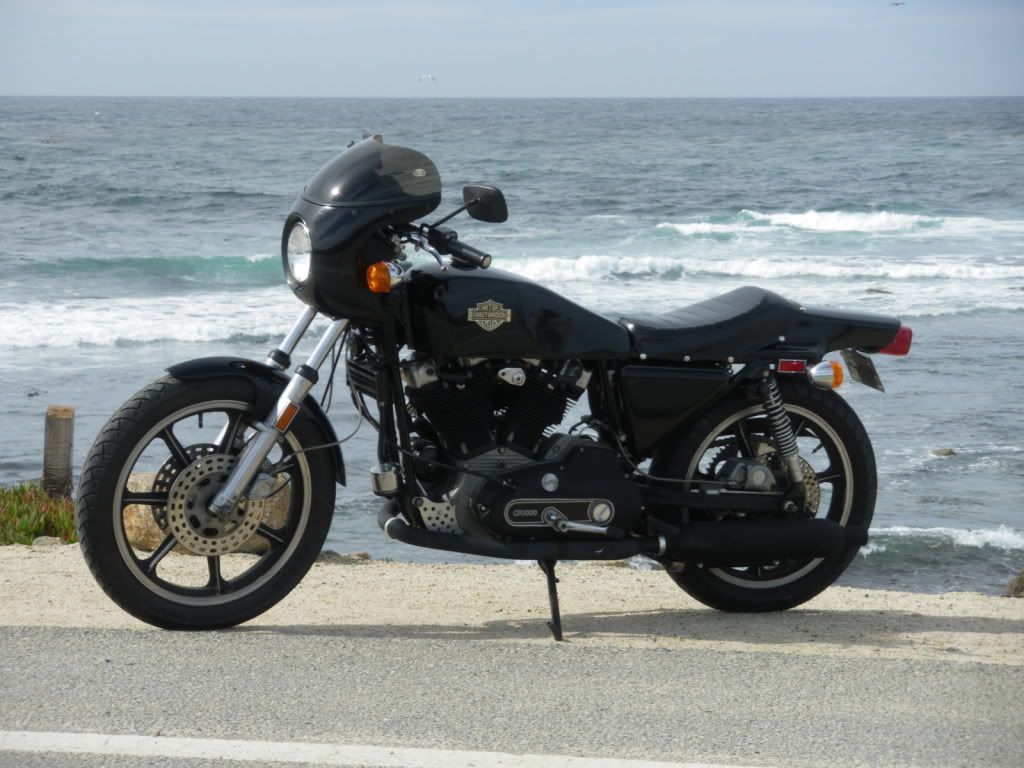
Willie G. Davidson saw the Sportster's capacity as a cafe bike over 30 years ago when The Motor Company released the XLCR in 1977. Unfortunately, nobody else saw that capacity and the XLCR was dropped after a two year run due to poor sales. Now the bike's a collector's item. Figures.
Tuesday, June 7, 2011
Six Things They Don't Tell You About Motorcycle Restorations
This time last year I was happily hauling home a rusted hulk that was, at one time, a 1965 Ducati 350 Sebring. I drove home that evening with the image of me putting on an old-school helmet, tromping on the kick start and then tearing off into the horizon to the tune of a thousand fluttering female hearts.
One year later I have a painted frame, a few other bits with paint on them and an engine spread all over the basement. With coffee mug in hand, I examine my pile of parts each morning and ask “where the hell does all this stuff go?”
So, with optimistic restorations in mind, I present The Six Things They Don’t Tell You about Motorcycle Restorations.
1. The cost
Sure, the bike was cheap. I only paid $150 for my Ducati. Parts, however, are not. $100 here, $50 there, $75 over here and soon you’re $1,000 in the hole on your $150 bike. Be careful how you spend because it adds up faster than you think, even if you think really fast.
Shipping cost is another area that you don’t often think about. When you’re stoked about getting that ϋber-rare part at a nice price, don’t forget to look and make sure you aren’t getting shafted on the shipping. I bought a new-old stock piston for my Ducati that cost $200. While that made my butt cheeks clench, the shipping threw me into spastic fit. It cost $14 to ship the piston from Cincinnati, OH to my home in Pittsburgh, PA, a distance of 300 miles. I bought a part from England of similar weight and it cost me $12 to ship it to my door. Yeah, I don’t get it either.
2. Finding parts
If I had purchased a rusty British bike or American bike, I would be up to my ears in restoration parts. No, I had to buy an obscure Italian bike that wasn’t very popular in the U.S. and one that doesn’t have great parts support. All I have to say is: thank God for the Internet.
While the Internet was originally designed by nerds for easy access to porn, it also doubles as an efficient and easy way to buy old motorcycle parts. Thanks to countless EBay sellers across America and from stores in England, Australia and Italy, I have been able to get parts relatively painlessly. I also have to give mad props (does anyone still say that?) to the Ducati guy that sells stuff at Vintage Motorcycle Days at Mid-Ohio every year. You’ve been a life saver. *does chest thump point thing*
3. Surprises
One usually goes into a restoration thinking “a few cans of paint, some metal polish and a bottle of Lucas Oil Treatment and I’ll be done in time for bike night.”
No, you won’t.
No, you’ll find that rust has eaten pits into your frame, the brakes are frozen in place and the seat is home to a colony of rare spiders that PETA won’t let you disturb. You’ll also take the cylinder head off to see why your engine won’t turn only to find a nickel-sized hole in the piston, the same piston that is seized to the bore.
I’m speaking from experience, here, folks. The things you’ll find tearing into an old motorcycle will shock you more than finding out your parents smoked pot (which they did).
I’m speaking from experience, here, folks. The things you’ll find tearing into an old motorcycle will shock you more than finding out your parents smoked pot (which they did).
4. The work
A lot of people glamorize the restoration process but it’s not glamorous at all. It’s really messy and dirty. You will swear, you will break stuff and you'll have to improvise. It does, however, teach you to think and how to deal with unpleasant situations. You can apply the lesson you learn in your garage (or basement) to your life. Wrenchin' and learnin'. I should write a book.
Also, old parts are usually covered in old oil that smells awful and will stay on your hands until the end of time. I once asked an old-time mechanic how to get the oil off my hands. He said I should wash my hands with gasoline. I then asked him what I should wash my hands with to get the smell of gas off and he just looked at me like I was crazy. I’m crazy? You’re the one washing your hands in gas. I hope this guy doesn’t like to use a grill.
Anyway, once your motorcycle has been reduced to bits and your hands resemble those of an Egyptian mummy, it’s time to put everything together. You did remember to take pictures and mark where everything goes, right? Good, now bolt your mess back together. Don’t forget where that wavy washer goes, or which clutch plate goes in first, or where that spring went. The service manual sure isn’t going to tell you.
5. The tools
Having an old bike to restore is a good excuse to buy tools. But don’t think you’re going to get by with a cheap socket set from Sears. Most of my Ducati’s bolts used Allen heads, requiring me to buy Allen keys. Okay, drive to Sears and buy Allen key set. Wait, the fork caps are 12mm Allens and I don’t have that size in my set. Drive back to Sears and buy 12mm Allen key. Wait, the oil plug and the drain plug are 14mm Allens and I don’t have that size in my set. Drive to Sears again and buy 14mm Allen key.
But it doesn’t stop there. Disassembling the engine requires a whole slew of special tools that aren’t produced by Ducati anymore. You need tools to hold the cams, tools to help with timing, tools to remove the valve springs. The Internet can help you find new-production versions of those tools but be prepared to pay a lot for them and for their quality to be on the lower end.
6. Riding your restored bike
Um, I really don’t have much to say about this because I’m nowhere near that point. I imagine it’s very satisfying and I long for that day. Until then, though, I’m going to be down here in my basement trying to find the really small o-ring that went between the cylinder head and the piston barrel. I know it’s around here somewhere. Wait, where does this piece go? Hey, don’t shut the light out on me!
Friday, May 20, 2011
A Few of My Favorite Things
There really is a lot to like about riding a motorcycle. It's exciting, fascinating and wholesome good fun. Well, it might not be wholesome and good if you were in an outlaw biker gang, but I'm sure it would still be fun.
Anyway, I thought I'd share a few reasons why I like motorcycling. Here goes:
1. The character of the motorcycle
Every motorcycle has its own unique character; something you don't get in your average car. British motorcycles have traditionally been brash, sporty and loud. German motorcycles have traditionally been meticulously engineered and smooth as silk. Italian motorcycles are expressive, impractical and reflective of Italy's love for speed and style. Even the Japanese have managed to give their motorcycles character: precision, focus and reliability.
The motorcycles produced by each country reflect their values and ethos and in turn, make each motorcycle an entity unto itself. When you talk to someone about a BMW, a Laverda or a Honda, connections are made between the motorcycle and the country from whence it came. It just goes to show that there is no correct way to build a motorcycle.
2. Being exposed
On a motorcycle, you have nothing around you. You are exposed; part of the environment. In a car, you're surrounded by this large metal box that insulates you from the world in which you are traveling. You view the world moving past your windows almost like you're watching a television. You can see the trees, the weather and the roadkill but you can't experience them. You can't feel the temperature change as you go into a shaded area, you can't feel the cool rain on a hot summer day and you can't smell the three-day-old dead opossum.
Yeah, you can get an open-air experience with a convertible but whenever it gets too hot, cold or rainy, you can put the top up and shut off the world. You don't have that luxury on a motorcycle. You have to adapt, improvise and overcome to deal with whatever nature throws your way.
3. The sound and the fury
Yes, a motorcycle with some loud exhausts annoys the neighbors, aggravates the dog and scares the old ladies, but, man, does it sound good. To go along with the unique character of each motorcycle, the uniqueness of a motorcycle's exhaust note is another beautiful thing. A rabid enthusiast's ear can tell the difference between a BMW flat-twin, a Ducati V-twin, a Harley Big Twin or a Norton parallel twin. Few sounds on Earth can match the high-pitched wail of a Japanese four as it screams to its astronomical redline.
And, because the engine is right in between your knees, you get to experience a bevy of sounds you miss when the engine is buried under a car's hood. You can hear valves clacking, cams spinning and gears whirring. It really is a symphony of sound.
The British term 'flat chat' is in reference to the noise produced by the valvetrain in British motorcycle engines. It seems that when the riders were going as fast as possible on their bikes, there was so much valvetrain noise that it seemed like the engines were talking. That's cool.
4. Simplicity
Two wheels, a gas tank and a seat; what more do you need? Sure there are loaded out barges like Honda Goldwings and Harley-Davidson Electra-Glides that have radios and such but the real draw toward a motorcycle is the utter simplicity of the machine. A proper motorcycle has everything you need and nothing you don't. The simplicity of the motorcycle also manifests when you travel on it. With a lack of storage space, you're forced to take what you absolutely need.
However, the simplicity of the motorcycle is diminishing with our increasingly technological world. Simple carbs have been replaced by complex EFI. Electronic control modules are popping up on new motorcycles like acne on a teenager's face. Still, simplicity remains in motorcycles like the Triumph Bonneville, Royal Enfield Bullet and the iconic Russian Ural.
5. The sense of speed
I often find myself thinking "wow, I'm really moving along, here" only to look down at the speedo and see I'm doing 40 mph. It's really kind of funny. Since you're so close to your surroundings on a motorcycle, the scenery you're moving past fools you into thinking you're going faster than you are. It is kind of sad, though, when you're running up through the gears thinking you're Valentino Rossi and you get passed by a minivan. I mean, not like that's ever happen to me. Nope, that's never happened to me.
6. The jargon
Flat chat. Hoops. Pillion. Clip-ons. Tickover. Mag. Thunper. One lung. Shovel. That's just a few examples of the jargon that comes with riding a motorcycle. Even the motorcycle brands have their own names: Bimmer, Trumpet, Soozook, Yammy, Duke/Duck, Goose, Beeza, Kaw, Hog, Big Red, Velo, Squariel, Triton, Tribsa, Norvin.
Anyway, I thought I'd share a few reasons why I like motorcycling. Here goes:
1. The character of the motorcycle
Every motorcycle has its own unique character; something you don't get in your average car. British motorcycles have traditionally been brash, sporty and loud. German motorcycles have traditionally been meticulously engineered and smooth as silk. Italian motorcycles are expressive, impractical and reflective of Italy's love for speed and style. Even the Japanese have managed to give their motorcycles character: precision, focus and reliability.
The motorcycles produced by each country reflect their values and ethos and in turn, make each motorcycle an entity unto itself. When you talk to someone about a BMW, a Laverda or a Honda, connections are made between the motorcycle and the country from whence it came. It just goes to show that there is no correct way to build a motorcycle.
2. Being exposed
On a motorcycle, you have nothing around you. You are exposed; part of the environment. In a car, you're surrounded by this large metal box that insulates you from the world in which you are traveling. You view the world moving past your windows almost like you're watching a television. You can see the trees, the weather and the roadkill but you can't experience them. You can't feel the temperature change as you go into a shaded area, you can't feel the cool rain on a hot summer day and you can't smell the three-day-old dead opossum.
Yeah, you can get an open-air experience with a convertible but whenever it gets too hot, cold or rainy, you can put the top up and shut off the world. You don't have that luxury on a motorcycle. You have to adapt, improvise and overcome to deal with whatever nature throws your way.
3. The sound and the fury
Yes, a motorcycle with some loud exhausts annoys the neighbors, aggravates the dog and scares the old ladies, but, man, does it sound good. To go along with the unique character of each motorcycle, the uniqueness of a motorcycle's exhaust note is another beautiful thing. A rabid enthusiast's ear can tell the difference between a BMW flat-twin, a Ducati V-twin, a Harley Big Twin or a Norton parallel twin. Few sounds on Earth can match the high-pitched wail of a Japanese four as it screams to its astronomical redline.
And, because the engine is right in between your knees, you get to experience a bevy of sounds you miss when the engine is buried under a car's hood. You can hear valves clacking, cams spinning and gears whirring. It really is a symphony of sound.
The British term 'flat chat' is in reference to the noise produced by the valvetrain in British motorcycle engines. It seems that when the riders were going as fast as possible on their bikes, there was so much valvetrain noise that it seemed like the engines were talking. That's cool.
4. Simplicity
Two wheels, a gas tank and a seat; what more do you need? Sure there are loaded out barges like Honda Goldwings and Harley-Davidson Electra-Glides that have radios and such but the real draw toward a motorcycle is the utter simplicity of the machine. A proper motorcycle has everything you need and nothing you don't. The simplicity of the motorcycle also manifests when you travel on it. With a lack of storage space, you're forced to take what you absolutely need.
However, the simplicity of the motorcycle is diminishing with our increasingly technological world. Simple carbs have been replaced by complex EFI. Electronic control modules are popping up on new motorcycles like acne on a teenager's face. Still, simplicity remains in motorcycles like the Triumph Bonneville, Royal Enfield Bullet and the iconic Russian Ural.
5. The sense of speed
I often find myself thinking "wow, I'm really moving along, here" only to look down at the speedo and see I'm doing 40 mph. It's really kind of funny. Since you're so close to your surroundings on a motorcycle, the scenery you're moving past fools you into thinking you're going faster than you are. It is kind of sad, though, when you're running up through the gears thinking you're Valentino Rossi and you get passed by a minivan. I mean, not like that's ever happen to me. Nope, that's never happened to me.
6. The jargon
Flat chat. Hoops. Pillion. Clip-ons. Tickover. Mag. Thunper. One lung. Shovel. That's just a few examples of the jargon that comes with riding a motorcycle. Even the motorcycle brands have their own names: Bimmer, Trumpet, Soozook, Yammy, Duke/Duck, Goose, Beeza, Kaw, Hog, Big Red, Velo, Squariel, Triton, Tribsa, Norvin.
Subscribe to:
Posts (Atom)