Friday, November 18, 2011

It's a Great Time to Ride Italian

Motorcycling's cup has runneth over with Italian bikes at the Milan International Motorcycle Show.  Bimota released a bunch of new bikes, Ducati debuted some new bikes including the 1199 Panigale and Moto Guzzi revamped the V7 line for 2012.  This is great news for Italophiles everywhere.

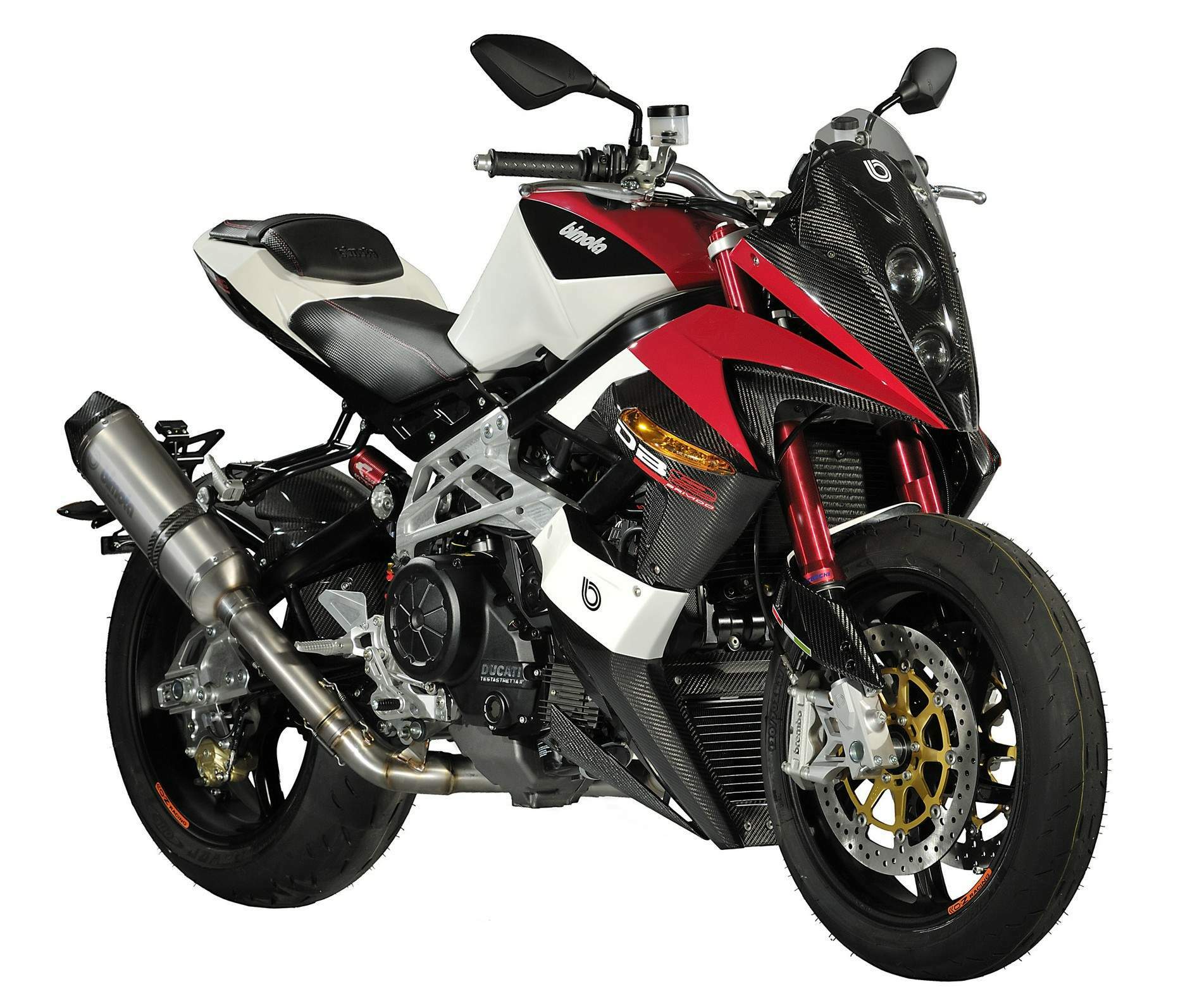
First up from Bimota is the DB10 Bimotard based on the Ducati Hypermotard.  The air-cooled Ducati L-Twin remains and it bears a vague resemblance to the Hypermotard.  The similarities end there.  It's awash in carbon fiber and has a hand-formed trellis frame holding the bike together.  Fully-adjustable suspension is standard, naturally, and it consists of 50mm Marzocchi forks up front and an Extreme Tech shock out back.  There are also giant radial Brembos to make sure you stop before you hiy whatever you're screaming toward.  Bimota claims a dry weight of 369 lbs, 10 pounds less than the standard Hypermotard.


Bimota's entry into the naked bike segment is the DB9 Brivido, based upon the Ducati Streetfighter.  This model is also awash in carbon fiber but is built around the liquid-cooled 1198cc twin that blasts out 162 hp.  Yes, it has fully-adjustable suspension from Marzocchi and Extreme Tech but this time the front forks are 43mm, compared to the 50mm forks on the Bimotard.  Stopping all this carbon fiber are the same big Brembos but this time they're bolted to lightweight wheels from O.Z.

 If you were expecting another Ducati-based Bimota, you're in for a disappointment.  The final new Bimota released is a dirt bike called the BBX300.  It has the hand-formed chassis you'd expect from Bimota but it has something you didn't: a two-stroke engine built in-house.  Normally, Bimota builds their bikes around the engines of other manufacturers.  Bimota tried their hand at building a two-stroke in-house with the V Due back in the 90s.  The bike was a mess and never really worked properly.  Let's hope the new engine works out.

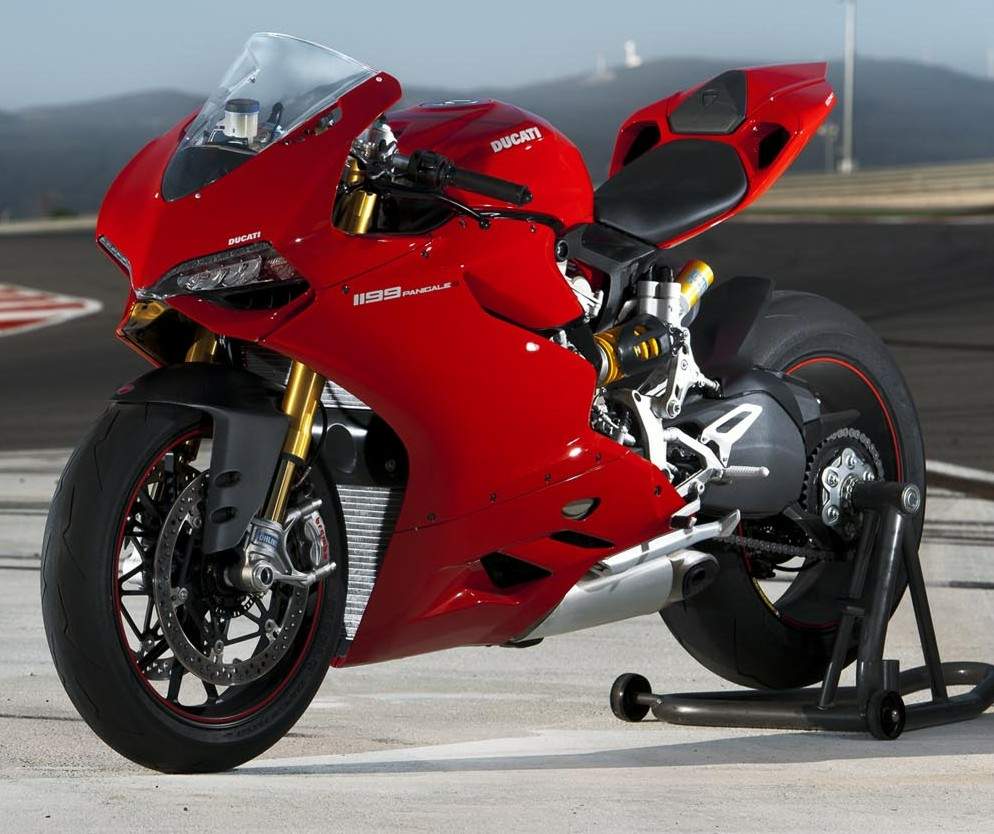
From Ducati, all eyes were on the 1199 Panigale.  This bike is the replacement for not only the 1198 but also for the Testastretta engine that has served Ducati well for so many years.  The Testastretta can trace its roots all the way back to the Ducati Pantah, which debuted in 1980.  The engine in the Pantah was 500cc, air-cooled and SOHC.  Over the course of 30 years, the engine came to have 1198cc, liquid-cooling, DOHC and 170 hp.

The new engine is 1199cc and pumps out 195 hp, making it the most powerful twin cylinder engine you can buy.  This engine heralds another change for Ducati: the ubiquitous L-Twin is no more.  The V-Twin's cylinders are still 90 degrees apart but they have been rotated back, resembling a typical V-Twin arrangement.

Surrounding the engine is an all-new monocoque chassis, giving the bike a dry weight of 362 lbs.  That's astonishing, especially with an engine that puts out 195 hp.  The Panigale is also overflowing with three letter acronyms like ABS, DTC, DES, DQS, EBC, RbW and TFT.  It's best to get the monoposto version so you don't bore your passenger while explaining all the acronyms.

Ducati also showed the Diavale Chromo, which is a restyling of the Diavale.  Basically, they gave the tank a black-chrome effect, covered the rest of the bike in black paint and hiked up the price.  Next to the Chromo was the 848 Evo Corsa Special Edition.  This 848 has an Ohlins shock out back, special paint, bigger brakes, traction control, quick shifter and a really long name.


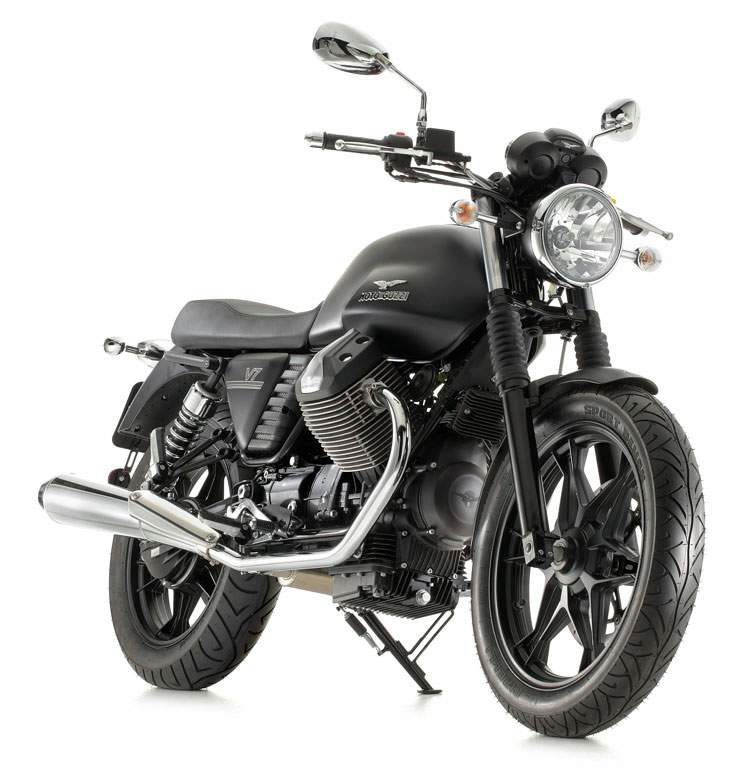
From Mandello del Lario comes a refreshed V7 in all-black paint.  The spoked wheels have been replaced by mags, which are, you guessed it, black.  The new V7 has a new 750cc engine with a single throttle body and a bump up in compression.  70% of this engine is completely new, including the throwback valve covers.  All of this leads to more torque and a jump to 51 hp.  Over all, the V7 is still absolutely gorgeous, still too slow and still too expensive.

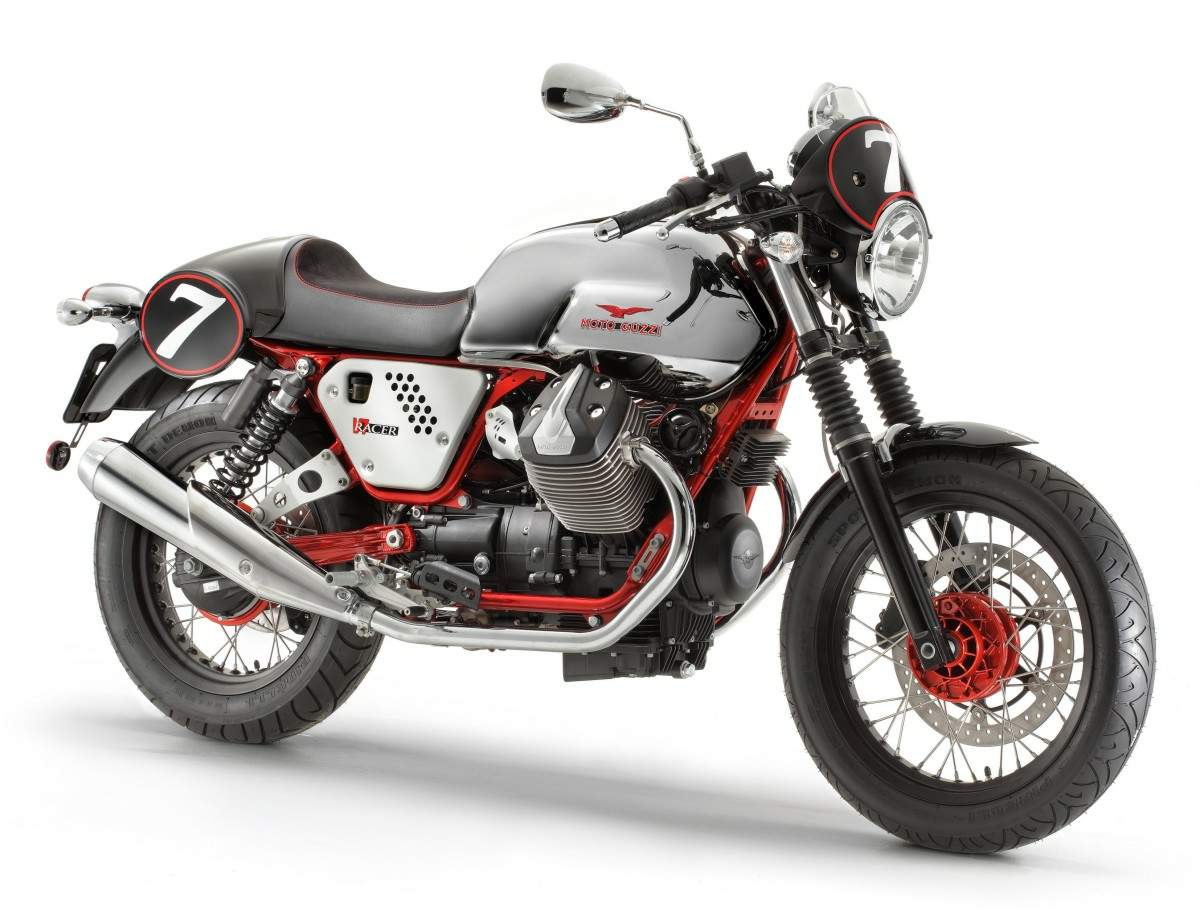
Following the regular V7 is a Special Edition model with different paint and the same specs and the Racer.  The Racer (above) takes the place of the V7 Cafe Classic and has a chrome gas tank, a special seat, clip-ons and a small flyscreen above the headlamp.  You might be interested in the new spoked wheels that reduce weight by 1,440 grams up front and 860 grams in the back.  To put those numbers in perspective, that's less than Ozzy Osbourne's daily cocaine intake during the 1970s.  Overall, the Racer is a ghastly replacement for the classically beautiful Cafe Classic.  At least it has more power.

Saturday, November 5, 2011

Going Naked with MV Agusta

All three people who read this blog have probably figured out by now that I like MV Agusta's bikes.  They are fantastically beautiful Italian exotica and that really turns me on.  So I guess it was only a matter of time before a post about the 675 Brutale made it on here.

Well, the wait is over.

A few days ago, the 675 Brutale was introduced to the world and my body temperature has just now begun to cool down to normal levels.  The bike is just gorgeous.  It's stylish, modern, detailed, aggressive, restrained, classic, avant garde, unmistakable and provocative.  Above all, though, it's quintessentially Italian.

The bodywork and the frame come together in a seamless fashion.  On a lot of naked bikes, the body looks like a bit of plastic plopped on the frame.  It looks like an afterthought.  On the 675 Brutale, the bodywork and the frame are woven together, as they should be.

MV has also done some interesting things with the Brutale's colors.  The plastic side panels on the seat can be had in beige and silver and the seat can be had in brown or black.  The contrast in colors of the white bike with beige panels and a brown seat looks really good.  Far too many bikes today are covered with a boring coat of  black.  It's nice to see some different colors and some new options with contrasting colors.  The Brutale does have some black plastic around the radiator but that's inevitable.  At least the engine is silver.

What really tickles my fancy are the exhausts.  MV's F4 line, with its four pipes sticking out from under the seat, held the crown for best-looking exhaust.  The 675 line might challenge that, though.  The three short pipes poke out of the right side of the bike like guns on a WWII fighter.  They even come with bronze tips.  I can already hear the scorching wail of the three-cylinder engine just by glancing at the exhaust.

Yes, that's right; MV Agusta has a 675cc triple just like some other European motorcycle company.  Unlike that other company's triple, which makes 105 hp, the MV's triple makes 115 hp.  It also makes 52 lb/ft of torque, which is two more.  The MV, though, makes its power and torque higher in rev range.  The MV might be lighter or heavier and that could make a difference.  I don't know which bike is heavier because the other company publishes wet weight and MV publishes dry weight.  I'll just say the Brutale 675 weighs 358 lbs dry and move on.

Surrounding the engine is a frame made from steel tubing and aluminum.  Attached to the frame are 43mm upside-down forks at the front and a single-sided swingarm with a Sachs shock at the back.  Halting forward progress are big 320mm radial brakes from Brembo.  The front calipers have four pistons each, as if you couldn't guess.

The mechanical specs are all very nice but what gets me is the traction control.  It's called MVICS and it has eight settings.  How many settings do you need?  I wonder if I can think of eight settings.  Here goes: off, sport, race, tarmac, gravel, snow, power slide and donut.  Anyway, what's wrong with two settings: off and on?

And there a few other niggles to point out.  The rear fender looks like a crane hanging off the back.  It's like a big sign saying "this is here because the law says it has to be here."  I imagine most owners will chuck it in the trash immediately.

And not even MV's team of Michelangelos can make a catalytic converter look visually appealing.  It's like a blob of metal stuck on the bottom of the bike.  Also visually unappealing is the LCD dashboard.  The face looks like something you'd find on a treadmill and its placement above the headlamp is awkward.

None of these niggles, though, distract from the overall goodness of the Brutale 675.  MV continues to bring out gorgeous new pieces of art brimming with technology and speed.  Here's hoping that trend continues.

Is the 675 Brutale the best-looking naked?  It's hard to argue against it.  I like the white paint, brown seat and beige side panels.  The contrasting colors go together well and give the bike a touch of class missing in other sporty nakeds.

Of course the bike looks best from this angle.  Look at the exhausts.  They look like they're ready to unleash a burst of .50 cal on some unsuspecting ground targets.  I like the wheels, too.

Sunday, October 30, 2011

Radical Ducati Vendetta

Over the years, I've looked at many bikes from Spanish firm Radical Ducati and have come to same conclusion after looking at each one: they're hideous.

Honestly, the bikes looked liked they were styled by an angry blind man using an axe.  I'm sure the bikes are fast and all but I can't get past the styling.  Radical Ducati takes all of the beautiful styling of a new Ducati and replaces it with angles, cuts and exhaust wrap.  And I think they throw away more parts than they keep.  In short, Radical doesn't just paint a mustache on the Mona Lisa, they give her dreads and tattoos.

So it was with justified skepticism that I went to look at the new Vendetta.  I was expecting the worst.  The Vendetta is based on the new and soon-to-be-replaced Ducati 1198, a bike I think is gorgeous.  To ease the shock, I put my hand over my eyes and clicked on the link to the pictures.  Ever so slowly, I peeled my hand from in front of my eyes, only to find my skepticism was misplaced.

They've actually made a good-looking bike!

What Radical Ducati did (with help from fellow Spaniards Dragon TT) was take the normal Ducati 1198, remove all the standard bodywork and replace it with all-new bodywork.  The solid lights on the standard 1198 were replaced with four smaller lights that look like an angry man's furrowed brow.  The fairing has turn signals built into the sides and has been redesigned to allow more air to flow around the engine, paving the way for more performance.  The fuel tank is larger and the seat is totally unique, incorporating LED lights and turn signals into the tail.  You can even choose between two exhausts.  All the better to compose your mechanical symphony with.  All of this new bodywork is offered in either fiberglass or carbon fiber.

I like the Vendetta's styling because it's not over-the-top like Radical's other bikes.  It has a beautiful sense of aggression and evil to it.  It's like a Hollywood leading man went to the gym and has come back more fit, more cut but still handsome.  Radical's other bikes were like taking the same leading man and giving him a green mohawk and a safety pin to put through his nose.  They just didn't work.

I'd even venture to say the Vendetta is one of the best-looking bikes I've seen in awhile.

Saturday, October 15, 2011

Moto Guzzi Valve Adjustment

There are many pluses that come with doing your own maintenance.

You can save a lot of money by not having to pay for someone else to do it, for example.  You also get dirt under your fingernails and oil all over your hands, giving you the look and smell of a Real Man.  Plus you get to use all those shiny tools you have in that big red toolbox.  Most importantly, though, you get to create mechanical harmony between you and your machine.  The intimate knowledge you gain from working on your own machine comes in handy should something happen in the future and it never hurts to know your bike works.

The biggest downside, unfortunately, is that if you cock up, you've only yourself to blame.

With the goal of mechanical harmony in mind, I set out on this blustery Autumn day to adjust the valves on my Guzzi.  I have been hearing some tapping lately, more than the usual start up tapping and decided to check the adjustment.  Now, many have said that Guzzi valve adjustments are fairly straightforward and simple.  Thinking about it, it should be.  There are only two valves per cylinder; one for the intake and one for the exhaust.  The V11 engine also used pushrods to open the valves, meaning the solitary cam is in the block and out of the way.  This really shouldn't be hard at all.

Right, let's get to it.

Begin by taking off the alternator cover.  It helps to loosen the crossover pipe, a piece that was already strangely loose on my bike.  You'll need to get access to the big nut so you can turn the crankshaft to set the pistons at top dead center (TDC).  You'll have to move the rectifier out of the way and do a lot of wiggling to get the cover off.  I had to bend the horns out of the way, too.

After the cover is off, this is what you'll see.  The nut on the end of the crankshaft is 15/16, which, for those in foreign lands, is 24mm.

Before you turn the big nut, though, remove the spark plugs.  This way you won't have to fight the compression as you turn the crankshaft.  Begin by taking the spark plug protectors off the valve covers to give you better access to the plugs.  As with most bikes, the plugs use the 13/16 plug socket.  Once the plugs are out, rotate the crankshaft clockwise until the cylinder on the left is at TDC.

Using a 5mm hex socket, remove the other four bolts from the valve cover.  Once that's been completed, the above picture is what you'll see.  Like I said earlier, this is a very simple valve train.

With the piston at TDC, slide the feeler gauge between the valve and the rocker arm.  The specs for the clearance are .006" for the intake and .008" for the exhaust.  The clearance on my valves was about .004" over spec on all four valves.

To adjust the clearance, loosen the small 11mm nut on the rocker arm and turn the shaft with a small pair of pliers.  Wiggle the feeler gauge in position as you turn the shaft and stop when you feel resistance.  Once the proper resistance is felt, hold the shaft with the pliers and snug up the 11mm nut.  Be careful snugging the nut as the shaft will rotate and throw off your adjustment.  It's best to leave a little bit of clearance and then tighten the nut to get the clearance into spec.  Repeat for the other three valves.  For the right cylinder, you'll have to rotate the crankshaft to get that piston at TDC first.

Get the valve cover ready for installation by cleaning up the mating surfaces on the cylinder head and the cover.  There was a bit of gasket residue left on the head and that can be removed with a razor blade and some caution.  Don't get too aggressive or you'll gouge the aluminum and that would be bad.  Luckily the paper gasket came off in one piece and stayed on the cover.  A simple wipe down of the gasket on the cover and the surface of the cylinder head is the final step of prep.

To ensure a good seal, I like to use Permatex Indian Head Gasket Shellac Compound.  It's like a Great Wall of China preventing the Mongolian engine oil from invading the outside of your engine.  I'm surprised the P.C. ninnies haven't gone after the name of this stuff.

Anyway, this stuff's cheap so apply a liberal amount to the gasket.  Don't inhale the fumes, though, or Hawkwind's lyrics might start to make sense.  I'm guessing that maybe three people know who Hawkwind is.  Repeat the above three steps for the other valve cover, minus the bad Hawkwind joke.

With the gasket sealer in place, plop the valve cover back on and torque the bolts to, um, some pound/feet.  Make sure to put the spark plug back in before putting on the protectors.  I made the mistake of not doing that and had to take them off again.

Finally, put the alternator cover back on and bolt up the rectifier.  Tighten up the crossover pipe, too.  Even with the clamps fully tightened, my crossover is still very loose.  It's definitely something I'll have to address.

And there you have it.  Moto Guzzi valve adjustments are as easy as they say.  Having never done it before, the whole job took just under an hour to complete.  As this is something that needs to be done every 6,000 miles, I'm sure I can get that time down as I get more familiar with the procedure.

Now I'm going to take my manly, oil-covered hands and do something manly.  Maybe I'll go use a chainsaw or something.

Saturday, October 8, 2011

Sex on Wheels

There are some who believe that beauty is more than skin deep, that what's on the inside is most important.

After looking at the new MV Agusta F4, that's a load of rubbish.

MV subtly restyled the F4 for 2011, giving the bike a leaner, more aggressive look.  The nose is pointier and the fairing has a more chopped and sloped look to it.  The fairing also has a few more holes cut into it, looking like someone took an axe to it.  F4s of old looked a bit slabbed-sided, as the fairing sides were flat areas with nothing really going on to break them up.  Taking up residence under the new pointy nose are larger split ducts that make the bike look like a hungry cyclops ready to tear your head off.  And I mean that in a good way.

A few things remain from the previous F4, too.  The single diamond-shaped headlight remains, though it's subtly restyled enough for the new nose.  Also remaining are the gorgeous five-spoke wheels and single-sided swing arm, though this swing arm is all-new and weighs a scant 11 lbs.  The F4's trademark quad exhaust is also back and restyled with square exhaust tips.  Apparently MV didn't get the memo saying under seat is exhaust is passe on new superbikes.  The silencer housing the quad tips is literally right under your butt, guaranteeing to warm it faster than a jalapeno and habanero sandwich.

Under all the gorgeous styling is some serious superbike power.  One hundred ninety-five horsepower finds its way to the Earth through a six-speed gearbox and a rear wheel modulated with advanced traction control.  Two injectors per cylinder work through MV's new Torque Shift System, a variable intake system.  Titanium valves reside in a new cylinder head. 

The chassis has all the trappings of a modern superbike: big Monoblock Brembos, steep steering angle and as many lightweight parts as possible.  Even the front axle was redesigned to be as light as possible.

But enough about what you can't see, let's talk about what you can.

Man, this bike is just gorgeous.  I didn't think MV would be able to top the F4 312RR Edizione Finale but they've topped it in spades.  The new aggressive look works, making the bike look fierce and ready for high-speed combat on racetracks everywhere.  The F4 is a piece of rolling art, not looking out of place at Road America, at a high-class restaurant or at the Guggenheim.

When describing the new F4, calling it sex on wheels would be an understatement.  I think it's the best-looking motorcycle you can buy today.  Sure you can get the same features, speed and specs for cheaper but you don't get the exclusivity and gorgeous styling of the MV.  When you have that combination, there are no substitutes.

I thought it would be hard, almost impossible, to improve on a classic like the previous F4 but MV did it.  They've improved on the Mona Lisa.

If motorcycles were rated like adult films, the F4 would be X to the 10th power.  Only the Italians would be able to combine the pure sex of the F4 with serious power and cutting-edge tech.

Wednesday, October 5, 2011

I Want the Ring Back

I'm officially over the Nurburgring.

Honestly, I'm tired of reading about it, I'm tired of hearing about which car is the fastest around it, and I'm tired of every car maker using it to buy sports car legitimacy. 

The 'Ring used to be a place of wonder and fear.  Jackie Stewart called it the "Green Hell."  Niki Lauda nearly died there.  Countless others actually have.  Today, "tuned at the Nurburgring" is the catchphrase that rolls out of car makers' marketing departments across the world.

Cadillac was there tuning the CTS.  Ferrari set a record there with the 599XX.  What, isn't Fiorano good enough anymore?  Acura was even there with the MDX, which is an SUV.  The Nurburgring-tuned suspension ought to come in handy on the way to the grocery store or to soccer practice.  Nissan tuned the Maxima's suspension at the 'Ring, too.

And that's what makes me mad.  Does the average owner of an MDX or Maxima really care about the 'Ring?  Do you think they could find it on a map?  I would imagine the answer would be a resounding no.  People buy an MDX because they want the space an SUV provides, not for driving excitement.  When was the last time the average owner of an MDX got up early and said "I think I'll take my MDX on a spirited run through the twisties.  You know, test that Nurburgring suspension"?  My guess would be never.

You see, the 'Ring belong to those of us interested in cars (and bikes).  It's not the place where car makers can go to buy credibility.  It's the place where all the things that make a great driver - skill, determination, bravery, concentration- need to come together in order to survive.  It shouldn't be the place where a manufacturer throws a pro driver in their car and then has the marketing department post the lap time to satiate all the fan boys and Internet bench racers.  It strips the circuit of its history and wonder.  Hearing people not interested in cars talk about the Nurburgring is like hearing your friend talk about spending the night with your ex-girlfriend.   

Today, the 'Ring isn't the place that was dropped from the Grand Prix circuit because too many drivers were crashing and dying.  It's now merely the place where the Nissan GTR is faster than the Porsche 911 Turbo.

Ho-hum.

Thursday, September 15, 2011

Living on Borrowed Time

As I'm writing this, the thermometer outside reads a chilly 49 degrees Fahrenheit.  Yes, the Autumn is upon us and it will be dragging along its sidekick Old Man Winter.  For us motorcyclists up north, we're living on borrowed time.

In no time at all, the batteries will be removed from the bikes (and the Corvette) and placed in the basement to ride out the winter.  I'll stare mournfully at my covered bikes as I warm up the snowblower.  I'll check the weather on a daily basis with the hope of a warmish day to do some riding only to find none.  The sky will be a perpetual shade of gray.  Winter is a time of longing - for sun, warmth and riding.

In the meantime, though, there's still plenty of riding to do.

Early Autumn offers some of the best riding of the year.  The heat and humidity of summer is replaced with much cooler temperatures and beautiful scenery as the trees change color.  It's nice not being drenched with sweat when coming home from a ride.  Another plus is riding quickly through a pile of leaves and watching them in your mirrors as they get blown around, just like in the movies.  That makes you feel fast.

But with all the pluses of Autumn riding, there's still the cold wind of Winter blowing down your back.  The knowledge that the one good riding day can be followed by a week of rain and cold can make Autumn riding depressing and bittersweet.  The onset of Winter is making me antsy and wanting to do more riding.  I know I don't have much riding time left and I should enjoy the time as much as possible.

And that's what I intend to do - enjoy the time left as much as possible.  With that thought in mind, I'm going riding.

Not now, though; it's dark.  I'll ride in the morning.