Wednesday, April 21, 2010

Black Light.

One of the most fun things about owning something is making it yours.  The automotive and motorcycle aftermarkets are a testament to that.

What makes modifying even more fun is doing the work yourself on the cheap.

My 2008 Triumph Bonneville is the Black model.  That means everything is black; the paint, the engine, everything.  Whatever isn't black is chrome.

The headlight on the Bonneville is a big seven-inch bucket of chrome.  While it looks nice on its own, it looks out of place on the front of the bike.  There are all of these black bits and then there's this big piece of chrome.  Mostly, it reflects all of the black around it, so it looks black at a quick glance.

So what I decided to do was paint the bucket part of the headlight black. 

I initially wanted to get it powdercoated but that costs money and I'm cheap.  I had some primer and satin black spray paint laying around and decided to use that.  If it didn't work out, I would then get it powdercoated.

Cheap and fool-proof.  I like that!

Let's get to it:


Here's what the headlight looked like stock.  All black and a big blob of chrome.

Right, the tools of the artist.  Poor Michaelangelo had to mix his own paints.  How easy life has become.

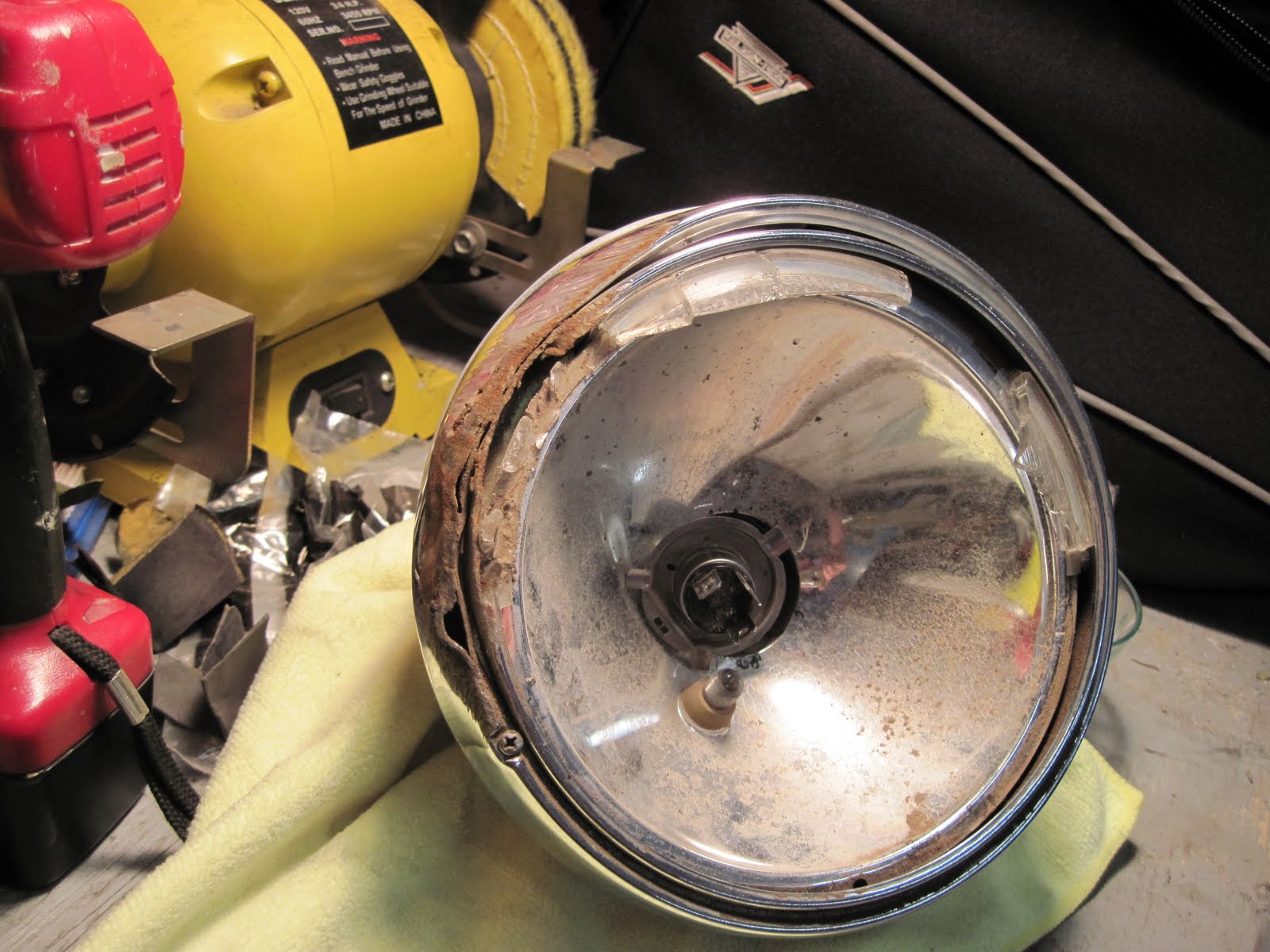
First I needed another headlight.  No way was I going to paint my as-yet-unpayed-for headlight, so I did the next best thing: I bought a used one off of Ebay.  This was from a wrecked Bonneville that looks like it was in a nasty crash.

I hit the chrome with some 400-grit sandpaper to rough the surface up a bit.  I then hit it with some primer.  After wet sanding it with 2,000 grit sandpaper, I hit it with primer again.  That ripple effect on the bucket used to be a dent.  I pounded it out blacksmith-style.

And here is the newly blackened headlight bucket.  I painted it, wet-sanded with 2,000-grit sandpaper and then painted it again.  Awesome.  Now all I have to do is take the old one off.

This is the mess you'll find when you take the headlight off.  All of those wires were shoved in the headlight bucket.  Should be fun putting them back in because it was fun taking them out.

And now, the finished product.  The black bucket definitely looks the business.  It fits in better with its surroundings, moreso than the chrome one did.

Modifying your vehicle is fun.  It's even more fun when your mods are cheap and they work.  For a total investment of around $25, I have a black headlight bucket and a nice new piece of individualization on my motorcycle.

I love it when a plan comes together.

Saturday, April 17, 2010

The More Things Change...

Looking at the new MotoGP race bikes that roll out every year, you have to wonder just how much has changed over the years. 

They are all still powered by an internal combustion engine.  And since the two-stroke-era is now cold in the grave, the engines are still four-stroke.  They still have two wheels and a frame holding the entire works together.

So, what has changed?

Well, everything has.

The items listed above are the only similarities between the ancient Grand Prix motorcycles of the 1950's and the techno-marvels of today.  The current crop of MotoGP motorcycles are a breeding ground for the future technologies that will be seen on eventual production models.  That's the exact reason manufacturers race in the first place.

To illustrate the differences, let's compare two motorcycles; one from the 1950's, an AJS-7R, and the championship-winning 2008 Yamaha YZR-M1.

The AJS-7R was a 350cc motorcycle built with one thing in mind: racing. 

The 7R had a duplex frame made from steel, telescopic front forks and twin rear shocks that stayed pretty much the same throughout its life-span (1948-1963).  It also had the standard-issue air-cooled drum brakes and the classic squatted racing position.

The 7R's air-cooled engine went through numerous changes during its racing career.  The bore and stroke started at 74x81 and was changed to 75.5x78 in 1956 by privateers.  The single-cylinder engine featured an overhead camshaft with two valves for the cylinder.  A special version called the AJS-7R3 with a three-valve head was built in 1951 but quickly abandoned.

Behind the engine was a four-speed gearbox.

The single pumped out 32 horsepower initially.  The three-valve version offered 36 horsepower.  Toward the end of the 7R's production in 1963, it was producing 40 horsepower at 7600-7800rpm and weighing in at 285lbs.  Top speed was around 115-120mph.

In extreme contrast, we have the 2008 Yamaha YZR-M1. 

The M1's chassis is built around an aluminum delta-box frame with fully-adjustable steering geometry, wheelbase and ride height.  The front suspension consists of fully-adjustable, upside-down Ohlins forks.  The rear suspension is made up of an aluminum swing-arm and a fully-adjustable Ohlins monoshock.

Providing the appropriate forward propulsion is an 800cc liquid-cooled four-cylinder engine.  The valvetrain features dual overhead cams and four-valves-per-cylinder for 16 valves in total.  The fuel and spark is provided by a fully-adjustable engine control unit and a fully-adjustable ignition control unit.  The coolest part of the engine is the four throttle bodies, one for each cylinder.

This powerplant spits out more than 200 horsepower.  Behind it is a six-speed gearbox with, you guessed it, adjustable ratios.

Tossing the anchor are twin 320mm carbon disc front brakes, each with a four-piston Brembo caliper.  Out back is a 220mm steel disc with a two-piston caliper.

The M1 also has a wind-tunnel designed fairing that, when combined with the prestigious power, allows for an estimated top speed of 236mph. 

236mph!  On a motorcycle!  Amazing.

All of this adjustability, aluminum and horsepower weighs in at 326lbs.

So what do these specs show us?

They show us that while some things have stayed the same, much of it has changed.

The AJS-7R is a pretty simple machine.  It is, for all intents and purposes, a beefed up street model.  Aside from the engine, nothing on it is exotic in any way.  Telescopic forks and twin rear shocks were pretty commonplace during its production life.  The frame is also a ho-hum steel frame, similar to 99% of the street motorcycles produced at the time.

The engine really isn't that exotic either.  Overhead cam aside, it's still an air-cooled single-cylinder.  The AJS-7R really isn't very much removed from a regular, production motorcycle.

The M1 is a two-wheeled spacecraft in comparison.

Almost everything is adjustable and the frame is of lightweight aluminum specifically designed for the bike.  Even the wheels are trick, with them being 16.5 inches front and rear and being made out of carbon fiber.

Add in the extreme horsepower and the insane top speed and you have an exotic piece.

The speed, lightweight materials and adjustability of the YZR-M1 make the AJS-7R look like an ox-cart.  Aside from them both being motorcycles, they have nothing in common. 

MotoGP bikes will continue to push the envelope because that is what they do.  For example, Ducati has used a carbon fiber frame for the past few seasons.

The motorcycle's concept hasn't changed much in the past 100 years but the execution changes at a hurried pace.

A 1959 AJS-7R shows what a race bike used to look like.  Pretty simple looking, isn't it?


The 2008 Yamaha YZR-M1 illustrates the future of the race bike.  That seat looks really comfortable...

Saturday, April 10, 2010

Moto Guzzi Otto.

It's 1955.

You are sitting on the hillside at Reims-Gueux, the public-roads-turned-racing-circuit between Thillois and Gueux in France.  Looking down from your spot, you can see turn six, Viragede la Garenne, a treacherous kink in the long back-straight. 

Grabbing another slice of cheese, another slice of bread and another sip of wine, you listen to the symphony of machines screaming past you as you dine.

There is the low, rhythmic rumble of the single-cylinder Nortons.  Following are the exotic wails of the four-cylinder Gileras and MV Agustas.  Next is the low rumble of the single-cylinder Matchless' and the flat-twin BMWs as they battle for position. 

Then, you hear a sound so ethereal approaching, it snaps you away from your French mid-day meal in an instant. 

Barreling toward you, setting up for the kink in the road, is the oddest-looking motorcycle you have ever seen.

It has a strange green tub of a fairing.  It completely covers the entire front of the machine, with only two cooling slots to break up the tub-like styling.  A massive clear-plastic windscreen towers up over the rider.

Clinging perilously to the top of the polished aluminum fuel tank is the black-leather-clad rider.  He's contorted in the classic racer's position: arms outstretched, clutching the clip-on handle bars, his knees tucked in close to his body and his weight placed over the rear wheel.

As polarizing as the sight of this machine is, it's the sounds that gets you.

It's an other-worldly howl not heard on any racing circuit before.  It's the howl of a high number of cylinders spinning at a high number of revs. 

As quickly as this seemingly alien craft is upon you, it passes you by.  You take one last look as it speeds away, belching fire from the exhausts as the rider upshifts.

All around you, people discuss the sight in a mixture of languages.  They all share the same sense of wonder and amazement at the green-and-sliver blur that came howling past.

What you and the rest of the people at Reims-Gueux experienced was the Moto Guzzi V8.

The Moto Guzzi V8 was conceived by Moto Guzzi's cheif engineer, Dr. Giulio Carcano, to not only compete in the ultra-competitive world of Grand Prix racing but to showcase Moto Guzzi's engineering prowess.

Typical racing machines of the day were not too far removed from their street-ridden brethren. 

The British were fond of pushrod, air-cooled single-cylinder engines.  Italian companies like Gilera and MV Agusta used dual overhead cam, four-cylinder engines that were very high-tech for the time, but still relied on ambient air for cooling.  BMW used their flat-twin that was designed in 1923, hardly ground-breaking in 1955.

The Guzzi V8 was on another planet compared to its competition. 

The V8 was 499cc (500cc being the maximum for Grand Prix) and featured liquid-cooling, four camshafts (two per bank), eight 20mm Dell'Orto carburetors (one per cylinder) and eight sets of points (again, one set per cylinder). 

In race trim, the V8 produced 78 horsepower at a staggering 12,000rpm.  Funneling this power to the road was a choice of a four-, five- or six-speed transmission.

One of the most amazing things about the V8 was that all told, it only weighed 99lbs.  Total weight for the motorcycle was only 330lbs.

Stuffing an eight-cylinder engine in a motorcycle frame was a feat unto itself.  This necessitated a compact design for the V8.  All of the components were so tightly packed together, the V8 almost resembled a scale model.

The odd styling was also a necessity.  The tub fairing, called a dust-bin at the time, helped the V8 cut through the wind.  The six-speed gearbox, low weight and incredible power gave this machine a top speed of 171mph.  It wasn't until the seventies that a grand prix machine would be capable of that kind of speed again.

Sadly, while the V8 was an engineering marvel, it was a failure in reality.

With eight carburetors and eight sets of points, it was a high-maintenance nightmare; nevermind the fact that it liked to break crankshafts, seize and overheat.  Sometimes all three happened at the same time.

Also, period motorcycle frame design could not cope with 78 horsepower or 171mph.  Stopping relied upon out-dated drum brakes that were prone to locking up when applied quickly, overheating in hot temperatures, and being almost murderous in wet weather.

The V8 competed for three seasons, in 1955, 1956 and 1957.  The best finish for the Moto Guzzi team was sixth place in 1955, with Englishman Bill Lomas at the V8's helm.

The V8 was just too radical for the time.  Chassis and brake technology just couldn't keep up with the V8's speed, making it a very dangerous motorcycle to ride.  Fergus Anderson, Moto Guzzi's racing director, crashed the machine on its maiden voyage.  Factory rider Ken Kavanagh refused to ride the V8 at Spa-Francorchamps in 1956.

Moto Guzzi pulled out of Grand Prix racing after the 1957 season and the V8's short but breathtaking career was over.  Two examples remain in Moto Guzzi's museum in Mandello del Lario, Italy. 

It's common speculation that with further development, the V8 could've re-written the Grand Prix history books.  As it stands now, The Moto Guzzi V8 is an interesting footnote in the continuous evolution of the motorcycle.


Definitely not pretty but brutally effective.  The V8's dust-bin fairing allowed the machine to cut through the wind toward its top-speed of 171mph.

A triumph of compact proportions, the 499cc V8 was crammed into a motorcyle frame and let loose on the unsuspecting racetracks of Europe.

Saturday, April 3, 2010

The Great Ride.

It's difficult to explain what makes riding a motorcycle so attractive.

You could use cliched terms and phrases like "freedom" and "the wind in your face" but they don't tell the whole story.  In fact, they really don't say anything about riding a motorcycle. 

It's a completely different experience than driving or riding in a car.  In a car, you are just a viewer.  You can turn up the heat when it's cold or turn up the A/C went it's hot.  The world is passing you by as you drive, isolated in a metal cocoon. 

Driving is almost like watching television.  You can see the world but you can't interact with it. 

When you are on a motorcycle, you are thrust into the world around you. 

When it's cold, so are you.  When it's hot, so are you.  When it rains, you get wet.

You also get to see and experience so much more on a motorcycle.  You can see the road surface around you.  You get a better and clearer view of the road ahead, as well.  Another plus is the completely unobstructed view of the world around you that riding grants you.  There aren't any windshield pillars to block your view; no roof to block the view above.

You are not just watching the world pass by your windows.  You are actually in the world around you.

I don't want to sound like one of those people who views riding a motorcycle as a religious experience of some sort.  Search around and you will find plenty of long-winded speeches about "biker lifestyles" and "staying true", whatever that means.  It all sounds way too corny to me.

Simply put, a motorcycle is a simple and fun mode of transportation.  It's as elemetal as motorized transport can get.  It also happens to be very fun.

And I think that's what I'm trying to say: motorcycling is just plain fun. 

That's what makes it great.

Saturday, March 27, 2010

Русский Мотоциклы

Russia.

Many things come to mind when Russia is thought about: Communism, Tsars, hockey, extremely cold weather.  Maybe bad guys in James Bond movies come to mind.

But what about motorcycles?

Since 1940, the land that brought us Nikita KhrushchevPyotr Romanov and Valeri Kharlamov has been manufacturing motorcycles as well. 

The Russian motorcycles industry started with five BMW R71s covertly purchased by the Soviet government through Swedish mediators.  The BMWs were then brought back to Moscow were they were reverse engineered (i.e. taken apart and copied) by Soviet engineers.  The BMW R71 was a ruggedly simple motorcycle and had served the German army well in WWII. 

The Soviets wanted a sturdy and highly mobile vehicle and the specifications of the R71 fit the Soviet's needs to a tee.  For the R71, BMW  took their air-cooled flat twin-cylinder engine, mounted it in a full steel frame and put a shaft final-drive out back. 

The cylinder heads stuck out of the frame which aided in engine cooling and longetivity, and the shaft final-drive negated the need for a chain and thus was easier to maintain.  The solid steel frame meant the design was very strong and could take the abusive Russian landscape with ease.

In the early part of 1941, the prototype M-72 motorcycle was shown to Josef Stalin and he cleared the motorcycle for production.  The motorcycles were intially produced in Moscow but fears of German bombs caused the Soviets to move production to Irbit in the Ural mountains.  Production was split between the Irbit Motorcycle Works (IMZ) plant in Irbit and the Gorkiy Motorcycle Plant (GMZ) in the Ukraine.  In total, about 10,000 M-72s were produced for the war effort.

During the fifties, the GMZ plant took over war production and the IMZ plant concentrated on civilian models.  Motorcycles produced at the IMZ plant were intially sold to developing countries and were branded as IMZ-Ural.  The GMZ plant eventually sold their own civillian version of the M-72 under the brand name Dnepr. 

Both of these brands sold the majority of their motorcycle equipped with sidecars and even offered two-wheel drive to combat the poor quality of Russian roads.  Most of the Ural and Dnepr models are sold within Russia but they do export to Europe, North and South America, Australia and the Middle East. 

Ural is by far the largest Russian motorcycle company.  Not much has changed in the models offered by Ural since the design of the original M-72.  The engine was stroked from the original 650cc to 750cc and electronic fuel injection was added to help meet U.S. EPA requirements.  Other major components were sourced from reputable companies.  The alternator is from Nippon Denso, the brakes are from Brembo, the forks are from Paoili and the electronics are from Ducati Energia. 

All of the models offered in the U.S. come equipped with a sidecar.  Ironically, an American-cruiser-style model without a sidecar is offered in other countries.  The base Ural-T starts at $9,999 and comes in stylish black paint with red pinstripes.  See, and you thought the Russians had no sense of style.

The real party-piece is the two-wheel drive Patrol. 

With the flick of a lever, the wheel on the sidecar is engaged and you can now conquer the expanses of Siberia, the vast forests of Tunguska or that snow-covered field across from your house.  The Patrol starts at $12,399.  It even comes in camo paint.

That may seem like a lot for a motorcycle that isn't very fast or good-looking but it isn't.  Sidecars range in price from $3,000 to $6,000.  Add in the cost of a motorcycle and you can easily cross the $12,000 barrier.  Not only that but you have to get the car attatched and aligned correctly.  With a Ural, it's all done for you.  All you have to do is get on. 

A Ural really is a time piece. 

It's a very simple and rugged machine, much like everything else born in Russia.  The Russians cannot claim to make the quickest, the highest-tech or the most beautiful motorcycles in the world.  The can, however, claim to make the most rugged and really, that's what they needed.  Much like the MiG-1, the ZAZ-968 or the Kliment Voroshilov tank, the Ural is built to be simple and effective.

Plus, they're really cool.

The rugged M-72.  Every motorcycle should come equipped with a gun holster.


The Ural-T is pretty sharp.  It looks a bit menacing.  Compared to the M-72 above, it really doesn't look that much different, though.

Saturday, March 20, 2010

The Ducati Virus.

There has been a voracious flu virus that has been sweeping the globe since the mid-fifties.  It is distingushed by an increased appitite for speed, a love for the color red, a need to perform preventative maintenance and an increased eye for style.

This particular ailment is also known for causing wallet pain, carbon-fiber withdrawl, marriage problems, speaking in tongues and comfort issues.

No, this is not some new version of bird-flu, swine-flu or whatever flu-named-after-an-animal is attcking the globe this week.  This is much worse.  The bubonic plague?  Ha!  A mere amateur.  It's much more dangerous and debilitating than that.

It's the Ducati Virus.

Once you are infected with the Ducati Virus, all hope is lost.  You will never recover.  You will forever be a slave to the flashy red machines that come bursting out of the small factory in Bologna, Italy.

And really, it's not a bad way to be.

Ducati is such a passionate company, it's hard not to admire them.  Ducati pours everything it has into producing its motorcycles in its own unique way.  Ducati's stand out-with their style, exhaust note, history and technology-against the rest of the cookie-cutter sportbikes of the world. 

It's hard to believe they started out building modified bicycles.

In the twenties, the Ducati brothers (Adriano, Marcello and Bruno) started an electronics firm.  While this was going on, SIATA founder Aldo Farinelli designed a small engine (50cc) that could be placed in a bicycle frame.  Ducati bought these engines and created their first model, the Cucciolo, which is Italian for puppy.

Ducati's legend started to grow in the sixties when fabled designer Dr. Fabio Taglioni created the bevel-gear driven overhead cam single cyclinder engine.  This engine was available in 250cc, 350cc and 450cc.  In the late sxties, the 250cc Mach 1 was the fastest 250cc bike available.

These singles also were available with a new valvetrain setup born from Ducati's racing experience.  The Desmondronic valve system did away with the brittle valve springs that were common at the time and replaced them with a mechanical valve system.  The opening and closing of the valve was done mechanically by the camshaft.  This allowed the engines to rev higher and in turn, make more power.

Besides Mach 1, the other singles had glorious names like Diana, Monza and Sebring.  They also had simple flowing lines and a subtle beauty.  They definitly were some of the most gorgeous motorcycles ever created.

In the early seventies, Dr. Taglioni was working on a new twin cylinder engine that would eventually become the company's trademark. 

Dr. Taglioni kept the upright cylinder from the single already in production and added another cylinder jutting out of the front of the crankcase, thus creating a 90 degree V-twin.  Even though this engine is a V-twin, it is often called an L-twin because of its shape.  This twin was sold in varients with the Desmo valvetrain and without.

This new 750cc engine found its way into two new models: the 750GT and the 750 Sport.  The GT was more of a touring machine with its large tank, two person seat and high handlebars.  The Sport was an all-out race replica.  It had clip-on handlebars, solo seat and rear set pegs.

The Ducati legend was cemented in the 1972 200 mile race at Imola in Italy.  In the capable hands of Englishman Paul Smart and Italian Bruno Spaggiari, Ducati finished one-two, with Smart taking the win. 

The most amzing part of the story was that the bikes went from the brain of Dr. Taglioni to the race track in six months.  The industry norm is around three years.

This L-twin would stay in production in various models and states of tune until the early eighties, when it was replaced by the new belt driven L-twin in the Pantah models.  The Ducati name and the Pantah survived the acquisition by Cagiva and the Ducati Virus was able to spread throughout the eighties.  Unfortunately, around this time, Ducati's products were getting to be a little long in the tooth compared to the offerings from Japan.

The nineties saw this remedied when Ducati released the 851 Superbike.  This model was a first for Ducati in many ways.  It was liquid-cooled, had dual overhead cams, an aluminum frame and electronic fuel injection.  Ducati went from a grandfather to a young stud overnight.

The 851 set the base for subsequent Ducati Superbikes like the 888, 916, 996 and the rare 998.

The introduction of the 999 in 2003 saw Ducati, and cheif designer Pierre Terblanche, receive much critcism over its controversial styling.  However. there was no controversy over its perfromance: 0-60 in three seconds and a 170mph top speed.  This was a very race-oriented machine. Any elements of comfort were nonexistant.

Today, Ducati is the largest Italian motorcycle company. 

The company produces 16 models based around five versions of the L-twin.  Ducati manufactures entry-level machines like the Monster to make sure people with small budgets can catch the Ducati Virus.  For those with deeper pockets, Ducati offers the Superbike range with the 848, 1198, 1198S and the straight-from-the-racetrack 1198R.  In between, there are retro machines, nakeds, motards and a tourer.

Like a plague of locusts, Ducati Virus has spread over all parts of the globe.  Ducati has built their image on race success, beautiful designs and uncompromising performance.

All that from a bicycle.

This is where it all started.  65cc and an estimated 200mpg.  Eat that, Toyota Prius!


The 250 Mach 1 was a light-weight rocket.  Contemporary tests had this machine top out at 107mph.

Ducati's legend was cemented by the 750 Imola.  This machine set the world on its ear and made Ducati a legitimate player in the big bike field.

The 999 was hardly what you would call "Ducatii beautiful."  It was Ducati fast, however.

And the modern Ducati rocket, the 1198R Corse.  Be prepared for extreme performance: 180hp, adjustable suspension and tons of MotoGP-spec parts.  Expect this to be in the $40,000 range.  Wow.

Images sourced from Wikipedia and Ducati.com

Friday, March 12, 2010

Lady of Spain

After what seemed like a February straight out of The Day After Tomorrow, Mother Nature decided it was time for spring. 

Much to my amazement, the tempurature was already around 50 degrees when I woke up earlier this week.  I figured the only real way to celebrate this wonderous change of the season was to hit the road on my Triumph.

Man, it's good to be back!

After looking at all of that snow and longingly looking at my bike while I grab the snow-blower, it was good to be out there.  It was good to smell the smells and feel that wind in my face, even if it was still a little chilly.

I didn't head in any particular direction but did end up stopping at a neat little bookstore.  And of course, I bought a book about motorcycles.

It's called Spanish Post-War Road and Racing Motorcycles by Mick Walker.  It follows the rise and fall of the large Spanish motorcycles companies-Bultaco, Derbi, Montesa, Ossa and Sanglas-and gives a few details about the smaller companies.

Spain's motorcycle industry and history is quite interesting. 

The rapid growth of the industry is due in large part to dictator Generalissimo Fransisco Franco's policies.  Franco (who is still dead, by the way) placed large controls on imports which allowed the fledgling industry to thrive.

In the 15 or so years following the end of WWII, the Spanish motorcycle industry went from nothing to a major motorcycle-producing power.  The Spanish companies also exported their motorcycles to the rest of Europe and to North America in large numbers.

During the 1960's, the motorcycle industry faced an economic downturn and intensified competition from car manufacturers like SEAT.  This left only the strong companies like Bultaco, Derbi, Montesa, Ossa and Sanglas in business.

The 1970's signaled the end of the line for the Spanish companies.  The nail in the coffin, quite literally, was the death of Franco in 1975.  With his death, the strict import regulations were lifted and Spain was flooded with imports.  The Spanish were now able to buy larger, faster and better motorcycle from any number of companies. 

Slowly, the Spanish marques started to die off or were bought by foreign companies.  Ossa and Bultaco were among the first to fold.  Montesa was bought by Honda and is still a subsidiary.  Mototrans was bought by Yamaha.  Derbi is now a subsidiary of Piaggio, the makers of the Vespa scooter.

Today, the largest Spanish-owned motorcycle company is Gas Gas.  They were formed with the remnants of Bultaco in 1985.  They specialize in motocross and trials motorcycles and are the only Spanish company that still exports to North America. 

The Spanish industry was built around a simple premise: cheap, reliable transportation.  The majority of the bikes produced during the glory years were quite similar.  The formula was: take a simple, small-capacity two-stroke single cylinder engine and build a small, lightweight motorcycle around it. 

It's qiute sad to see a once strong and vibrant motorcycle industry such as the Spanish no longer in existance.  The Spanish made some unique machines that deserve a place next to the storied marques from Britain, Italy and Germany.


This is a Montesa Impala Sport 250.  It has 26 horsepower and a 4 speed gearbox.  It's also really good-looking.


This is a 1969 Bultaco Metralla MKII.  This could be called Spain's superbike.  It had a 244cc single, 27 horsepower and a 5 speed gearbox. 


   Bikes like this 1974 Bultaco Sherpa T, built during the motocross boom in the 1970s, helped keep the Spaniards on life-support a little longer.


This is a 1965 Ossa 175 Sport.  It has very Italian styling, similar to something from MV Agusta or Ducati.


And the modern Spanish motorcycle: a Derbi GPR125.  It shares its engine with the Yamaha TZR125.  It follows the traditional Spanish motorcyle formula: small single cylinder two-stroke engine surrounded by a lightweight motorcycle.  It's good to see some things never change.