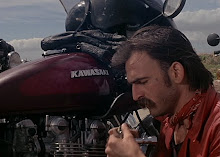
Moto Guzzi has been going crazy with its V7 Classic.
So far they've added the Cafe Classic, a Racer version for Europe only (what a shocker, there) and now they've shown a scrambler concept based on the V7. Looks like Guzzi wants to sit at the modern classic table and have a piece of Triumph's pie.
Not so fast, though.
The V7 does a very good job at recalling the original V7 that Guzzi started selling in the late sixties. The V7 Cafe is an almost spot-on homage to the V7 Sport, gracefully recalling the Sport's basic profile, design and color. In all, they look very good.
The problem I have with the V7 is two-fold, however. Not only is it more expensive than the Triumph Bonneville it aims to compete with, it's a lot less powerful, too. Now, math was never my subject, but I don't think more money plus less power equals better.
The V7 is built around Guzzi's venerable "small-block" V-twin. The small-block engines were a way for Guzzi to make smaller models in the seventies and eighties to help increase production and reduce weight. Sizes of the engines ranged from 750cc to 350cc.
Nestled between the frame rails of the V7 is a 750cc version of the small-block twin churning out 48 horsepower. Here's where the problem starts. I'm not one to get mesmerized by numbers (well...) but that is 18 less than the Bonneville and frankly, not enough.
I'm not going to pretend a Bonneville is on par with a Suzuki GSXR-1000 when it comes to performance, but 18 horsepower is a lot. If you add 18 ponies to a stock Bonneville's 66, you end up with 84 very healthy horsepowers. Hmm, maybe I can do math. Anyway, if you are going to charge more than your competition, the smart idea would be to have more than your competition. I know people are going to talk about weight, torque and balance but the fact remains, the Bonneville offers more for less.
The V7 does have Triumph beat in a few areas. It weighs a lot less at 400lbs dry, the front disc is larger and clamped by four-piston calipers, and the rear shocks are adjustable for rebound and preload. Those aren't bad specs for any bike.
But the V7 is still style over substance. Guzzi could have wrung Triumph's neck with the V7 but instead chose to build a pretty bike and not a real competitor. The choice to equip the V7 with an engine that was inadequate way back in the eighties hurts the bikes chances to be anything more than a pretty face.
Again, I'm not going to pretend a Bonneville is superbike fast, but it gets along very well. There is also the ability to mod the Bonneville that you don't get with the V7 and its small-block twin. Plus, you have to pay more to start with Guzzi and then dump cash into it just to match the performance of the cheaper, bog-standard Triumph. I'm sorry but that doesn't work for me.
I really want to love the V7, and the Cafe especially, because I love the old V7 Sport and I love Moto Guzzi but I just can't do it. For modern classics, you have to go Triumph because the bang for the buck is better.
I mean, the Bonneville range is gorgeous anyway, so it's not like you're losing out.
Sunday, January 30, 2011

Saturday, January 22, 2011
It's Finally Happened
As the title of this post suggests, it has finally happened: I've fallen ass over tea kettle for a Harley-Davidson.
The cold breeze that just blew past was not from the winter storm but it was from Hell as it freezes over. Don't let my Triumph know or it may disown me.
The Harley I've embraced is the new XR1200X. It's an updated version of the Sportster-based XR1200 released in Europe in 2009 and in the U.S. in 2010.
What remains on the 2011 model is the pumped-up twin pushing out 90 horsepower and the flat track inspired styling. The typical cruiser-esque styling of the regular Sportster was chucked in favor of a more aggressive standard riding position with flat track-style bars and rear mounted foot pegs. In all, it's the closest Harley has ventured into sport bike territory since the look-fast-go-slow XLCR of 1977.
Black is the order of the day on the X. The twin exhaust is now menacing black, replacing the silver of the regular XR. All of the sliver bits on the engine are now black, too. The seat is black, the gauges are black, the bars are black, the wheels are black; everything is black.
The only color you can add to the bike is the option of white paint. Frankly, I think that's the best option because the blackness of the bike consumes it. Everything is the same color so you lose a lot of the details. It's a bit monotonous.
I can live with monotonous black, though. After all, my Triumph is the Black model and it is really only two colors - black and chrome.
Where the X really wins in my book is the suspension. The XR1200 used twin shocks in the rear and an upside-down fork up front, all made by Showa. While they were a momentous improvement over the standard Sportster suspension, the drawback was their lack of adjustability. Adjustable units were available in the Screamin' Eagle catalog at a hefty price on top of the hefty price for the XR.
With the X, Harley equipped it with the adjustable Showa units as standard and lowered the price. That's a pretty good deal. The rear shocks now have that oh-so-cool-and-functional remote reservoir and the front fork is the straight-from-the-track Showa Big Piston Fork. This fork works wonders on the liter superbikes from Japan, so imagine what it'll do for the Sportster.
From a pure sport bike angle, the XR1200 is a bit of a miss. With 90 horsepower, it's really not that fast and at 573 pounds wet, not very light, either. It's a bit of mish-mash of styles, too. It goes for the flat track look but the exhausts are way too low and the flat track bars look very uncomfortable. It's abilities as a back road burner can be questioned as well because of the low exhaust. I can just imagine having an easy time grinding those massive cans on tight right-hand curves.
In spite of all that, I was really impressed with the XR1200 when it debuted in 2009. I thought it would be perfect for Harley and it would allow them to broaden their customer base here in the U.S. It's nice to see Harley put their engineering ability to work on something other than the same old thing they've been building since time began. We know that Harley can build a great bike to get you to the bar and back or allow you to lazily chuff along the interstate; now they've shown they can build a sporty bike, as well.
The sales of the bike here, however, really weren't that good and I've only seen one on the road. Time will tell how the XR1200 gets on but I'll keep my eye out for a used one in the future, that's for sure. Like I've said, the XR is far from perfect but that makes it perfect for me. I like bikes with character and character flaws. It makes them more realistic and more human in my mind. There are numerous superbikes from Italy and Japan that will get you close to engineering perfection, all the while being as realistically useful as having your own pet dinosaur. I don't want perfection, I want fun and that's what the XR provides.
Now, how do I mount the sissy bar and the fringe?
Saturday, December 25, 2010
Merry Motorcycle Christmas
With the icy hand of winter strangling my ability to ride, I needed some way to exercise my lust for all things motorcycle.
Luckily for me, Christmas arrived and helped to satiate my lust. Well, maybe it did.
First up among my gifts was a gel seat for my Bonneville. This gel seat comes courtesy of the Triumph accessory catalog and is actually for the Thruxton, a factory cafe racer version of the Bonneville.
Initial tests (i.e., putting it on the fireplace and sitting on it) show it to be more comfortable than the stock plank of wood, I mean, seat. Truth be told, just about anything would be comfortable than the stock Bonneville seat. The stock seat has a comfort range of about, oh, five miles or so before numbness sets in. I'm hoping the gel seat will extend the comfort range deep into the double digits.
Additionally, this seat will allow me to install the accessory rear cowl cover on the seat. Yes, I'm excited about that.
Next up was a much-needed balaclava to help make cold weather rides bearable. It resembles a ski mask but is much lighter and works better as a helmet liner. Plus, if this whole going to work thing doesn't pan out, I can use it as a mask to rob banks. It's a very versatile item.
History alert: the name 'balaclava' comes from the Ukrainian town of Balaklava. During the Crimean War of 1853-1856, knitted balaclavas were passed out to British soldiers to help combat the intense cold weather during the winter months.
Finally, I received a motorcycle from the Lego Technic line. It's a total nerd's delight and I absolutely love it. I've had a thing for Lego's since I was a little kid and I usually receive a new kit every year.
With this motorcycle, it has a working engine, transmission and suspension. You can also build it one of two ways - either as a three-cylinder sport bike (Triumph Daytona, anyone?) or as a V-twin chopper. The chopper even has the traditional exposed primary drive. I built mine as the sport bike, of course.
The first thing you notice is its size. It's freakin' huge! The amount of detail that goes into it and the time it takes to build it are impressive, as well. It's also pretty heavy. I plan to buy another one and build it as the chopper.
You really have to give it up for the Lego engineers. The amount of time that went into the design of this kit had to be staggering. It's also much more complex than the Lego's I had as a kid.
The bad news about all of this stuff is that it did nothing to satiate my lust. In fact, I think it made my lust worse.
I want to go for a ride so bad!
Tuesday, December 21, 2010
More Ducati Updates
The summer and fall months have been highlighted by continued work on my old and rusty Ducati.
I can proudly say now that it's not rusty anymore.
I striped and painted just about every piece that was salvageable. The foot pegs, brake switch bracket, engine mounts and lower steering yoke were all given a nice new coat of shiny black paint. The frame was also taken down to the bare metal and painted the same shade of black. I also purchased new fork tubes and now my forks are together and ready to install.
To look at the bike now, you'd never know it sat outside for a decade or more. Progress is being made, however at a moderate pace.
The real work, though, lies within the engine.
When I first went to look at the bike, I couldn't check to make sure the engine would turn over because the kick-start lever was missing. No worries, I thought, I'll just take the timing cover off and turn the engine with a wrench.
Wrong.
With the timing cover removed, I put a wrench on the nut and it never moved. My worst fear had been realized: the piston was seized to the bore.
With this knowledge, I tore into my Ducati's engine expecting to find the worst and that's exactly what I found. I now know why the bike was parked oh-so-many years ago and I began to regret my purchase.
The piston was not only seized to the bore but it had a nickel-sized hole in it, as well. Moisture had entered the engine through the open carb and seized the piston to the bore. A motorcycle won't run if the piston has a hole in it and so the bike was parked. Ten years later, this schmuck (me) comes along and buys it.
So now I have to remove the center jug section of the head to get the piston out. That involved rotating the crank back and forth to get the jug to separate from the bottom end. Slowly the jug raised off the bottom and I worked it off with a few screwdrivers and wooden shims.
In keeping with my luck, the wrist pin that holds the piston on the connecting rod was blocked by the bore. I couldn't get to it to press it out. The piston was not moving for anybody so I had to break the bottom of the piston to free the wrist pin from the piston. After some hammering and squishing of my fingers, the bottom of the piston came apart and I could separate the jug from the bottom end.
The steel bore liner was cracked and ruined along the bottom and the piston was not going anywhere. I managed to press out the bore liner and I picked up a new one from Classic Ducati in Derbyshire, England. The new liner has to be machined for the head bolts. It's also a little too long and hits the crank. In all, though, having the liner gets me closer to putting the bike back on the road, even if it's only a few millimeters closer.
The rest of the engine looks pretty solid. There is some rust on the crank from the moisture that got in through the carb but other than that, it's clean. The transmission shifts into and out of every gear and I can turn the crank by hand. The clutch plates were rusted together but I was going to replace them, anyway.
Right now, I'm waiting for my alternator puller to arrive so I can split the engine cases. I'd like to disassemble everything and sandblast the cases to get all the calcium off.
My old rusty bike is coming along quite nicely. I hope to breath new life into its once-tired bones and get this bike out on the road. The list of things that still need addressed is long and a bit daunting but nothing I can't handle.
I've got my eyes on the day I can put on my puddling bowl helmet and goggles, hop on the kick-start and ride off to the sweet sound off a Ducati single.
Wednesday, June 16, 2010
Ducati Update.
Ever since I picked up my new (old and rusty) Ducati, it has been a flurry of activity.
Parts were taken off and cleaned, broken items were fixed and knuckles were busted. All in all, they were good times.
Now the part begins where real progress is made.
With my awesome new sandblaster, I stripped the rust and paint off of the frame while creating a beach behind my shed. After the paint and rust were removed, I smoothed over the pits with filler and applied a rust-prevention coating over the bare metal. All that's left to do is to get one minor area welded and to primer the frame.
I took this time to pull both wheels to see how bad they were inside.
To my surprise, they weren't bad at all. The friction surface on the rear drum has a few small areas of rust that can be machined out. The rear drum was also a home for a colony of ants that were not too pleased with my disruption of their home. The front drum was in similar condition; minus the ants, of course.
I disassembled the front forks and found the dampening fluid was a strange green color and possessed a horrendous smell.
Aside from the color and the smell, the big problem is rust on the fork tubes. The tube is in good condition in the seal-area but the top has quite a bit of rust. I'm going to blast the tops (I love my sandblaster) and see how it turns out before I shell out $300 for new fork-tubes. I only paid $150 for the whole bike.
Another problem I addressed was the issue of bodywork.
My standard 1965 bodywork was ruined by years of neglect at the hands of Mother Nature. I picked up a used 1967 square-style tank and rear-fender off of Ebay to replace my rusted originals. I'm in the process of blasting (my sandblaster rules) and repainting the bodywork. All that's missing is a matching front fender and a headlight.
I still haven't addressed the issue of my frozen engine or the myriad of parts I need. After the chassis is finished, it's on to the engine.
I think I should be done by, say, 2012. Let's hope; I'd like to ride it before the world ends.
Wednesday, May 26, 2010
My New Ducati
Common sense tells you to never buy a basket-case.
Common sense says that you'll never break-even with the purchase and it'll be more headache that it's worth. Common sense also says to just buy whatever you want in running condition; it just makes more sense.
So, with my common sense tied to a chair in a dark portion of my brain, I went to look at a Ducati that had been sitting in a junkyard for 10 years or longer.
And I bought it.
And I paid $150 for it.
And it's a basket-case.
I've had a long-standing love affair with the single-cylinder Ducatis from the sixties. I love their styling, I love their bevel-drive engine and I just love their light-weight, nimble handling.
My basket-case single-cylinder Ducati turned out to be a 1965 350 Sebring. 1965 was the first year of production for the 350 and, in classic Italian tradition, was named after Ducati's victory at Sebring International Raceway in Sebring, Florida.
It was pretty rough. The headlight was missing, the wiring was non-existent and the whole bike was covered in a fine coating of rust. The seat was a wreck and the original Silentium muffler was, sadly, corroded beyond repair.
In short, it looks like hell and I don't have any idea if the engine will even turn over because the kick-start lever is missing.
But its condition doesn't matter. When I saw it resting up against that beat-up camping trailer, it tugged at my heartstrings and a few minutes later it was in the back of my truck.
Well, first I needed help getting it in the truck.
The chain was rusted to the rear sprocket and wouldn't turn. Oh, and the rear brake was jammed on. So, with the help of two other guys, we dragged the bike from its resting place and heaved it into the bed of my truck. After strapping the bike down, I was on my way to the fanciful land of Ducati ownership.
Once it was in my garage, I could sit down and look at what I've purchased.
I believe that no matter which bike you buy, whether it's a rusty old Ducati or brand-new superbike, you have to sit down and look the bike over. This way, your mind gets to wander and you can begin to visualize yourself on the bike, or in my case, what the bike will even look like.
Looking at your new bike, you can see yourself riding it, imagine what it will sound like or imagine the scenery you will pass. You can imagine yourself parked by a beautiful overlook with the bike in the forground and a picturesque view in the background. You can imagine yourself tearing up through the gears and you can make the appropriate vroom noises to accompany your fantasy.
Drifting out of the fantasy, the veracity of the bike in front of me hit really hard.
What the hell was I thinking?
I'll tell you what I was thinking: I have to rescue this bike.
I felt so sorry for it that I had to rescue it from its hellish misery and put it back on the road where it belongs.
The last few days have been a flurry of activity. I took a few of the covers off of the engine and was relieved to find it was spotless inside. Even the oil in the crankcase looked alright, though it was really black.
The rust on the tank, fenders and frame looked severe but a few minutes with a wirewheel showed it to be mostly surface rust. There is some minor pitting in a few places but it's nothing that can't be smoothed over and painted.
There is a ton of work that needs to be done to the bike. The wheels are junk, the carb is gunked solid, the exhaust nut is frozen in place, as is the spark plug and it needs a wiring harness, lights and controls.
But I now own a single-cylinder Ducati and therefore, I can't stop smiling.

Well, here's my new Ducati. Not quite as nice as, say, a 999R but it's still a cool bike. Underneath all of that rust is a cool little soon-to-be Italian cafe-racer.

With the bodywork removed you can see that there really isn't much to a Ducati single. I started to grind away some of the rust but I would be there until the end of time. I bought a sand-blaster instead and in a few hours, I had the paint and rust off of the frame and I had myself covered in sand.

Cool. I can't wait until that is polished.
Wednesday, April 21, 2010
Black Light.
One of the most fun things about owning something is making it yours. The automotive and motorcycle aftermarkets are a testament to that.
What makes modifying even more fun is doing the work yourself on the cheap.
My 2008 Triumph Bonneville is the Black model. That means everything is black; the paint, the engine, everything. Whatever isn't black is chrome.
The headlight on the Bonneville is a big seven-inch bucket of chrome. While it looks nice on its own, it looks out of place on the front of the bike. There are all of these black bits and then there's this big piece of chrome. Mostly, it reflects all of the black around it, so it looks black at a quick glance.
So what I decided to do was paint the bucket part of the headlight black.
I initially wanted to get it powdercoated but that costs money and I'm cheap. I had some primer and satin black spray paint laying around and decided to use that. If it didn't work out, I would then get it powdercoated.
Cheap and fool-proof. I like that!
Let's get to it:

Here's what the headlight looked like stock. All black and a big blob of chrome.

Right, the tools of the artist. Poor Michaelangelo had to mix his own paints. How easy life has become.
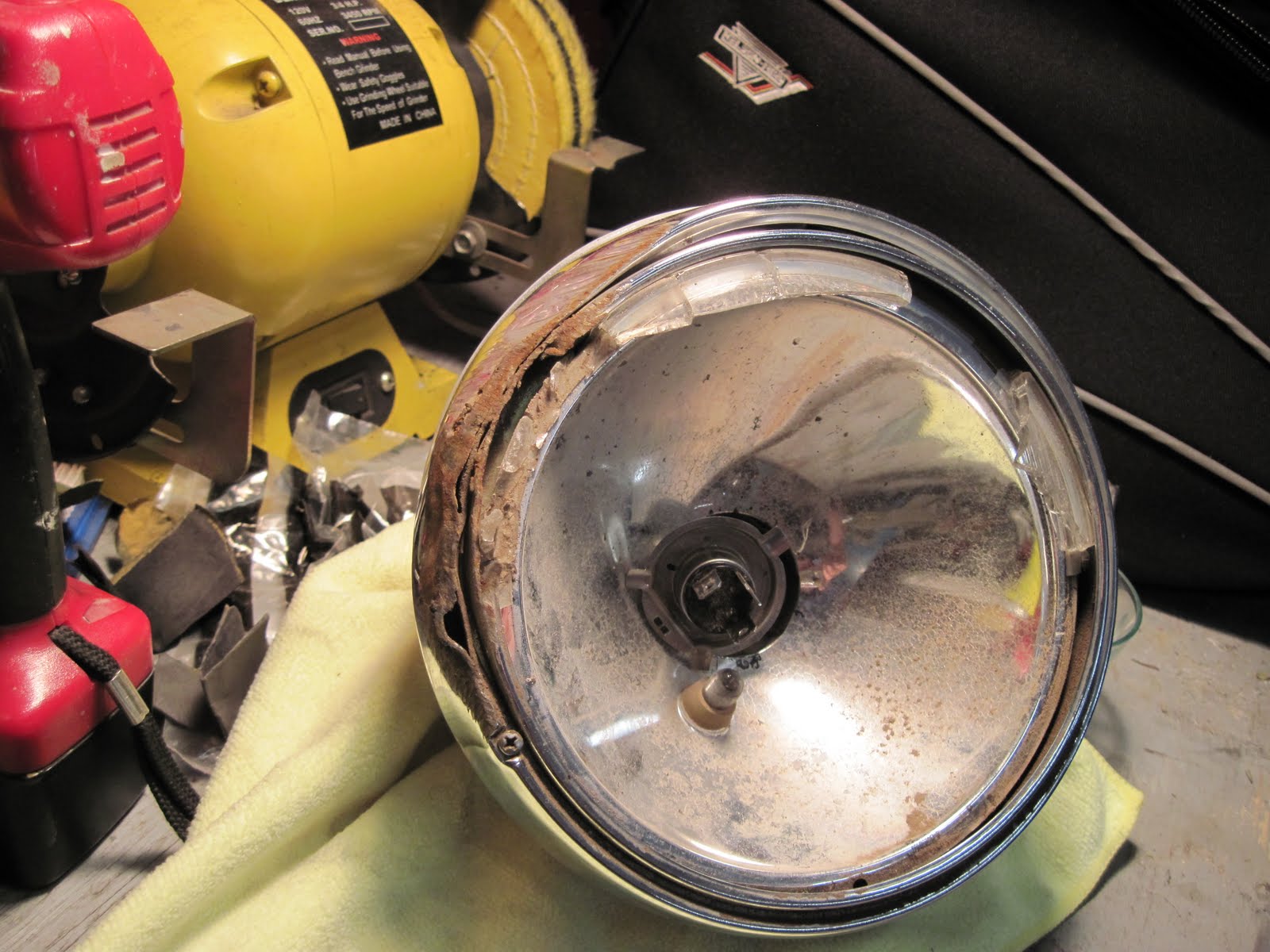
First I needed another headlight. No way was I going to paint my as-yet-unpayed-for headlight, so I did the next best thing: I bought a used one off of Ebay. This was from a wrecked Bonneville that looks like it was in a nasty crash.

I hit the chrome with some 400-grit sandpaper to rough the surface up a bit. I then hit it with some primer. After wet sanding it with 2,000 grit sandpaper, I hit it with primer again. That ripple effect on the bucket used to be a dent. I pounded it out blacksmith-style.

And here is the newly blackened headlight bucket. I painted it, wet-sanded with 2,000-grit sandpaper and then painted it again. Awesome. Now all I have to do is take the old one off.

This is the mess you'll find when you take the headlight off. All of those wires were shoved in the headlight bucket. Should be fun putting them back in because it was fun taking them out.

And now, the finished product. The black bucket definitely looks the business. It fits in better with its surroundings, moreso than the chrome one did.
Modifying your vehicle is fun. It's even more fun when your mods are cheap and they work. For a total investment of around $25, I have a black headlight bucket and a nice new piece of individualization on my motorcycle.
I love it when a plan comes together.
Subscribe to:
Posts (Atom)