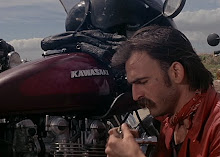
I was just thinking today that it's been over a month since I've driven my car to work. Mostly, my VW has sat forlorn in the driveway, save for weekend runs to the grocery store. My Triumph has been pounding the pavement everyday and battling the traffic on my four-mile commute.
Most of my commute is spent idling, which is really fun when it's 90° F outside. Save for a few close-calls and some obscenities hurled at offending drivers, it's been really uneventful commuting. One thing that has been interesting is the questions I get at work.
People see me in my jacket, holding my full-face helmet and ask "do you ride a motorcycle?" "No, I just carry this stuff around for fun" is what I would like to tell them but some of these people are higher on the ladder than me, so I can't.
The responses I get are along the lines of the danger of motorcycles, how they would never ride one or how I don't look like someone who'd ride a bike.
The last one gets me because what does a motorcycle rider look like? Non-riders think of the Hell's Angels or the Sons of Anarchy guys as the stereotypical rider but that shows a lot of ignorance. Yes, I've met and seen lots of people who fit that mold but most of the riders I know are normal people. They're doctors, businessmen, mechanics, factory workers, office workers, etc. They just happened to ride motorcycles.
Sure, riding a motorcycle is dangerous but so is everything that's worth doing. Mountain climbing, skydiving, deep sea diving and many other activities would be pretty boring if the amount of inherent risk was gone. Climbing Mt. Everest or racing in the Isle of Man TT is a big deal because it's dangerous. If all you had to do was ride an elevator to the top or putt-putt around the TT course, there wouldn't be much sense in doing it.
The attraction to the amount of risk or to the rush of adrenaline you get when blasting down a back road is difficult to explain to people. That's what attracted me to motorcycles in the first place and that's what continues to do so. My boring four-mile commute is so much more fun on a motorcycle. That I save on gas and parking is a nice bonus.
When I explain this, I'm usually meant with blank stares. I just smile and think about how someone won't blink an eye at skiing or snowboarding yet won't ride a motorcycle 50 feet.
It boggles the mind, really.
Wednesday, June 26, 2013

Friday, May 31, 2013
Reunited
So last month I was bragging about my new bike and how much it was going to save me in parking. I was feeling pretty good about myself. Finally, I thought, you made an adult decision and bought something you could actually use. Maybe I'm finally growing up...
Well, not so fast.
While the little Honda may have sipped gas and may have been too ugly to steal, it had some issues. There were a number of parts broken or missing but like I said, it was $800. I wasn't going to get perfection for that price.
The Honda had one major flaw, though, regardless of its price: it wasn't my Triumph.
You see, days after I bought the Honda, my Triumph showed up here in Denver. All the new bike excitement disappeared and old friend bike excitement took over. It was like being reunited. The Honda was immediately put on the back burner and unceremoniously sold a short time later.
My Triumph and I have had some adventures together. There were boring commutes, exciting backroad blasts, rides in the rain, crashes in the mud; overnights, trips, etc, etc. That bike and I have had a lot of fun together over the last five years.
Being away from it for a few months really got me thinking about how easy it is to get attach to an object. Let's face it, there's no reciprocity with a motorcycle because it's just a thing. It's not alive; it has no feelings. I can't help but feel a bit of kinship with my machine, though. I can't help but feel every trip, no matter how mundane, is a trip with a friend.
I mean, we're sharing the same experiences and while the bike lacks the ability to verbalize its memories, the scars on the bike tell the story. There are a host of scrapes and scratches on the left side of my Triumph from when we crashed in West Virginia. Those scratches really bothered me at first. My Triumph was so pretty, so new and the marks gnawed at me. I felt sorry for the bike.
After some time, the marks started to grow on me. This was now my bike. Triumph made thousands of black Bonnevilles in 2008 but only one is mine.
This one, with the scratches and the droopy turn signal, is mine.
Well, not so fast.
While the little Honda may have sipped gas and may have been too ugly to steal, it had some issues. There were a number of parts broken or missing but like I said, it was $800. I wasn't going to get perfection for that price.
The Honda had one major flaw, though, regardless of its price: it wasn't my Triumph.
You see, days after I bought the Honda, my Triumph showed up here in Denver. All the new bike excitement disappeared and old friend bike excitement took over. It was like being reunited. The Honda was immediately put on the back burner and unceremoniously sold a short time later.
My Triumph and I have had some adventures together. There were boring commutes, exciting backroad blasts, rides in the rain, crashes in the mud; overnights, trips, etc, etc. That bike and I have had a lot of fun together over the last five years.
Being away from it for a few months really got me thinking about how easy it is to get attach to an object. Let's face it, there's no reciprocity with a motorcycle because it's just a thing. It's not alive; it has no feelings. I can't help but feel a bit of kinship with my machine, though. I can't help but feel every trip, no matter how mundane, is a trip with a friend.
I mean, we're sharing the same experiences and while the bike lacks the ability to verbalize its memories, the scars on the bike tell the story. There are a host of scrapes and scratches on the left side of my Triumph from when we crashed in West Virginia. Those scratches really bothered me at first. My Triumph was so pretty, so new and the marks gnawed at me. I felt sorry for the bike.
After some time, the marks started to grow on me. This was now my bike. Triumph made thousands of black Bonnevilles in 2008 but only one is mine.
This one, with the scratches and the droopy turn signal, is mine.
Tuesday, May 14, 2013
Over The Mountain
Since I've been reunited with my Triumph, there was only one place to celebrate: the mountains.
Ever since I moved to Denver, I've looked at the mountains with lust. The twisting roads, the beautiful scenery; it's so close yet without my bike, so far away. Sure, my GTi is fun to drive on twisty roads but it's not the same. It's just so much better on a bike.
With so many good roads to choose from, it was hard to pick just one. I finally settled on Golden Gate Canyon up to Nederland and I would then continue on to Estes Park. This would give me a chance to get a taste of proper canyon riding and also allow me to break in my new Michelin Pilot Activ shoes. I topped off the air in the tires and topped off the gas and went on my way. There were some clouds but I wasn't worried. I don't think the Devil himself could have stopped me.
When I got on Golden Gate Canyon, it was everything I imagined: challenging, delightful, invigorating. Even the gravel in the corners didn't bother me. I was in some proper motorcycling stuff now, not the crap I knew back in Pennsylvania. I could set up for corners and not have to dodge potholes big enough to swallow a Dodge. I wasn't getting beaten to death by appalling road conditions. The road was smooth and the bike just glided along.
I must say, the Bonneville is a joy to ride. I modified the suspension a few years ago (it's on this blog somewhere) with Progressive fork springs and Hagon 2810 rear shocks. This setup was good on PA's roads but just magic here in Colorado. The bike was rock solid in the turns and turn-in was crisp. A slight bit of countersteer was all that was needed to get the bike to lean. I looked into Ricor Intimators and Race Tech Emulators for the forks but after that ride, I don't think they're necessary.
Back to the ride. Mile after mile of cornering bliss brought me to Nederland where I stopped to use a grungy bathroom and a fuel pump from the 1950s. After that it was onward and upward to Estes Park.
A strange thing started to happen after I left Nederland. It started to get colder. I chalked it up to being at nearly 8,500 feet of elevation. Something else was strange: the sun was disappearing. Clouds were dominating the sky and they were getting grayer. Hmm, I'd better check my handy phone for the weather. Oops, no reception. Well, I guess I'll continue on.
As I got on, the sky became worse, so much so that nearly-black clouds were obscuring the mountains. It looked like I was riding into Mordor. I started to get nervous about riding into snow, since it was getting damn cold now. To confirm my fears, I started to hear the plink of raindrops on my helmet. It was time to turn around.
I busted a u-turn and headed back to Nederland, not before getting slightly wet. The ride back was just as much fun, only a bit faster since I was now going downhill. I got back to Nederland and took a glimpse to my left. The storm was now hovering over where I needed to go.
I was making great time on my return. I didn't even get lost, which was a first. With about 15 miles to go on Golden Gate Canyon Road, the familiar plinks of rain returned. This time, I wouldn't avoid the storm.
It rained on me from then all the way down Route 6 and for most of my return up Colfax Avenue. I could outrun the rain but it would catch up with me at the redlights. I finally did outrun it and stayed dry on the rest my way home. I put the bike away when I got home, admiring how dirty it was. It looked like I rode it through Uzbekistan.
And now for the final bit of hilarity: I decided to go on a nice walk through City Park to relax a bit. As I'm walking, I feel the soft patter of rain on my head. Yes, the same storm that I narrowly avoided once, got caught in again and then outran is over me for a third time. I just smiled as I walked, watching the lightning and listening to the thunder.
What a great day.
Ever since I moved to Denver, I've looked at the mountains with lust. The twisting roads, the beautiful scenery; it's so close yet without my bike, so far away. Sure, my GTi is fun to drive on twisty roads but it's not the same. It's just so much better on a bike.
With so many good roads to choose from, it was hard to pick just one. I finally settled on Golden Gate Canyon up to Nederland and I would then continue on to Estes Park. This would give me a chance to get a taste of proper canyon riding and also allow me to break in my new Michelin Pilot Activ shoes. I topped off the air in the tires and topped off the gas and went on my way. There were some clouds but I wasn't worried. I don't think the Devil himself could have stopped me.
When I got on Golden Gate Canyon, it was everything I imagined: challenging, delightful, invigorating. Even the gravel in the corners didn't bother me. I was in some proper motorcycling stuff now, not the crap I knew back in Pennsylvania. I could set up for corners and not have to dodge potholes big enough to swallow a Dodge. I wasn't getting beaten to death by appalling road conditions. The road was smooth and the bike just glided along.
I must say, the Bonneville is a joy to ride. I modified the suspension a few years ago (it's on this blog somewhere) with Progressive fork springs and Hagon 2810 rear shocks. This setup was good on PA's roads but just magic here in Colorado. The bike was rock solid in the turns and turn-in was crisp. A slight bit of countersteer was all that was needed to get the bike to lean. I looked into Ricor Intimators and Race Tech Emulators for the forks but after that ride, I don't think they're necessary.
Back to the ride. Mile after mile of cornering bliss brought me to Nederland where I stopped to use a grungy bathroom and a fuel pump from the 1950s. After that it was onward and upward to Estes Park.
A strange thing started to happen after I left Nederland. It started to get colder. I chalked it up to being at nearly 8,500 feet of elevation. Something else was strange: the sun was disappearing. Clouds were dominating the sky and they were getting grayer. Hmm, I'd better check my handy phone for the weather. Oops, no reception. Well, I guess I'll continue on.
As I got on, the sky became worse, so much so that nearly-black clouds were obscuring the mountains. It looked like I was riding into Mordor. I started to get nervous about riding into snow, since it was getting damn cold now. To confirm my fears, I started to hear the plink of raindrops on my helmet. It was time to turn around.
I busted a u-turn and headed back to Nederland, not before getting slightly wet. The ride back was just as much fun, only a bit faster since I was now going downhill. I got back to Nederland and took a glimpse to my left. The storm was now hovering over where I needed to go.
I was making great time on my return. I didn't even get lost, which was a first. With about 15 miles to go on Golden Gate Canyon Road, the familiar plinks of rain returned. This time, I wouldn't avoid the storm.
It rained on me from then all the way down Route 6 and for most of my return up Colfax Avenue. I could outrun the rain but it would catch up with me at the redlights. I finally did outrun it and stayed dry on the rest my way home. I put the bike away when I got home, admiring how dirty it was. It looked like I rode it through Uzbekistan.
And now for the final bit of hilarity: I decided to go on a nice walk through City Park to relax a bit. As I'm walking, I feel the soft patter of rain on my head. Yes, the same storm that I narrowly avoided once, got caught in again and then outran is over me for a third time. I just smiled as I walked, watching the lightning and listening to the thunder.
What a great day.
Sunday, April 21, 2013
Little Honda
So I've moved to a new city (Denver, CO) and started a new job smack dab in the middle of downtown. All is going well; Denver is lovely, my job is good, the pay is good and the commute is very easy. All seems perfect, right? Well, no.
As with all good things, it comes with bad as the side dish. In my case, the bad is parking. You see, I'm in downtown, so parking is scarce and expensive. Even with early bird special rates, I'll spend over $1,000 per year on parking. As a cheapskate, that makes my skin crawl. Now it's time to find some way to ease my parking expense.
I could ride a bicycle. Bikes park for free on the sidewalk and I'd get the side benefit of exercise. Of course, that also means I'd have to dodge the traffic that sees a bicycle as a nuisance and it would make my short commute longer. During the summer, I'd also sweat my ass off and I don't want to stink for the rest of the day. Let's not mention the many, many times I've crashed my bicycle as a kid. I think I spent more time wreathing on the ground in pain after a crash than actually riding the bike. So a bike is out.
The next option is public transport, which means a bus in my case. The Denver Light Rail is so far away it's not even an option. My company offers free passes for the RTD buses. For me, that means driving across town, parking my car, and then riding the RTD in to work. In that same amount of time, I could just walk to work. I could ride the regular bus, which means a longer commute and the chance to sit next to someone who smells like pee. So the bus is out.
It's gets a little better because scooters under 50cc get to park on the sidewalk for free. For free, you say? Hmm, my inner cheapskate likes that. While a scooter isn't a motorcycle, it does have an engine and two wheels. They're also cheap to buy and run and are fairly simple. Yes, I think a scooter could be the answer to my problems.
With a scooter in mind, I went off to the dealers to look at a few. The Chinese junk were out immediately. Vespas were out, too, because they're too expensive. Even used Vespas are too much. Genuine Scooter Stellas are nice but are, again, more than I wanted to spend.
That left me with two choices: the Honda Metropolitan or the Piaggio Fly 50. Both are new for 2013. The Honda has been restyled and looks even more like a Vespa than an actual Vespa. It has lots of storage and is really quite good looking. I liked it in pearl white with the brown seat. It's also fuel injected, which is nice.
The Fly 50 is much more modern looking with its styling. It also boasts bigger wheels than the Honda and has a front disc where the Honda has a drum. The Piaggio is slightly more expensive and gets slightly less MPG. The Fly offers similar amount of storage, though, and goes about as quickly as the Honda.
Both are surprisingly quick on the road and are as nimble as a gazelle. Steering is fast on the Honda due to its 10-inch wheels; the Piaggio felt much more stable. Both would be perfect for riding around town and commuting. So it seems my parking dilemma has been solved with a scooter.
Well, not so fast.
As I was riding around on the Honda, I caught a glimpse of myself in a store window. It was not good. I'm used to looking like a complete nerd but this was too much even for me. I went back with that image gnawing at my mind. I chalked it up to a momentary bought of self-consciousness. It would pass, I thought. Later on in the week, I went to look at a used Malaguti Yesterday 50, which had the distinction of being hideously ugly. That was out.
However, something happen while I was sitting on the Malaguti. I had an epiphany.
The place that had the Malaguti also sells Royal Enfields. As I was sitting on this ugly scooter, I was staring at the chrome and the big engine of the Enfield and I realized I couldn't ride a scooter. I just couldn't do it. Nothing personal is directed toward scooter riders, but it's just not me. I decided on a cheap motorcycle.
In my search for parking solutions, I found a nearby garage that charges half price for motorcycles. That would put me well under $1,000 per year in parking. While still more expensive than free, I wouldn't be on a scooter. So the search for a cheap motorcycle ensued. After a few false starts, a few dreamers and a few potential candidates, I came across a little Honda that fit the bill.
It was a 1981 Honda CM400T, a pseudo-cruiser from Japan's Great Cruiserfication period. At least it has a round headlamp. It was $800, ran and had new tires. It has issues, like a tach that doesn't work, faded paint and a busted headlamp shell, but I wasn't expecting perfection for under a grand. The contacts on the starter switch could use some cleaning, as well. It also came with a giant sissy bar/luggage rack that was so 70s and was ditched on the quick-fast. I picked it up yesterday and spent most of the day riding around without a license plate. Don't tell Johnny Law...
The first thing that sticks out is how light the Honda is. Fueled and ready to go, it tips the scales at just over 400 lbs. That's significantly lighter than my Triumph and my Guzzi. It felt so playful and easy to throw around. There's not much in the way of torque from the little twin, but that's to be expected. The brakes are terrible, which I chalk up to me being spoiled by modern brakes. In all, though, it feels pretty solid.
There it is: my parking problem has been solved. I feel much more comfortable on a motorcycle than on a bicycle or a scooter. I also don't have to sit next to a vagrant on public transport and I don't have to walk to work. Things are looking up for me, all thanks to Soichiro Honda and the power of dreams.

As with all good things, it comes with bad as the side dish. In my case, the bad is parking. You see, I'm in downtown, so parking is scarce and expensive. Even with early bird special rates, I'll spend over $1,000 per year on parking. As a cheapskate, that makes my skin crawl. Now it's time to find some way to ease my parking expense.
I could ride a bicycle. Bikes park for free on the sidewalk and I'd get the side benefit of exercise. Of course, that also means I'd have to dodge the traffic that sees a bicycle as a nuisance and it would make my short commute longer. During the summer, I'd also sweat my ass off and I don't want to stink for the rest of the day. Let's not mention the many, many times I've crashed my bicycle as a kid. I think I spent more time wreathing on the ground in pain after a crash than actually riding the bike. So a bike is out.
The next option is public transport, which means a bus in my case. The Denver Light Rail is so far away it's not even an option. My company offers free passes for the RTD buses. For me, that means driving across town, parking my car, and then riding the RTD in to work. In that same amount of time, I could just walk to work. I could ride the regular bus, which means a longer commute and the chance to sit next to someone who smells like pee. So the bus is out.
It's gets a little better because scooters under 50cc get to park on the sidewalk for free. For free, you say? Hmm, my inner cheapskate likes that. While a scooter isn't a motorcycle, it does have an engine and two wheels. They're also cheap to buy and run and are fairly simple. Yes, I think a scooter could be the answer to my problems.
With a scooter in mind, I went off to the dealers to look at a few. The Chinese junk were out immediately. Vespas were out, too, because they're too expensive. Even used Vespas are too much. Genuine Scooter Stellas are nice but are, again, more than I wanted to spend.
That left me with two choices: the Honda Metropolitan or the Piaggio Fly 50. Both are new for 2013. The Honda has been restyled and looks even more like a Vespa than an actual Vespa. It has lots of storage and is really quite good looking. I liked it in pearl white with the brown seat. It's also fuel injected, which is nice.
The Fly 50 is much more modern looking with its styling. It also boasts bigger wheels than the Honda and has a front disc where the Honda has a drum. The Piaggio is slightly more expensive and gets slightly less MPG. The Fly offers similar amount of storage, though, and goes about as quickly as the Honda.
Both are surprisingly quick on the road and are as nimble as a gazelle. Steering is fast on the Honda due to its 10-inch wheels; the Piaggio felt much more stable. Both would be perfect for riding around town and commuting. So it seems my parking dilemma has been solved with a scooter.
Well, not so fast.
As I was riding around on the Honda, I caught a glimpse of myself in a store window. It was not good. I'm used to looking like a complete nerd but this was too much even for me. I went back with that image gnawing at my mind. I chalked it up to a momentary bought of self-consciousness. It would pass, I thought. Later on in the week, I went to look at a used Malaguti Yesterday 50, which had the distinction of being hideously ugly. That was out.
However, something happen while I was sitting on the Malaguti. I had an epiphany.
The place that had the Malaguti also sells Royal Enfields. As I was sitting on this ugly scooter, I was staring at the chrome and the big engine of the Enfield and I realized I couldn't ride a scooter. I just couldn't do it. Nothing personal is directed toward scooter riders, but it's just not me. I decided on a cheap motorcycle.
In my search for parking solutions, I found a nearby garage that charges half price for motorcycles. That would put me well under $1,000 per year in parking. While still more expensive than free, I wouldn't be on a scooter. So the search for a cheap motorcycle ensued. After a few false starts, a few dreamers and a few potential candidates, I came across a little Honda that fit the bill.
It was a 1981 Honda CM400T, a pseudo-cruiser from Japan's Great Cruiserfication period. At least it has a round headlamp. It was $800, ran and had new tires. It has issues, like a tach that doesn't work, faded paint and a busted headlamp shell, but I wasn't expecting perfection for under a grand. The contacts on the starter switch could use some cleaning, as well. It also came with a giant sissy bar/luggage rack that was so 70s and was ditched on the quick-fast. I picked it up yesterday and spent most of the day riding around without a license plate. Don't tell Johnny Law...
The first thing that sticks out is how light the Honda is. Fueled and ready to go, it tips the scales at just over 400 lbs. That's significantly lighter than my Triumph and my Guzzi. It felt so playful and easy to throw around. There's not much in the way of torque from the little twin, but that's to be expected. The brakes are terrible, which I chalk up to me being spoiled by modern brakes. In all, though, it feels pretty solid.
There it is: my parking problem has been solved. I feel much more comfortable on a motorcycle than on a bicycle or a scooter. I also don't have to sit next to a vagrant on public transport and I don't have to walk to work. Things are looking up for me, all thanks to Soichiro Honda and the power of dreams.

Here it is. It's not a big motorcycle just a groovy little motorbike.
Monday, April 8, 2013
Swiss Miss
The Swiss have given the world many things, such as absinthe, the Swiss Army knife, cellophane, and the bobsleigh. You can also thank the Swiss for LSD, which made Flower Power possible, and for Smaky, an 8-bit personal computer. The Swiss also built a number of motorcycles, though you probably never heard of them. You probably couldn't pronounce their name, either.
Motosacoche started in 1899 by the brothers DuFaux in Geneva building engines to put in bicycles or motorcycles. The design of this engine bared a resemblance to a bag, hence the Motosacoche name, which means 'engine in a bag'. Leave it up to the French language to make something as dull as 'engine in a bag' sound romantic. Within a few year's time, Motosacoche became the biggest motorcycle builder in Switzerland.
Motosacoche was so big that it was soon supplying engines to the large British motorcycle industry. Royal Enfield, Triumph and Brough Superior are said to have used Motosacoche engines. Many companies from Europe used Motosacoche engines in their motorcycles. During this period, the company had factories in Switzerland, France and Italy. Matchless won a number of events with a Motosacoche-powered racer in 1913 and 1914.
Aside from their engines, Motosacoche was known for their fast and robust motorcycles. The original 1922 24 hour Bol d'Or event in Paris was won by a 500cc Motosacoche. The 1928 350cc and 500cc championships went to an OHC Motosacoche ridden by Walter Hadley.
The company wasn't just involved in racing. They produced a number of singles up to 500cc and one liter v-twins that proved to be stable workhorses. As most road bikes of the time were, Motosacoches were simple and rugged. While the company was certainly Swiss, many of the bits on their road bikes weren't. English-made Terry saddles, Amal carbs, Dunlop tires, and Pilgram oil pumps were used. Enfield also made gearboxes on early models. English Gearboxes from other companies were used later. Actually, the frame, engine and bodywork were made in Switzerland while most of the rest was imported.
Racing and industry dominance was short-lived for Motosacoche. English companies, particularly Norton, caught up quickly in speed on the track and with the economic environment of the 1930s, decline came quickly. During WWII, Motosacoche built motorcycles for the Swiss military (no, the didn't have spoons or toothpicks) alongside other Swiss brands such as Condor.
After the war, the company tried to get back into motorcycle manufacturing with a strange 200cc prototype. This vehicle had a side-valve engine and looked like a Scott Flying Squirrel (only uglier). Not surprisingly, this model failed to make it past the prototype stage. Motosacoche gave motorcycle building one last try in 1953 with a couple of bikes bought from Germany's U.T. motorcycle company.
Unfortunately, European buyers at this time were hungry for cars and the new Motosacoche machines didn't sell. By 1956, their motorcycle building days were over and they went back to building engines, this time for industrial and agricultural use.
Motosacoche started in 1899 by the brothers DuFaux in Geneva building engines to put in bicycles or motorcycles. The design of this engine bared a resemblance to a bag, hence the Motosacoche name, which means 'engine in a bag'. Leave it up to the French language to make something as dull as 'engine in a bag' sound romantic. Within a few year's time, Motosacoche became the biggest motorcycle builder in Switzerland.
Motosacoche was so big that it was soon supplying engines to the large British motorcycle industry. Royal Enfield, Triumph and Brough Superior are said to have used Motosacoche engines. Many companies from Europe used Motosacoche engines in their motorcycles. During this period, the company had factories in Switzerland, France and Italy. Matchless won a number of events with a Motosacoche-powered racer in 1913 and 1914.
Aside from their engines, Motosacoche was known for their fast and robust motorcycles. The original 1922 24 hour Bol d'Or event in Paris was won by a 500cc Motosacoche. The 1928 350cc and 500cc championships went to an OHC Motosacoche ridden by Walter Hadley.
The company wasn't just involved in racing. They produced a number of singles up to 500cc and one liter v-twins that proved to be stable workhorses. As most road bikes of the time were, Motosacoches were simple and rugged. While the company was certainly Swiss, many of the bits on their road bikes weren't. English-made Terry saddles, Amal carbs, Dunlop tires, and Pilgram oil pumps were used. Enfield also made gearboxes on early models. English Gearboxes from other companies were used later. Actually, the frame, engine and bodywork were made in Switzerland while most of the rest was imported.
Racing and industry dominance was short-lived for Motosacoche. English companies, particularly Norton, caught up quickly in speed on the track and with the economic environment of the 1930s, decline came quickly. During WWII, Motosacoche built motorcycles for the Swiss military (no, the didn't have spoons or toothpicks) alongside other Swiss brands such as Condor.
After the war, the company tried to get back into motorcycle manufacturing with a strange 200cc prototype. This vehicle had a side-valve engine and looked like a Scott Flying Squirrel (only uglier). Not surprisingly, this model failed to make it past the prototype stage. Motosacoche gave motorcycle building one last try in 1953 with a couple of bikes bought from Germany's U.T. motorcycle company.
Unfortunately, European buyers at this time were hungry for cars and the new Motosacoche machines didn't sell. By 1956, their motorcycle building days were over and they went back to building engines, this time for industrial and agricultural use.
Wednesday, March 20, 2013
A Real Runner
If you mention the Gilera name to most people today, they'll either know the company as a maker of mopeds, scooters, and small-bore motorcycles or they'll give you a confused look.
That was not always the case, however. In the years before and after World War II, Gilera was the maker of a series of fearsome four-cylinder racing machines. That's quit a difference from their current position as being another one of Piaggio's many brands.
In the 1950s, Gilera's mighty 500 Four won six championships in eight years, including five straight from 1952 until 1957. They also won Isle of Man TT in 1955 and 1957.
Those big air-cooled fours belted out 70 hp and with the bathtub fairings of the day would propel the bike to 160 mph. After 1957 season, the declining prices of cars in Italy and the escalating costs of racing caused the Italian manufacturers to come to a gentleman's agreement: they would all pull out of racing. The dominating era of the Gilera Four came to an end.
After pulling out of racing, Gilera concentrated on small road machines and was purchased by Piaggio in 1969. They have gone on to produce motorcycles of various sizes, along with mopeds and scooters. The company also made a comeback to racing in 1992 and has won championships in the 125cc class in 2001 and the 250cc class in 2008.
But what kicked off their era of dominance? How did a company that now sells rebadged Piaggio MP3s once rule the racing world? Well, it starts with the purchase of an aircraft engine.
In 1923, two Roman engineers named Carlo Gianini and Piero Remor, with capital invested by wealthy Roman count Giovanni Bonmartini, designed a 500cc four-cylinder engine for aircraft use. The supercharged engine was originally air-cooled but was later redesigned for liquid-cooling. This engine was eventually purchased by the Caproni aircraft company, who then later sold it to Gilera.
The only similarities between this engine and later the Gilera fours was the number of cylinders and the displacement. This engine was angled forward at a steep 45° and was liquid-cooled. Nestled behind the cylinders was a rotating lobe supercharger and the exhaust was a four-into-two setup.
Shoving an airplane engine into a motorcycle frame isn't exactly easy. A special frame was designed and it was similar in concept to Yamaha's Deltabox frame that would arrive nearly 50 years later. Two layers of steel tubes ran along the sides of the powertrain and connected to a large spar just under the seat. This odd frame concept was necessary not only because of the engine's width but because of the size and placement of the radiator. The front suspension was a traditional girder-style and the scissor-type dampers for the rear suspension were of a pivoting fork design.
This machine debuted in 1937 and immediately began to make an impact. Piero Taruffi guided it to 170 mph over the flying kilometer and into the record books. The next year, the 500 Gilera won at Taranto and Lario. In 1939, Dorino Serafini rode the bike to a record-breaking win at the Ulster Grand Prix in Ireland and on to a world championship. The next year, the fascinating Gilera was gone.
The innovative chassis played a part in the Gilera's success but the lion's share went to the engine. It pumped out 85 hp and with the unitized four-speed gearbox and sans fairing, the machine would hit 143 mph. Put a fairing on it and top speed went up to 170 mph. That was truly heady stuff for the day.
This Gilera is an important piece of motorcycle history. It's innovative chassis and powerful engine put the world on notice and paved the way for Gilera's future domination. The 500s that came later would be less radical, however. Their engines were naturally-aspirated and air-cooled while their frames were more traditional.
It's a shame that the gentleman's agreement between the Italian manufacturers ended Gilera's reign. They were such iconic and ground-breaking machines and it's sad to see the Gilera name on scooters and mopeds and not on world-beating superbikes. I don't think ever got to see just what Gilera was capable of.
I think the world was cheated.
That was not always the case, however. In the years before and after World War II, Gilera was the maker of a series of fearsome four-cylinder racing machines. That's quit a difference from their current position as being another one of Piaggio's many brands.
In the 1950s, Gilera's mighty 500 Four won six championships in eight years, including five straight from 1952 until 1957. They also won Isle of Man TT in 1955 and 1957.
Those big air-cooled fours belted out 70 hp and with the bathtub fairings of the day would propel the bike to 160 mph. After 1957 season, the declining prices of cars in Italy and the escalating costs of racing caused the Italian manufacturers to come to a gentleman's agreement: they would all pull out of racing. The dominating era of the Gilera Four came to an end.
After pulling out of racing, Gilera concentrated on small road machines and was purchased by Piaggio in 1969. They have gone on to produce motorcycles of various sizes, along with mopeds and scooters. The company also made a comeback to racing in 1992 and has won championships in the 125cc class in 2001 and the 250cc class in 2008.
But what kicked off their era of dominance? How did a company that now sells rebadged Piaggio MP3s once rule the racing world? Well, it starts with the purchase of an aircraft engine.
In 1923, two Roman engineers named Carlo Gianini and Piero Remor, with capital invested by wealthy Roman count Giovanni Bonmartini, designed a 500cc four-cylinder engine for aircraft use. The supercharged engine was originally air-cooled but was later redesigned for liquid-cooling. This engine was eventually purchased by the Caproni aircraft company, who then later sold it to Gilera.
The only similarities between this engine and later the Gilera fours was the number of cylinders and the displacement. This engine was angled forward at a steep 45° and was liquid-cooled. Nestled behind the cylinders was a rotating lobe supercharger and the exhaust was a four-into-two setup.
Shoving an airplane engine into a motorcycle frame isn't exactly easy. A special frame was designed and it was similar in concept to Yamaha's Deltabox frame that would arrive nearly 50 years later. Two layers of steel tubes ran along the sides of the powertrain and connected to a large spar just under the seat. This odd frame concept was necessary not only because of the engine's width but because of the size and placement of the radiator. The front suspension was a traditional girder-style and the scissor-type dampers for the rear suspension were of a pivoting fork design.
This machine debuted in 1937 and immediately began to make an impact. Piero Taruffi guided it to 170 mph over the flying kilometer and into the record books. The next year, the 500 Gilera won at Taranto and Lario. In 1939, Dorino Serafini rode the bike to a record-breaking win at the Ulster Grand Prix in Ireland and on to a world championship. The next year, the fascinating Gilera was gone.
The innovative chassis played a part in the Gilera's success but the lion's share went to the engine. It pumped out 85 hp and with the unitized four-speed gearbox and sans fairing, the machine would hit 143 mph. Put a fairing on it and top speed went up to 170 mph. That was truly heady stuff for the day.
This Gilera is an important piece of motorcycle history. It's innovative chassis and powerful engine put the world on notice and paved the way for Gilera's future domination. The 500s that came later would be less radical, however. Their engines were naturally-aspirated and air-cooled while their frames were more traditional.
It's a shame that the gentleman's agreement between the Italian manufacturers ended Gilera's reign. They were such iconic and ground-breaking machines and it's sad to see the Gilera name on scooters and mopeds and not on world-beating superbikes. I don't think ever got to see just what Gilera was capable of.
I think the world was cheated.
Friday, March 8, 2013
Knowing Better
Have you ever liked or done something that you know you shouldn't? When you were told not to touch the hot stove, didn't that make you want to touch it even more? One of my professors in college told me to never open a story with a question, yet here I am doing just that. Why? Because it's too tempting not to.
The Royal Enfield Bullet falls into the above category perfectly.
Everything I've read about the Bullet says it's a quality control nightmare. It's a good thing the Bullet is good-looking because it will spend a lot of its time stationary. Every time I see one, though, I can't help but be drawn in by its looks. I know there are issues and I know owning one will be a headache but I keep looking.
The Bullet is motorcycling's version of the coelecanth. It's a living fossil based off a machine that first hit the pavement in 1948. From that time until a few years ago, very little about the Bullet changed. It still had drum brakes front and rear, a kick starter, four speeds, and 1940s English build quality. The big pushrod 500cc single belted out just 22 bhp.
Recently, sweeping changes were made to the Bullet. The drivetrain was unitized, EFI was added and so was a front disc brake. And that was about it. On the plus side, power for the 500 went up to 27.5 bhp.
While unit construction and disc brakes are hardly revolutionary in the 21st century, adding them to the Bullet was like adding nuclear power to the USS Monitor or like adding electricity to a 16th century house. The gorgeous, timeless outside remained but with "modern" touches hidden underneath.
And gorgeous the Bullet is. By not changing much over the last 65 years, the simple and elegant styling has remained. Even the pinstripes are still applied by hand. While modern motorcycles are shaped by science, the Bullet was shaped by the human soul. Everything about the Bullet just looks right. It's one of those shapes that screams "motorcycle," not "sci-fi horror show" like many modern motorcycles. Even the little tool box on the right side looks good.
Hidden under the beauty of the Bullet is the ugliness. That ugliness is quality. Scour the Internet or talk to owners and the stories are eye-opening. Until the recent upgrades, the Bullet really was an old bike with turn signals, so it had all the old bike foibles. Included among the foibles was the fact that it was achingly slow. Flat out, the Bullet would struggle to hit 80 mph. The infusion of power raised top speed only marginally. And the quality of the metal wasn't and still isn't great, either, with rusting after one season common.
But then you look at one and the foibles you know are there move to the background. When mom was telling you not to touch the stove, you weren't really listening, were you?
The Bullet is one of those machine you have to get to really understand. But once you get it, you get it and it makes complete sense. The Bullet will never compete with a Honda CBR1000RR but then it's not supposed to. It's meant to be retro and unlike the Hinckley Bonneville or the Moto Guzzi V7, it's actually retro. It's not a modern bike styled to look like an old bike. It's an actual old bike.
I like the Bullet because it's a total museum piece that somehow continues to be sold. It's contemporaries have all gone the way of the dodo but the Bullet remains. That's staying power, especially when today's superbike is tomorrow creaking old door.
So when the apocalypse comes and civilization as we know it is obliterated, you can take solace in the fact that three things will remain: cockroaches, Cher and the Royal Enfield Bullet.
The Royal Enfield Bullet falls into the above category perfectly.
Everything I've read about the Bullet says it's a quality control nightmare. It's a good thing the Bullet is good-looking because it will spend a lot of its time stationary. Every time I see one, though, I can't help but be drawn in by its looks. I know there are issues and I know owning one will be a headache but I keep looking.
The Bullet is motorcycling's version of the coelecanth. It's a living fossil based off a machine that first hit the pavement in 1948. From that time until a few years ago, very little about the Bullet changed. It still had drum brakes front and rear, a kick starter, four speeds, and 1940s English build quality. The big pushrod 500cc single belted out just 22 bhp.
Recently, sweeping changes were made to the Bullet. The drivetrain was unitized, EFI was added and so was a front disc brake. And that was about it. On the plus side, power for the 500 went up to 27.5 bhp.
While unit construction and disc brakes are hardly revolutionary in the 21st century, adding them to the Bullet was like adding nuclear power to the USS Monitor or like adding electricity to a 16th century house. The gorgeous, timeless outside remained but with "modern" touches hidden underneath.
And gorgeous the Bullet is. By not changing much over the last 65 years, the simple and elegant styling has remained. Even the pinstripes are still applied by hand. While modern motorcycles are shaped by science, the Bullet was shaped by the human soul. Everything about the Bullet just looks right. It's one of those shapes that screams "motorcycle," not "sci-fi horror show" like many modern motorcycles. Even the little tool box on the right side looks good.
Hidden under the beauty of the Bullet is the ugliness. That ugliness is quality. Scour the Internet or talk to owners and the stories are eye-opening. Until the recent upgrades, the Bullet really was an old bike with turn signals, so it had all the old bike foibles. Included among the foibles was the fact that it was achingly slow. Flat out, the Bullet would struggle to hit 80 mph. The infusion of power raised top speed only marginally. And the quality of the metal wasn't and still isn't great, either, with rusting after one season common.
But then you look at one and the foibles you know are there move to the background. When mom was telling you not to touch the stove, you weren't really listening, were you?
The Bullet is one of those machine you have to get to really understand. But once you get it, you get it and it makes complete sense. The Bullet will never compete with a Honda CBR1000RR but then it's not supposed to. It's meant to be retro and unlike the Hinckley Bonneville or the Moto Guzzi V7, it's actually retro. It's not a modern bike styled to look like an old bike. It's an actual old bike.
I like the Bullet because it's a total museum piece that somehow continues to be sold. It's contemporaries have all gone the way of the dodo but the Bullet remains. That's staying power, especially when today's superbike is tomorrow creaking old door.
So when the apocalypse comes and civilization as we know it is obliterated, you can take solace in the fact that three things will remain: cockroaches, Cher and the Royal Enfield Bullet.
Subscribe to:
Posts (Atom)