Being back down to one bike was, in a way, refreshing. There was less expense, in that I was just buying stuff for one bike, and you can only ride one at a time, anyway. That saved me from feeling guilty when I chose to ride my Bonneville instead of its garage mate.
Also, having one bike really made me realize how well my Bonneville fits my needs. I can tour on it, I can commute on it and I can play in the canyons with it. That's a wonderful bit of versatility.
Bliss was interrupted quite quickly, though, when I returned to my bike after work one day and found a Suzuki V-Strom laying on top of it. It was time to find a commuter.
Luckily, the Strom had only cracked the plastic front fender and lightly scuffed the right muffler. The majority of the scuffs came out with some metal polish and I had to order a new fender. I picked one up from eBay, which made that the third front fender I've put on the bike.
Much searching on Craigslist commenced after this debacle and that was an experience in itself. I set myself a low budget since the bike would be used for my commute (eight miles, round trip) and nothing more. Also, the bike would more than likely be Japanese, though I did get tempted by a Triumph Tiger Cub but good sense intervened quickly on that one and thank God it did.
Each bike I looked at was crap in one way or another. I wasn't expecting much in my price range but there really was some crap out there. One bike caught my eye, however.
It was something I'd wanted for years but never got around to owning, mostly because they're hard to find in decent condition. Many of them were crashed and destroyed. The ones that were crashed and salvaged were made into street fighters or ruined in various other ways. This one was all there, though, even if it was rough around the edges.
What I bought was a 1987 Yamaha FZR1000 Genesis.
Yes, I know that's not a commuter. Much like when I was looking for a lightweight motard and ending up buying a 500 lb Moto Guzzi, I went looking for a commuter and bought an '80s super bike. Let the face-palming begin.
Like I said, the bike was all there but rough. The plastics were heavily scratched but not broken and it wouldn't rev beyond 5k but it ran well enough to get me home. Once at home, I began to dig into its problems.
It seems that the passage of time made the intake boots that connect the air box and the carbs had swelled. The boots were replaced by Uni pod filters jammed into the air box. This allowed the bike to run enough to get around but it was crazy lean in the higher RPM ranges.
Luckily, Yamaha still makes the intake boots, so with a new set, some new spark plugs and a new fuel filter, the bike runs like a champ. It fires up easily and will pull hard to it's 11,000 RPM redline.
The only other issue I had to deal with was a burned out turn signal bulb. That's it. Sure, the rear tire leaks a bit and the bike could use a chain and sprocket set but, honestly, it's a solid bike and I paid next to nothing for it. I consider that a win.
Oh, and did I mention how fast it is? It's fast. Very fast. Spooky fast, in fact.
The '87 and '88 models had the 20 valve Genesis engine that was 989cc and made 135 hp. In '89, the engine was punched out to 1003cc and the EXUP valve was added to the exhaust. All FZR1000 models had a five-speed gearbox.
Getting back to the fast bit, it's fast. The bike just pulls so hard in every gear that you'd swear the engine is bigger than it is. Even at highway speeds in fifth, a slight twist of the wrist is all that's needed to find yourself at 80 or 90 mph. Contemporary tests had the bike blitzing the quarter in 10.7 seconds. That's only a few tenths slower than a 2014 R1. Not bad for a 27-year-old bike.
Even with the aluminum Deltabox frame, the bike's a hefty 500 lbs. It hides its weight well, though, because it's all situated very low in the chassis. The engine sits forward 45°, which allows the carbs to lay flat and direct the fuel and air mixture straight to the three intake valves. This also means the air box sits where the fuel should be. Yamaha then put the fuel down and behind the engine where the carbs traditionally went. Add in the aluminum frame spars and you have a bike that feels light even when it isn't.
The fuel tank holds about five gallons and I was expecting the bike to feel very top heavy like the other inline fours I've ridden and owned. Even my Triumph Tiger, which had a huge tank sitting on a tall three-cylinder engine, felt really heavy even though it wasn't. The FZR doesn't feel like that at all. In fact, it feels like a BMW flat twin in that all the weight is carried very low. You expect to have to heave it off the stand but you don't.
On the road it's a bit of an animal. It has a four-into-one Vance and Hines exhaust that's very loud and it has a racing shifter, so that means it's down to upshift and up to downshift. Yeah, that's fun when you're coming to a stop. What I end up doing is pulling in the clutch, applying the brakes and going "wait, which way is it again?" I hope to have it figured out before I find myself in the back seat of a minivan next to some kid eating ice cream. If I do find myself in that situation, I hope the kid will at least share.
In the twisties it's sublime. Getting my Guzzi to turn was a wrestling match, one I usually lost. That bike was work but the FZR isn't. A bit of countersteer is all that's needed and the bike just attacks the bends. It makes me curious to see how good modern super bikes are.
I've always had a soft spot for '80s superbikes but I never thought about buying one because I expected them to be awful. I like the Lamborghini Countach a lot but I wouldn't buy one because I know I would be disappointed by it. I must say, I'm surprised by this Yamaha. I expected it to be rough and hard to ride but it really isn't.
Once you get used to the riding position and the shifter, it's as easy to ride as any normal bike. Even the acceleration isn't that scary as long as you don't grab a handful on a busy street. Also, the engine's quite happy to dawdle around town or scream up to redline.
So I'm having quite a bit of fun with my classic super bike. Sometimes, you get what you pay for. Other times, you get more. I'd like to think I got quite a bit more.
As for that commuter, well, let's just say it's on the list of bikes I'll eventually own. It's on there somewhere around the motard and a Laverda Jota but ahead of a Honda Goldwing. I'm not old or fat enough for that yet.
Saturday, August 16, 2014

Monday, February 17, 2014
More Air
Since I purchased my Bonneville, I've read all there is to read about removing the air box. Some say it's good, others say it's bad. Yes, you get more power but you lose low-end torque, they say. Yes, you get more power but you also get more noise. Yes, you get more power but the bike has an air box for a reason.
I've read all that and the phrase that kept popping up is 'more power'. Hmm, more power you say? Well, I'd like to give that a try. So, here we are, nearly six years after buying the bike, and I'm just getting around to removing the 'box.
Previously, I did all the "free" air box mods: removing the snorkel, widening the intake opening and removing the restrictor. That worked well for a time but I couldn't resist the allure of More Power. More power is better because there's more!
Prefab removal kits are available from numerous online vendors and they come with all the filters, mounts and a nice metal battery box. The problem is they're all around $300, which is one of the reasons it's taken me six years to eighty-six the 'box. Three hundred dollars for some filters and a bit of metal? There has to be another way.
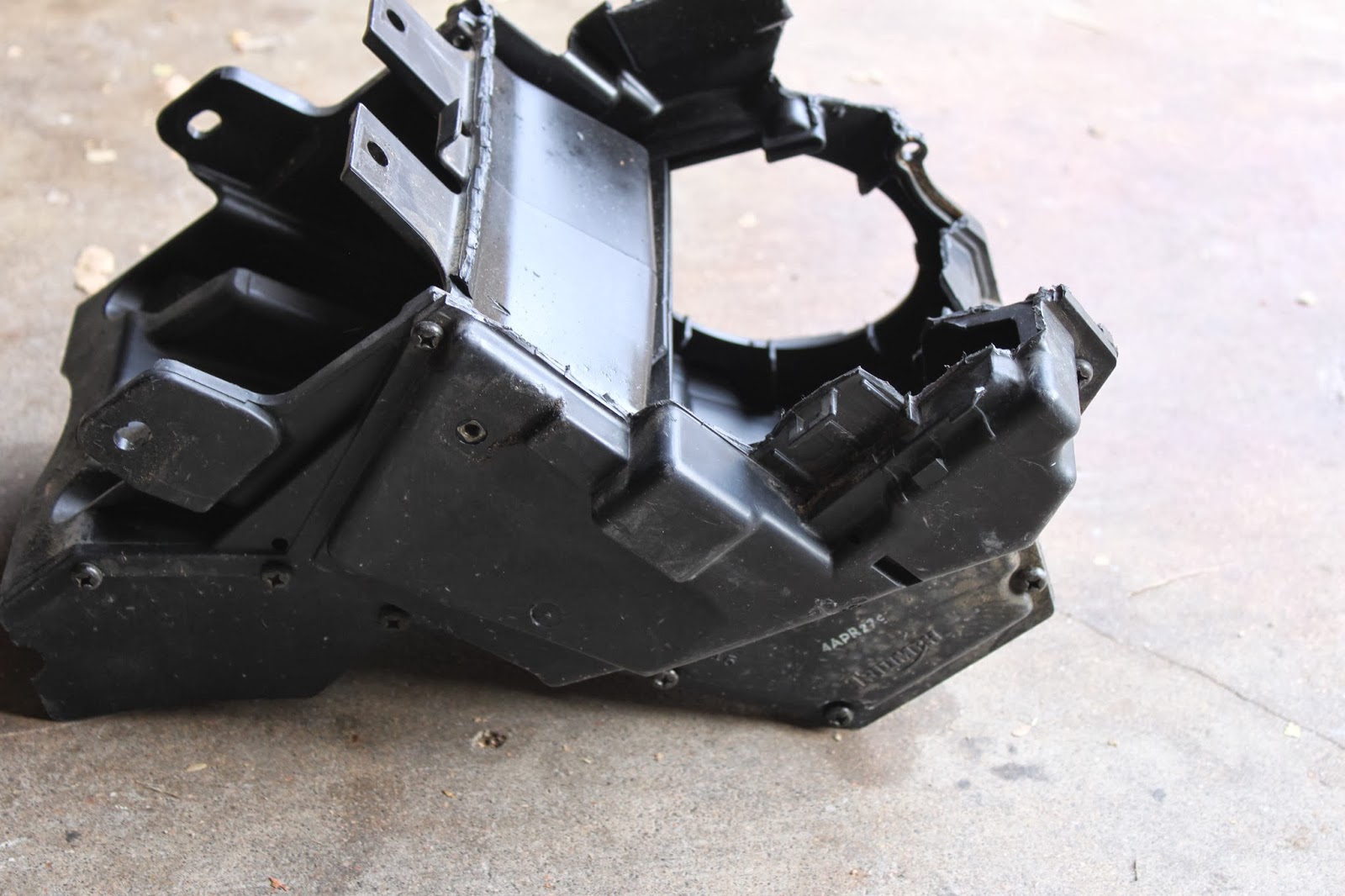
I lieu of shelling out the cash for a fancy kit, I decided to chop up the stock 'box. Naturally, I wasn't going to chop up the 'box that came with my bike, so a spare was sourced off Ebay for $10. Using other chopped air boxes as guides, I carved that mother up.
Next I had to put it in and here's how that went down:
First, let's get a look at what's behind the side covers:

 As you can see, a whole bunch of stuff goes on the air box. Carving it up retains the spaces for that stuff while giving you room for the pod filters. So let's go ahead and take all that stuff off.
To get the 'box out, we'll have to remove the rear fender, so let's do that:
 Getting the 'box out also requires dropping the rear wheel. Time to get the jack out and lift the bike.
 When dropping the rear wheel, the swing arm will contact the side stand/center stand stopper on the left silencer. Twist it out of the way and you should do the same for the right one, just to be safe. I didn't and got some gouges on the pipe. Thankfully, they're not noticeable.
 With that done, unbolt the top shock bolts and ease the wheel to the ground. That wheel is heavy, isn't it?
Removing the 'box requires a lot of finagling and the removal of both sides. Also, the bike needed to go a bit higher to get the box all the way out. Once it's out you should see this:
 This:
This:
 And this:
 Take this time to rejet the carbs. It will probably never be this easy to do again. What jets to use? That's a very good question. Everything I've read put the jetting in the 140 range. I bought jets in sizes 140, 142 and 145 to give me some wiggle room. Since I'm at an altitude of 5,280 ft., your jetting requirements will be either higher or lower depending on where you live. I split the difference between what I bought and went with the 142 jets and set the idle mixture screws to 2.5 turns out. I also installed my new Innovate MTX-L air/fuel gauge to make tuning easier.
Right, with the jetting done it's now time to put the filters on. I used foam filters from Uni because they flow better than K&N filters and are much cheaper. I'll be honest, the better flow rate wasn't my top priority. Oil them before installation and you should be rewarded with this view:
 Ah, what a lovely sight. Next it's time to put the carved 'box in. Here are a few shots of my carved 'box:

 While not exactly a masterpiece, I don't think it turned out too bad for using a pair of side cutters instead of a Dremel. Installing the carved 'box is a breeze. Also, you'll want to brace the carbs since the old airbox did that job. You could buy one of the nice braces online for molto scarole or you could go to Home Depot and buy a nice aluminum-and-stainless-steel turnbuckle for $5.00. The choice is yours.
 Once the carved 'box was in place, there was a bit of a clearance issue. The mount for the starter solenoid was making contact with the left pod filter:
 A bit of trimming with the side cutters and all was well:
 Now it's time to bolt all the stuff to the 'box:
 It looks tight but there is a lot of room between the fuse box and the pod filter.

On this side, you'll notice an extra filter. That's for the crankcase breather. Normally it would vent straight to the air box to be ingested by the engine. Since that part of the 'box is gone, it will have to vent to its own filter. The stock rubber hose will work in a pinch with a filter of the correct size but I found it easier to buy new line and use this filter from the parts store. A quick trip to Home Depot for the correct adapters and that was done. A side benefit is that it hides the filter behind the side cover.
Finally, bolt the wheel back up, swing the exhausts back into place, bolt the fender on and install the side covers. I found the side cover on the right to be a little bulky to put back on but I figure it's because of the pod filter.
Initial test rides show a slight dip in torque below 3,000 rpm but a nice, throaty wail and lots of thrust above that. I might put the 145 jets in just to see but right now, it's running quite well. A/F readings show a nice 12.5-13.0 at idle once warmed up, a cruising ratio of 13.5-14 and full-throttle readings of 13.0-13.5.
I'm quite satisfied and it was worth the wait. This mod will tide me over for the time being, at least until I can spring for some 39mm FCRs. In the meantime, I'm looking into some bits for the front suspension, so stay tuned for that.
I've read all that and the phrase that kept popping up is 'more power'. Hmm, more power you say? Well, I'd like to give that a try. So, here we are, nearly six years after buying the bike, and I'm just getting around to removing the 'box.
Previously, I did all the "free" air box mods: removing the snorkel, widening the intake opening and removing the restrictor. That worked well for a time but I couldn't resist the allure of More Power. More power is better because there's more!
Prefab removal kits are available from numerous online vendors and they come with all the filters, mounts and a nice metal battery box. The problem is they're all around $300, which is one of the reasons it's taken me six years to eighty-six the 'box. Three hundred dollars for some filters and a bit of metal? There has to be another way.
I lieu of shelling out the cash for a fancy kit, I decided to chop up the stock 'box. Naturally, I wasn't going to chop up the 'box that came with my bike, so a spare was sourced off Ebay for $10. Using other chopped air boxes as guides, I carved that mother up.
Next I had to put it in and here's how that went down:
First, let's get a look at what's behind the side covers:
To get the 'box out, we'll have to remove the rear fender, so let's do that:
Removing the 'box requires a lot of finagling and the removal of both sides. Also, the bike needed to go a bit higher to get the box all the way out. Once it's out you should see this:
Right, with the jetting done it's now time to put the filters on. I used foam filters from Uni because they flow better than K&N filters and are much cheaper. I'll be honest, the better flow rate wasn't my top priority. Oil them before installation and you should be rewarded with this view:
On this side, you'll notice an extra filter. That's for the crankcase breather. Normally it would vent straight to the air box to be ingested by the engine. Since that part of the 'box is gone, it will have to vent to its own filter. The stock rubber hose will work in a pinch with a filter of the correct size but I found it easier to buy new line and use this filter from the parts store. A quick trip to Home Depot for the correct adapters and that was done. A side benefit is that it hides the filter behind the side cover.
Finally, bolt the wheel back up, swing the exhausts back into place, bolt the fender on and install the side covers. I found the side cover on the right to be a little bulky to put back on but I figure it's because of the pod filter.
Initial test rides show a slight dip in torque below 3,000 rpm but a nice, throaty wail and lots of thrust above that. I might put the 145 jets in just to see but right now, it's running quite well. A/F readings show a nice 12.5-13.0 at idle once warmed up, a cruising ratio of 13.5-14 and full-throttle readings of 13.0-13.5.
I'm quite satisfied and it was worth the wait. This mod will tide me over for the time being, at least until I can spring for some 39mm FCRs. In the meantime, I'm looking into some bits for the front suspension, so stay tuned for that.
Sunday, February 9, 2014
Something New
I'd like to shift the focus of this blog for a second toward vehicles of the four-wheeled variety. I'd like to talk about cars. Don't worry; I'll get back to bikes soon enough.
Anyway, I recently traded in my beloved '04 VW GTi on a new car. I had my old GTi for eight years and it was a wonderful, fun and dependable car. I loved it and didn't want to get rid of it. That car saw me through college, took me on road trips and delivered me safely from Pittsburgh to Denver without missing a beat. It was a wonderful machine and I wish I could have kept it, if only for nostalgia's sake. You were a dear friend and I'm going to miss you.
But, like all relationships, this one had to end. The old girl was getting, well, old. Before something major happened or before it depreciated too much, it was time to move on. So I went car shopping. I would have rather bought a bike, but necessity trumped desire in this case.
The first stop was to look at the Fiat 500 Abarth, a car I've liked since it debuted in Europe a few years ago. There was trouble from the start when I was wandering around the lot. $24,000, $28,000, $31,000... Are people really paying these prices? I also noticed that most of the Abarths were 2013 models. Hmm, could that be related to the price...
Since I was there, though, I may as well go on a test ride. The salesman, who I think got his fashion tips from Huggy Bear, through me the keys and told me to take it on a nice long drive. Well, if you insist.
You sit up high in the Abarth and it feels vaguely like you're in a van. Also, the interior plastics and overall quality is not that great. I'm sure it would be alright if the car was $20,000. At $28,000, it's poor.
So, on with the driving. On the road, it doesn't feel that quick. According to the magazines, it has equal performance to my old GTi but it doesn't feel it. With my old car, the turbo would spool up quickly and you would feel this rush of power and torque. With the Abarth, I kept waiting for that to happen and it never did. Also, the Abarth had an exhaust that was supposed to sound sporty but it really sounded like the muffler fell off. If I was 16, I would have liked it. Since I'm nearly 30, I didn't.
It held the road well, though, and braking seemed pretty good. I'm sure it would be very fun to throw around a twisty road but I have a motorcycle for that. Yes, I'd like a fun car but I need it mostly for hauling people and stuff. The Abarth had no room for either.
By far the worst thing about the Abarth was the shift light. Dear God, I don't think a more annoying piece in any car exists today or ever. In the middle of the boost gauge, which is left of the steering wheel, is a yellow light that screams SHIFT UP constantly. It's like SHIFT UP, SHIFT UP, SHIFT UP, SHIFT UP! I wanted to rip this thing out of the dash. That alone would put me off the car.
So, that's off the list. On to something else.
I walked across the street to the VW dealer to look at new GTis but all they had were DSG models. I wanted a paddle shift trans as much as I wanted a sex change, so it was on to another dealer.
The next stop was at a Mini dealer. I've driven many Minis over the years and they are fun cars but are very small and very expensive. Since the hatchback model has virtually no room for rear passengers or luggage, I was interested in the coupe and roadster models. The roadster sounded interesting because I'd never owned a drop top before. I walked around the lot and the models there made the Abarth seem like a bargain. One model, a John Cooper Works roadster, was $45,000. For a Mini! To put that in perspective, that's $5,000 cheaper than a Porsche Boxster. Let's see, Porsche or Mini; which do I want more...
Well, that was out. What's next? Lunch.
After that, I walked to the Ford dealer.
I was interested in a Mustang and the Focus ST. I looked at the Mustangs but i couldn't justify paying $30,000-plus for a car that isn't very good. The only real redeeming quality about the Mustang is its V8. Everything else about it is pretty terrible.
The Focus ST was different. It's a hot hatch like the others on my short list. Also, I've driven all the older versions of the Focus (and its cousins the Mazda3 and the Volvo C30) and they were very fun to drive. I walked around the Focus, looked in the windows, sat in it and decided I couldn't do it.
I grew up in a GM family and have never liked Fords. I would feel like a sellout. Plus, the interior was just okay and it had way too many buttons.
Welp, time to look at VWs.
All this time, I had my heart set on a new GTi. These other cars had to work really hard to sway me off the GTi and they all failed miserably. Getting in the new GTi was like going home. All the quintessentially German touches of my old GTi were there: the logically laid out dash, the minimal buttons and the quality of materials. This one also had the plaid seats, which is just the coolest thing ever.
On the road, the car felt even better. The body roll that plagued my Mk IV was gone, as was the numb steering. I was leery of the electric steering but it felt great. It was as easy to steer as a GM car from the 70s in a parking lot and then stiffened up at speed. Also, the clutch was nice and light and the shifter snicked perfectly in to each gear. The shifting was fantastic and it liked to be shifted quickly, unlike my old GTi, which didn't like to be rushed.
The interior was nice and roomy, as well. The trunk area was reduced to make more room for passengers, which I can live with. I like that while everything had changed inside, nothing really changed. The controls for the lights, radio and HVAC were all in the same place as my old car.
So, that;s it, then, i bought the new GTi.
Well, not so fast.
There are issues with the new GTi, too. You see, the Mk VII models are coming later this year, so VW really scaled back on the 2014 models. Only two levels are available: the Wolfsburg and the Driver edition. The only option is the DSG 'box. Also, the 2014 GTi is only available in black, gray or white and only available as a five-door.
I'm fine with only having the choice between two trim levels. The Wolfsburg had all the stuff I wanted (except a sunroof) and was significantly cheaper. What I didn't want was black, gray or white paint and I didn't want a five-door. Five doors are fine for the regular Golf but a GTi should be a three-door. If you want a GTi with more doors, buy a Jetta GLI.
So, what to do? I pondered this as I looked around the Internet that night. Hold on, what's this? A 2012 GTi? With low miles, three doors and a six-speed manual? And it's red? Hmm...
I went to look at the car and to my amazement, it was perfect. I was hesitant to buy used because I got such a screaming deal with my old GTi I didn't think it could happen again. This 2012, though, proved me wrong.
Not only was the car right, the price was right and it's a Certified Pre-Owned VW, which means more warranty when the factory one runs out.
So there you have it. Out with the old and in with the new. Early impressions of the new car are quite good. It's much faster than my old GTi while also being quieter and roomier. It doesn't have a sunroof and a few of the things I liked about my old GTi aren't in this version, but I can live without them.
I think i made a good choice.

Anyway, I recently traded in my beloved '04 VW GTi on a new car. I had my old GTi for eight years and it was a wonderful, fun and dependable car. I loved it and didn't want to get rid of it. That car saw me through college, took me on road trips and delivered me safely from Pittsburgh to Denver without missing a beat. It was a wonderful machine and I wish I could have kept it, if only for nostalgia's sake. You were a dear friend and I'm going to miss you.
But, like all relationships, this one had to end. The old girl was getting, well, old. Before something major happened or before it depreciated too much, it was time to move on. So I went car shopping. I would have rather bought a bike, but necessity trumped desire in this case.
The first stop was to look at the Fiat 500 Abarth, a car I've liked since it debuted in Europe a few years ago. There was trouble from the start when I was wandering around the lot. $24,000, $28,000, $31,000... Are people really paying these prices? I also noticed that most of the Abarths were 2013 models. Hmm, could that be related to the price...
Since I was there, though, I may as well go on a test ride. The salesman, who I think got his fashion tips from Huggy Bear, through me the keys and told me to take it on a nice long drive. Well, if you insist.
You sit up high in the Abarth and it feels vaguely like you're in a van. Also, the interior plastics and overall quality is not that great. I'm sure it would be alright if the car was $20,000. At $28,000, it's poor.
So, on with the driving. On the road, it doesn't feel that quick. According to the magazines, it has equal performance to my old GTi but it doesn't feel it. With my old car, the turbo would spool up quickly and you would feel this rush of power and torque. With the Abarth, I kept waiting for that to happen and it never did. Also, the Abarth had an exhaust that was supposed to sound sporty but it really sounded like the muffler fell off. If I was 16, I would have liked it. Since I'm nearly 30, I didn't.
It held the road well, though, and braking seemed pretty good. I'm sure it would be very fun to throw around a twisty road but I have a motorcycle for that. Yes, I'd like a fun car but I need it mostly for hauling people and stuff. The Abarth had no room for either.
By far the worst thing about the Abarth was the shift light. Dear God, I don't think a more annoying piece in any car exists today or ever. In the middle of the boost gauge, which is left of the steering wheel, is a yellow light that screams SHIFT UP constantly. It's like SHIFT UP, SHIFT UP, SHIFT UP, SHIFT UP! I wanted to rip this thing out of the dash. That alone would put me off the car.
So, that's off the list. On to something else.
I walked across the street to the VW dealer to look at new GTis but all they had were DSG models. I wanted a paddle shift trans as much as I wanted a sex change, so it was on to another dealer.
The next stop was at a Mini dealer. I've driven many Minis over the years and they are fun cars but are very small and very expensive. Since the hatchback model has virtually no room for rear passengers or luggage, I was interested in the coupe and roadster models. The roadster sounded interesting because I'd never owned a drop top before. I walked around the lot and the models there made the Abarth seem like a bargain. One model, a John Cooper Works roadster, was $45,000. For a Mini! To put that in perspective, that's $5,000 cheaper than a Porsche Boxster. Let's see, Porsche or Mini; which do I want more...
Well, that was out. What's next? Lunch.
After that, I walked to the Ford dealer.
I was interested in a Mustang and the Focus ST. I looked at the Mustangs but i couldn't justify paying $30,000-plus for a car that isn't very good. The only real redeeming quality about the Mustang is its V8. Everything else about it is pretty terrible.
The Focus ST was different. It's a hot hatch like the others on my short list. Also, I've driven all the older versions of the Focus (and its cousins the Mazda3 and the Volvo C30) and they were very fun to drive. I walked around the Focus, looked in the windows, sat in it and decided I couldn't do it.
I grew up in a GM family and have never liked Fords. I would feel like a sellout. Plus, the interior was just okay and it had way too many buttons.
Welp, time to look at VWs.
All this time, I had my heart set on a new GTi. These other cars had to work really hard to sway me off the GTi and they all failed miserably. Getting in the new GTi was like going home. All the quintessentially German touches of my old GTi were there: the logically laid out dash, the minimal buttons and the quality of materials. This one also had the plaid seats, which is just the coolest thing ever.
On the road, the car felt even better. The body roll that plagued my Mk IV was gone, as was the numb steering. I was leery of the electric steering but it felt great. It was as easy to steer as a GM car from the 70s in a parking lot and then stiffened up at speed. Also, the clutch was nice and light and the shifter snicked perfectly in to each gear. The shifting was fantastic and it liked to be shifted quickly, unlike my old GTi, which didn't like to be rushed.
The interior was nice and roomy, as well. The trunk area was reduced to make more room for passengers, which I can live with. I like that while everything had changed inside, nothing really changed. The controls for the lights, radio and HVAC were all in the same place as my old car.
So, that;s it, then, i bought the new GTi.
Well, not so fast.
There are issues with the new GTi, too. You see, the Mk VII models are coming later this year, so VW really scaled back on the 2014 models. Only two levels are available: the Wolfsburg and the Driver edition. The only option is the DSG 'box. Also, the 2014 GTi is only available in black, gray or white and only available as a five-door.
I'm fine with only having the choice between two trim levels. The Wolfsburg had all the stuff I wanted (except a sunroof) and was significantly cheaper. What I didn't want was black, gray or white paint and I didn't want a five-door. Five doors are fine for the regular Golf but a GTi should be a three-door. If you want a GTi with more doors, buy a Jetta GLI.
So, what to do? I pondered this as I looked around the Internet that night. Hold on, what's this? A 2012 GTi? With low miles, three doors and a six-speed manual? And it's red? Hmm...
I went to look at the car and to my amazement, it was perfect. I was hesitant to buy used because I got such a screaming deal with my old GTi I didn't think it could happen again. This 2012, though, proved me wrong.
Not only was the car right, the price was right and it's a Certified Pre-Owned VW, which means more warranty when the factory one runs out.
So there you have it. Out with the old and in with the new. Early impressions of the new car are quite good. It's much faster than my old GTi while also being quieter and roomier. It doesn't have a sunroof and a few of the things I liked about my old GTi aren't in this version, but I can live without them.
I think i made a good choice.
This pic from my phone is the only one I have so far. It's not a good pic, I know, but it proves I'm not lying.
Sunday, January 26, 2014
More Bonnie Updates
Coming this March, I will have had my Bonneville for six years. Since the day I brought it home, I've scoured the Internet and have stared at parts. There have been a ton of mods I've wanted to do but time and money has always gone elsewhere.
Since I'm down to one bike, well, one-and-half bikes, I can finally focus some of my hard-earned on the mods I've been drooling over for six years.
Two months on (has it been that long?) and the rectifier is working beautifully. The clutch dress-up parts haven't fallen off, either, so that's a good sign.
Earlier in the month I bought a Procom igniter and that didn't work so well. The bike became very hard to start in the cold and since I live in Denver, it does get cold here. So that went back.
I also bought the remaining parts to finally jettison my airbox, another mod I've wanted for a long time. They should be here by the end of the week, so watch this space. I'll have updates on that.
In the meantime, let's talk about handlebars.
Yes, we could discuss this to death. And lets not forget the myriad of choices out there: buckhorns, apes, trackers, ace, superbars, etc. One could go mad looking for bars. Since I'm already mad, I had an idea of what I wanted.
I like the stock bars on the Bonnie but I wanted something a little lower and sporty. I looked at stock Sportster 48 bars and they have a good feel. They are similar in height to the stock Bonnie bars but don't have as much pullback. They felt good but I couldn't find a used set and there wasn't much of a difference to shell out $80-plus for a set. So, on to something else.
Next, I picked up a set of stock Thruxton handlebars that had been powder coated black. I like the Thrux bar. It's very low and aggressive and gives the bike a planted feel. When I put them on, I found they were too low and aggressive. They also hit the gas tank on full lock. I bought the Thrux clutch cable to fit the bars but I would also need Thrux throttle cables and front brake line to make the bars fit properly. In the end, they were too stubby and weren't worth the hassle.
Keeping with the low and aggressive approach, I picked up a used set of Norman Hyde m-bars. They are similar to the Thrux bar but not as stubby or as low. Plus they were chrome and I like chrome.
Installing them was much easier as I could keep the stock throttle and clutch cables and front brake line. They are also wider, giving much better leverage at low and high speed. The only issue with the bars I ran into during installation was rusty threads for the bar end weights. The rust wasn't bad enough to break a bolt but it did require careful progress, some patience and lots of lube. Stop snickering, perverts.
I finally got to take the bike for a ride today and I can say I'm pleased with the change. The position is much more aggressive but not so much so that it's become uncomfortable. I was worried that the stock footrests would be too far forward but that's proven to be a non-issue. In fact, they feel better with the lower bar. I wouldn't do a 1,000-mile tour with these bars in place but for the blasts through the mountains I do on the weekends, they are perfectly comfortable.
The bike also felt better and more planted in the corners. Maybe it's my imagination but cornering required minimal effort and the front felt so much more confidence-inspiring. I think the bike also got faster, but that, too, could be my imagination.
And I should add that they flat-out look the biz. I'm quite happy with them, though I am going to try some superbars just for fun.

Since I'm down to one bike, well, one-and-half bikes, I can finally focus some of my hard-earned on the mods I've been drooling over for six years.
Two months on (has it been that long?) and the rectifier is working beautifully. The clutch dress-up parts haven't fallen off, either, so that's a good sign.
Earlier in the month I bought a Procom igniter and that didn't work so well. The bike became very hard to start in the cold and since I live in Denver, it does get cold here. So that went back.
I also bought the remaining parts to finally jettison my airbox, another mod I've wanted for a long time. They should be here by the end of the week, so watch this space. I'll have updates on that.
In the meantime, let's talk about handlebars.
Yes, we could discuss this to death. And lets not forget the myriad of choices out there: buckhorns, apes, trackers, ace, superbars, etc. One could go mad looking for bars. Since I'm already mad, I had an idea of what I wanted.
I like the stock bars on the Bonnie but I wanted something a little lower and sporty. I looked at stock Sportster 48 bars and they have a good feel. They are similar in height to the stock Bonnie bars but don't have as much pullback. They felt good but I couldn't find a used set and there wasn't much of a difference to shell out $80-plus for a set. So, on to something else.
Next, I picked up a set of stock Thruxton handlebars that had been powder coated black. I like the Thrux bar. It's very low and aggressive and gives the bike a planted feel. When I put them on, I found they were too low and aggressive. They also hit the gas tank on full lock. I bought the Thrux clutch cable to fit the bars but I would also need Thrux throttle cables and front brake line to make the bars fit properly. In the end, they were too stubby and weren't worth the hassle.
Keeping with the low and aggressive approach, I picked up a used set of Norman Hyde m-bars. They are similar to the Thrux bar but not as stubby or as low. Plus they were chrome and I like chrome.
Installing them was much easier as I could keep the stock throttle and clutch cables and front brake line. They are also wider, giving much better leverage at low and high speed. The only issue with the bars I ran into during installation was rusty threads for the bar end weights. The rust wasn't bad enough to break a bolt but it did require careful progress, some patience and lots of lube. Stop snickering, perverts.
I finally got to take the bike for a ride today and I can say I'm pleased with the change. The position is much more aggressive but not so much so that it's become uncomfortable. I was worried that the stock footrests would be too far forward but that's proven to be a non-issue. In fact, they feel better with the lower bar. I wouldn't do a 1,000-mile tour with these bars in place but for the blasts through the mountains I do on the weekends, they are perfectly comfortable.
The bike also felt better and more planted in the corners. Maybe it's my imagination but cornering required minimal effort and the front felt so much more confidence-inspiring. I think the bike also got faster, but that, too, could be my imagination.
And I should add that they flat-out look the biz. I'm quite happy with them, though I am going to try some superbars just for fun.
Now where did I put that 59 Club patch?
Tuesday, November 26, 2013
New Parts
It's been a while since I've done a tech post, so I thought I'd share some updates on my Bonnie. I recently installed some parts to dress up the clutch lifter and a new rectifier/regulator. I know that's not as sexy as installing FCR39s, cams and a turbo but all that will come later.
... Except the turbo...
... Maybe...
Anyway, let's break out the tools and get dirty. First we'll have a look at the clutch lifter area as it comes from Triumph:
 Yuck! That looks terrible. The only way to fix that is to add some chrome. As they say, if it don't go, chrome it!
The first step is to remove the bracket holding the clutch cable to the clutch cover. Loosen up the nuts on the cable with a pair of 12mm wrenches and then remove the two 8mm bolts. With that loose, you can now wiggle the clutch cable out of the lifter arm. When you do this, the arm will slacken and move backward. Don't worry because it will very easily go back into position.
With the cable in your hand, spin off the nut facing the rear of the bike and remove the bracket. Slide the new awesome chrome bracket on, install the nut and then the rubber boot, slip the cable back into the lifter arm and bolt up the bracket. The new bracket is thicker than the old one but there are plenty of threads on the bolts.
For the lifter arm cover, remove the two hex screws on the cover and apply thread locker to the threads. This will prevent the little screws from vibrating out. I used hi-temp thread locker because it does get hot down there. Slip the cover over the arm and install the screws one at a time. Tighten until they're snug.
Once completed, it should look like this:

Oh, hang on. It should look like this:

Yes, that looks more better. The chrome adds a bit of bling to an otherwise dull area of the bike. Readjust the clutch cable and that job is finished.
Next up is the rectifier.
The standard rectifier on the Bonnie runs hot and does an alright job. This is an area that could be better and a MOSFET rectifier is a big improvement. This will strengthen the charging system while running much cooler than stock, meaning increased life for the unit. I chose a Hotshot rectifier from Rick's Motorsport Electrics.
When I took it out of the box, it looked huge and I didn't think it would fit in the stock location. Comparing it the stock unit, however, shows it's actually smaller:

To begin, remove the headlamp and gaze into the mess of wiring behind it. Somewhere in there is the connecter for the rectifier.
 Once you've found it, wiggle it out of the bucket and remove the two 8mm bolts holding the stock unit in place. To install the new unit, first wiggle the connecter into the bucket. Next, install and tighten the two 8mm bolts. As you can see in the pic with the two units, the new one is narrower than stock. There is enough room, thankfully, to bolt the new unit in place. once the rectifier is secure, apply some dielectric grease to the terminals and plug it in. Install the headlamp and let's fire up the engine.
At normal idle with the standard rectifier, here is the charging voltage:
 With the new rectifier, here is the charging voltage at the same idle speed:
 That's quite an improvement. The battery likes it, too, because it's holding voltage a lot better than it did with the stock rectifier.
And that's that. Go grab yourself a celebratory beer, coffee or whatever and stand back and admire your work.
... Except the turbo...
... Maybe...
Anyway, let's break out the tools and get dirty. First we'll have a look at the clutch lifter area as it comes from Triumph:

The first step is to remove the bracket holding the clutch cable to the clutch cover. Loosen up the nuts on the cable with a pair of 12mm wrenches and then remove the two 8mm bolts. With that loose, you can now wiggle the clutch cable out of the lifter arm. When you do this, the arm will slacken and move backward. Don't worry because it will very easily go back into position.
With the cable in your hand, spin off the nut facing the rear of the bike and remove the bracket. Slide the new awesome chrome bracket on, install the nut and then the rubber boot, slip the cable back into the lifter arm and bolt up the bracket. The new bracket is thicker than the old one but there are plenty of threads on the bolts.
For the lifter arm cover, remove the two hex screws on the cover and apply thread locker to the threads. This will prevent the little screws from vibrating out. I used hi-temp thread locker because it does get hot down there. Slip the cover over the arm and install the screws one at a time. Tighten until they're snug.
Once completed, it should look like this:

Oh, hang on. It should look like this:

Yes, that looks more better. The chrome adds a bit of bling to an otherwise dull area of the bike. Readjust the clutch cable and that job is finished.
Next up is the rectifier.
The standard rectifier on the Bonnie runs hot and does an alright job. This is an area that could be better and a MOSFET rectifier is a big improvement. This will strengthen the charging system while running much cooler than stock, meaning increased life for the unit. I chose a Hotshot rectifier from Rick's Motorsport Electrics.
When I took it out of the box, it looked huge and I didn't think it would fit in the stock location. Comparing it the stock unit, however, shows it's actually smaller:

To begin, remove the headlamp and gaze into the mess of wiring behind it. Somewhere in there is the connecter for the rectifier.

At normal idle with the standard rectifier, here is the charging voltage:


And that's that. Go grab yourself a celebratory beer, coffee or whatever and stand back and admire your work.
Tuesday, November 19, 2013
Small Errors in the Big Picture
When posting about my trip to San Diego, I mused that I would be looking for a touring-oriented motorcycle to take long trips. My Bonneville did wonderfully, apart from getting noisy in the desert heat, but I was cramped and sore. So, off I went to look at some bikes.
My main requirements were comfort, fuel injection and liquid-cooling. Comfort explains itself but I wanted fuel injection for elevation changes and liquid-cooling for the temperature changes. I wanted to climb every mountain and cross every desert. FI and liquid-cooling makes this easier.
I had my eyes on an older Triumph Sprint ST. I like the styling and I like how it fits in between a sports bike and touring barcalounger. I like the idea of being able to attack the twisty bits while also being able to pound out the miles.
The trouble was the riding position. My Guzzi was fun to ride but the position was too much for me after a few miles. The Sprint was only marginally more comfortable and I could see long distance comfort issues on the horizon. That was out.
I also liked the Triumph Tiger 1050. It has sportiness like the Sprint but you sit more upright. Hmm, I thought, this could be my answer.
Not so on the Tiger 1050 because it's a pseudo-adventure bike, which means it's tall and I'm not. I could barely touch the ground with both feet and, thus, the Tiger 1050 was out.
Other bikes came and went. I looked at Ducati Monsters (fun but not practical for touring and air-cooled), Ducati Multistrada (ugly, too tall and air-cooled), KTM Duke 690 (fun but so not a touring bike), etc.
One bike that kept coming up was the Triumph Tiger 800. It ticked all the boxes and I could fit on it. The Tiger seemed like the logical choice.
It wasn't without faults, though. I wasn't keen on having ABS, first off. I don't really find it necessary and it adds weight and complexity. It's just one more thing to go wrong. Unfortunately, all 2013 Tigers come with ABS. Another was cost. A new Tiger would be significant;y more expensive than any of the other bikes because they were used. I planned to trade my Guzzi in but I would still have a payment.
But I kept going back to the Tiger. Finally, I caved in and bought it. For the first time in my life, I listened to my head and made the logical choice.
All seemed well at first. I took it on a few rides, mostly to my local haunts and to work but something kept nagging at me. I couldn't put my finger on it but something was there, something odd.
It wasn't until I took a ride up to Fort Collins that it finally hit me.
The Tiger is incredibly smooth. The ride is supple and it absorbs every bump. I'm used to the harsh ride of my Bonneville and my Guzzi. This was like riding a Cadillac compared to those two. The 800 triple also has power everywhere. License-revoking speeds are just a twist of the wrist away.
The problem and the bike's biggest fault is that it's too smooth. It's actually quite dull.
At no point during any of my rides on it did I feel engaged with the bike. It seemed to me like a very blustery Toyota Camry. The same roads that have me gurning like an idiot on my Bonnie or Guzzi are dispatched lifelessly on the Tiger. It's a bike you ride with a serious face as you pile away the miles.
In short, I cocked up.
And I also miss my Guzzi. That bike had loads of warts: the gearbox was noisy, it was uncomfortable, it vibrated right at highway speed, the gas mileage was poor and so on. Twist the throttle, though, and all goes away as you ride this wave of power and noise. It was a glorious experience and because the roads that allowed such behavior are few, one to be cherished.
I got none of that fun riding the Tiger. If I wanted dullness and good gas mileage, I would have bought one of those new Honda 500s.
To sum it up, I made the logical choice. The Tiger 800 clicked every single box and met all the criteria. It is, without a doubt, a fantastic motorcycle. It's just missing that most important element, one that I didn't know was important to me: fun.
I made the logical choice but not the right one.
My main requirements were comfort, fuel injection and liquid-cooling. Comfort explains itself but I wanted fuel injection for elevation changes and liquid-cooling for the temperature changes. I wanted to climb every mountain and cross every desert. FI and liquid-cooling makes this easier.
I had my eyes on an older Triumph Sprint ST. I like the styling and I like how it fits in between a sports bike and touring barcalounger. I like the idea of being able to attack the twisty bits while also being able to pound out the miles.
The trouble was the riding position. My Guzzi was fun to ride but the position was too much for me after a few miles. The Sprint was only marginally more comfortable and I could see long distance comfort issues on the horizon. That was out.
I also liked the Triumph Tiger 1050. It has sportiness like the Sprint but you sit more upright. Hmm, I thought, this could be my answer.
Not so on the Tiger 1050 because it's a pseudo-adventure bike, which means it's tall and I'm not. I could barely touch the ground with both feet and, thus, the Tiger 1050 was out.
Other bikes came and went. I looked at Ducati Monsters (fun but not practical for touring and air-cooled), Ducati Multistrada (ugly, too tall and air-cooled), KTM Duke 690 (fun but so not a touring bike), etc.
One bike that kept coming up was the Triumph Tiger 800. It ticked all the boxes and I could fit on it. The Tiger seemed like the logical choice.
It wasn't without faults, though. I wasn't keen on having ABS, first off. I don't really find it necessary and it adds weight and complexity. It's just one more thing to go wrong. Unfortunately, all 2013 Tigers come with ABS. Another was cost. A new Tiger would be significant;y more expensive than any of the other bikes because they were used. I planned to trade my Guzzi in but I would still have a payment.
But I kept going back to the Tiger. Finally, I caved in and bought it. For the first time in my life, I listened to my head and made the logical choice.
All seemed well at first. I took it on a few rides, mostly to my local haunts and to work but something kept nagging at me. I couldn't put my finger on it but something was there, something odd.
It wasn't until I took a ride up to Fort Collins that it finally hit me.
The Tiger is incredibly smooth. The ride is supple and it absorbs every bump. I'm used to the harsh ride of my Bonneville and my Guzzi. This was like riding a Cadillac compared to those two. The 800 triple also has power everywhere. License-revoking speeds are just a twist of the wrist away.
The problem and the bike's biggest fault is that it's too smooth. It's actually quite dull.
At no point during any of my rides on it did I feel engaged with the bike. It seemed to me like a very blustery Toyota Camry. The same roads that have me gurning like an idiot on my Bonnie or Guzzi are dispatched lifelessly on the Tiger. It's a bike you ride with a serious face as you pile away the miles.
In short, I cocked up.
And I also miss my Guzzi. That bike had loads of warts: the gearbox was noisy, it was uncomfortable, it vibrated right at highway speed, the gas mileage was poor and so on. Twist the throttle, though, and all goes away as you ride this wave of power and noise. It was a glorious experience and because the roads that allowed such behavior are few, one to be cherished.
I got none of that fun riding the Tiger. If I wanted dullness and good gas mileage, I would have bought one of those new Honda 500s.
To sum it up, I made the logical choice. The Tiger 800 clicked every single box and met all the criteria. It is, without a doubt, a fantastic motorcycle. It's just missing that most important element, one that I didn't know was important to me: fun.
I made the logical choice but not the right one.
Saturday, September 21, 2013
On The Road, Pt. VII
This is the end... Beautiful friend, the end.
Yes, this is it. The final day of my journey has arrived and I would soon be spending the night in my own bed, using my own toilet and parking indoors. First I had to get there, though.
When I went to bed, it was still raining in Farmington and i figured on another rainy day of riding. To my surprise, the sun was out in the morning and it was cloudless. I gobbled down some more breakfast, packed up the bike and headed for home.
I was excited to get back into Colorado because that meant some twisty mountain roads. Bits of Cali and Arizona were nice but most of the areas were flat, straight and dull. At points I was actually wishing I was in a car. I could lean the seat back, put the cruise on and jam to some tunes. On the bike I couldn't do any of that. All I could really do is stare at the odometer and glance at the occasional pile of rocks on the side of the road that passed for scenery.
This was of course the Saturday of Labor Day weekend, so everyone and their dad was out on the road and driving at around four mph. Honestly, it was a bit frustrating because I was used to going 70 everywhere and now I'm feel like I'm at walking pace.
I also saw a lot of bikes. I think I saw more bikes this one day than I saw in the entire preceding days combined. Nearing the Wolf Creek Pass, I was passed by a group of Harleys complete with get back whips and do-rag-wearing riders. Excited by the corners, I jumped into the passing lane and blew by them as the road got twisty and then did the same to a couple of BMW riders. I waved to them all as I passed but none of them even looked at me. Bastards.
Wolf Creek is a delightfully twisty road that goes up well above 10,000 feet and it has a tunnel. I love tunnels. This tunnel even has a curve in it, making it a million times better. Another good thing for Wolf Creek is that its four lanes wide, so you can always pass the geezers in front and you can push it a bit because the edge of the world isn't inches away. I had a grand time scratching around the bends before the straight stuff returned.
I made a pit stop for a snack in Del Norte and got ready to head for the arrow straight section of 285 that headed toward Saguache. Breaking up the monotony are the two ridges that were cut through when the road was made. This was fantastic when I was heading this way before and its fantastic now. I bet its just as fantastic to be reading about it again, too.
As I was snacking on a protein bar I brought and an apple and banana I grabbed from the hotel, I noticed the sky getting cloudier. I didn't even check the weather because I knew it meant rain. By this point, I could predict the weather better than 100 Weather Channels. I just got on with the job at hand.
It got darker as I neared Saguache, darker still as I neared Buena Vista and then it finally rained when I got to Fairplay. I'm glad I got to see the scenery last week when it was sunny because it was miserable now. All I wanted at this point was to go home. I had had enough rain to last me for the rest of my life.
I wish I had more to say about this part of the trip but it was a blur. I was focused on home and really didn't look at the scenery and really didn't care about the roads. I went my speed, passed a bunch of cars and reminded myself how much fun it is to tour on a motorcycle. This is fun, they said. Riding is fun, they said.
I skipped a pee break in Fairplay to outrun the storm and that was a mistake. I thought I could hold it but I couldn't. Every bump was murder until I finally gave in. I pulled over, scampered down a hill and released the Nile. After what seemed like 20 minutes of continuous peeing, I walked back to bike and continued on my way a much lighter rider.
The rain came and went and came again during this time but I wasn't very bothered by it. It was pouring rain when I made my final stop in Bailey and my crotch was cold and wet. I think my penis ran away somewhere around there.
As I got closer to Denver, the sun came out and it finally got warmer. I was still focused on home and was passing cars like crazy. I was never so excited to see Denver as I got closer and closer. I slowed down at this point because I didn't want to make it this far only to have a crash on my doorstep. Turning down Colorado Blvd., then on to my street and finally up the drive was a wonderful feeling. I had done it. I rode my motorcycle to San Diego and back and lived to tell the tale.
Including going the wrong way and doubling back, the bike and I did just under 2,400 miles in six days. That doesn't include riding around while in San Diego. The bike never missed a beat the entire time, though it was quite dirty and sad-looking when we got home. The air-cooled engine did get quite noisy going through the hot desert and the chain's a bit looser now but otherwise, you can never tell it went that far. It never even used any oil. Let's have a round of applause for modern motorcycles, everyone.
Would I do it again? Well, yes and no.
My Bonneville may not have missed a beat but I sure did. As the days went on, fatigue set in quicker and quicker. The Thruxton gel seat I fitted to bike years ago helped some with comfort but the bike felt cramped, even for my short ass. Add in the stuff strapped to the back and there wasn't much room for me. I was constantly fighting for space with my luggage.
As for the riding, well, pockets of it were very good but most of it was quite boring. It was a bit like a 90 minute movie that had 12 minutes of action. I felt like I was always waiting for the good part to come along. A trip from Denver to San Diego will happen again (San Diego is too nice to not go back) but it will happen either on a more touring-oriented bike or in a car. My Bonnie loved the twisty bits but hated the slab. We share the same opinion, the bike and I.
So that's it. It's back to work and planning more trips, most of which I won't go on. At least it gives me something to do at work while I not do my job. In the meantime, I can also look at the Triumph Sprint STs that pop up used quite often. The 1050s, I think, look best in blue while I like 955i models best in green
Hmm...
Yes, this is it. The final day of my journey has arrived and I would soon be spending the night in my own bed, using my own toilet and parking indoors. First I had to get there, though.
When I went to bed, it was still raining in Farmington and i figured on another rainy day of riding. To my surprise, the sun was out in the morning and it was cloudless. I gobbled down some more breakfast, packed up the bike and headed for home.
I was excited to get back into Colorado because that meant some twisty mountain roads. Bits of Cali and Arizona were nice but most of the areas were flat, straight and dull. At points I was actually wishing I was in a car. I could lean the seat back, put the cruise on and jam to some tunes. On the bike I couldn't do any of that. All I could really do is stare at the odometer and glance at the occasional pile of rocks on the side of the road that passed for scenery.
This was of course the Saturday of Labor Day weekend, so everyone and their dad was out on the road and driving at around four mph. Honestly, it was a bit frustrating because I was used to going 70 everywhere and now I'm feel like I'm at walking pace.
I also saw a lot of bikes. I think I saw more bikes this one day than I saw in the entire preceding days combined. Nearing the Wolf Creek Pass, I was passed by a group of Harleys complete with get back whips and do-rag-wearing riders. Excited by the corners, I jumped into the passing lane and blew by them as the road got twisty and then did the same to a couple of BMW riders. I waved to them all as I passed but none of them even looked at me. Bastards.
Wolf Creek is a delightfully twisty road that goes up well above 10,000 feet and it has a tunnel. I love tunnels. This tunnel even has a curve in it, making it a million times better. Another good thing for Wolf Creek is that its four lanes wide, so you can always pass the geezers in front and you can push it a bit because the edge of the world isn't inches away. I had a grand time scratching around the bends before the straight stuff returned.
I made a pit stop for a snack in Del Norte and got ready to head for the arrow straight section of 285 that headed toward Saguache. Breaking up the monotony are the two ridges that were cut through when the road was made. This was fantastic when I was heading this way before and its fantastic now. I bet its just as fantastic to be reading about it again, too.
As I was snacking on a protein bar I brought and an apple and banana I grabbed from the hotel, I noticed the sky getting cloudier. I didn't even check the weather because I knew it meant rain. By this point, I could predict the weather better than 100 Weather Channels. I just got on with the job at hand.
It got darker as I neared Saguache, darker still as I neared Buena Vista and then it finally rained when I got to Fairplay. I'm glad I got to see the scenery last week when it was sunny because it was miserable now. All I wanted at this point was to go home. I had had enough rain to last me for the rest of my life.
I wish I had more to say about this part of the trip but it was a blur. I was focused on home and really didn't look at the scenery and really didn't care about the roads. I went my speed, passed a bunch of cars and reminded myself how much fun it is to tour on a motorcycle. This is fun, they said. Riding is fun, they said.
I skipped a pee break in Fairplay to outrun the storm and that was a mistake. I thought I could hold it but I couldn't. Every bump was murder until I finally gave in. I pulled over, scampered down a hill and released the Nile. After what seemed like 20 minutes of continuous peeing, I walked back to bike and continued on my way a much lighter rider.
The rain came and went and came again during this time but I wasn't very bothered by it. It was pouring rain when I made my final stop in Bailey and my crotch was cold and wet. I think my penis ran away somewhere around there.
As I got closer to Denver, the sun came out and it finally got warmer. I was still focused on home and was passing cars like crazy. I was never so excited to see Denver as I got closer and closer. I slowed down at this point because I didn't want to make it this far only to have a crash on my doorstep. Turning down Colorado Blvd., then on to my street and finally up the drive was a wonderful feeling. I had done it. I rode my motorcycle to San Diego and back and lived to tell the tale.
Including going the wrong way and doubling back, the bike and I did just under 2,400 miles in six days. That doesn't include riding around while in San Diego. The bike never missed a beat the entire time, though it was quite dirty and sad-looking when we got home. The air-cooled engine did get quite noisy going through the hot desert and the chain's a bit looser now but otherwise, you can never tell it went that far. It never even used any oil. Let's have a round of applause for modern motorcycles, everyone.
Would I do it again? Well, yes and no.
My Bonneville may not have missed a beat but I sure did. As the days went on, fatigue set in quicker and quicker. The Thruxton gel seat I fitted to bike years ago helped some with comfort but the bike felt cramped, even for my short ass. Add in the stuff strapped to the back and there wasn't much room for me. I was constantly fighting for space with my luggage.
As for the riding, well, pockets of it were very good but most of it was quite boring. It was a bit like a 90 minute movie that had 12 minutes of action. I felt like I was always waiting for the good part to come along. A trip from Denver to San Diego will happen again (San Diego is too nice to not go back) but it will happen either on a more touring-oriented bike or in a car. My Bonnie loved the twisty bits but hated the slab. We share the same opinion, the bike and I.
So that's it. It's back to work and planning more trips, most of which I won't go on. At least it gives me something to do at work while I not do my job. In the meantime, I can also look at the Triumph Sprint STs that pop up used quite often. The 1050s, I think, look best in blue while I like 955i models best in green
Hmm...
Monday, September 16, 2013
On The Road, Pt VI
When we last left our hero (me), I was getting wet yet again in Arizona. You know, I thought this was the desert southwest. Why is it raining so much?
Anyway, this morning was the beginning of the second-to-last day of my trip. Soon it would be back to the drudgery of everyday life. That wouldn't happen until blasted through the rest of Arizona, though.
After a trip to the bathroom, the first thing I did was check the weather. I had a choice of two routes (insert Joe Pesci voice here) that would take me to Farmington, NM. I could go through northern Arizona, the way I took on the trip out. I could also take 89A to Flagstaff, jump on I-40 to Gallup and then take 491 north. The difference between the two was 10 minutes but most importantly, it was raining in the north and not on I-40. I chose to take the slab.
After faffing about in Prescott trying to find gas, I got back on the brilliance that was 89A. In the valley before the descent into Cottonwood, the road reminded me of the veranda on the Isle of Man TT course. It was a long sweeping road that would be heaven on a fast motorcycle. I can believe that because it was fun on my Bonneville.
The descent is even better as you ride this ribbon draped across the mountain. The sheer drops on the right are blocked by a comically small guardrail while asperous rocks stick out on the left. You don't notice any of that, though, because the road commands your attention. Its myriad of curves are a long series of downshifting, upshifting, turning in, rolling off the throttle, powering down the straights and the occasional touch of brake. The oscillation of touching the white line and then heading for the double yellow becomes a dance; horse and rider as one.
Moments of extreme concentration such as this can only be broken by an equally extreme disturbance. Coming around a bend and finding a large boulder in your way is an example of that. Funnily enough, that's exactly what happened to me. Lucky for me no one was coming in the other direction, so I didn't have to break stride too much. The next boulder was even bigger and was surrounded by police, so I had to slow down for that one.
Snaking through Jerome, I finally caught up to civilization. This being a Friday before Labor Day, I was now in a long line of SUVs, minivans and RVs. The slowing of pace allowed me to take stock of the scenery and, wow, what scenery it is. Jagged rocks, majestic trees and beautiful houses are all fighting for the same space. Also, there's an oddly satisfying feeling to looking to the side or back and seeing the road you were just riding.
I stayed behind the long, slow train through Sedona and the wonderful canyon that followed. I so badly wanted to break away and pass everyone but I thought better of it since the passing zones were short and it gave me the opportunity to look around a bit more.
When I got to Flagstaff, I pulled over and busted out the GPS. I had a vague idea of where the entrance to I-40 was but wasn't quite sure. The GPS didn't know, either, as it took me all over town and a through a college campus before introducing me to the interstate.
It was gray and rainy in Flagstaff, which I was used to at this point. I spent my snack break and fuel stop under an awning to keep dry. I hopped on the interstate and was greeted by sunshine and clear skies. This was going to be a long haul but I was glad to be on the slab, to be honest. There isn't much out here, the northern route showed me that, and the interstate had more people on it.
As I was riding through the pouring rain a few days ago, I was thinking that if I had a crash or a breakdown, there wasn't much civilization around for help. At least on the interstate, there were more people and towns in case the worst happened.
After a couple fuel stops, a lunch break and some chatting with an outlaw motorcycle gang, I was nearing Gallup. The sky got blacker and blacker as I neared Gallup. Not again; not more rain.
I pulled into a gas station and ripped off the fastest refuel this side of Formula One. The massive storm was on my right moving west but I was moving north. The speed limit in Gallup was 40 mph but as you got away from town, it went up to 70. If I kept my speed up, I could out run it. The problem was I needed a stop in Tohatchi to make it all the way to Shiprock. Would that allow the storm to catch me?
I pulled into the station in Tohatchi ready to rip off another blazing stop. I stared at the ominous black cloud while the tank filled up way too slowly. Of course the fuel cap, bloated by years of ethanol gas, decided now it wouldn't go on. I whipped out the WD-40 I brought for just this instance and a quick shot of it allowed the cap to tighten. As I was getting ready to depart, an old guy wandered over and wanted to talk about my bike. This is a scene so common to Hinckley Bonneville owners. I quickly apologized, pointed at the storm and high-tailed it out of there.
Out on the road, I could feel the storm getting closer. The temperature dropped significantly and the wind picked up. Soon the wind really started to move. Dust and debris were flying across the road and it was all I could do to keep control of the bike. I hunkered down as much as I could and fought the wind. The passing minutes were agonizing.
As I rounded a bend, the wind began to die down and the temperature started to rise. I had done it, I cleared the storm! The view in my mirrors was a menacing black but the view ahead was blue and cloudless. This same area I had mistakenly gone through earlier was much more scenic drenched in sunshine.
As if on cue, the construction zone I turned around in last time appeared and I knew then that Shiprock wasn't too far off. I got some gas in Shiprock while it was miserably hot and pushed on to Farmington. Once in Farmington, I grabbed a hotel room for the night and finally relaxed.
It was dinner time and as I stepped outside, I was greeted with a familiar sight: rain. The rain had also brought along its buddies thunder and lightning, too. The walk to the Mexican restaurant wasn't much fun but at least the food was good. Afterward, I squished back to the room and collapsed.
Tomorrow was it, the final day. The trip I had been planning for months would soon be over. The final day wouldn't be without its moments, though.
Stay tuned for Part VII, the final chapter...
Anyway, this morning was the beginning of the second-to-last day of my trip. Soon it would be back to the drudgery of everyday life. That wouldn't happen until blasted through the rest of Arizona, though.
After a trip to the bathroom, the first thing I did was check the weather. I had a choice of two routes (insert Joe Pesci voice here) that would take me to Farmington, NM. I could go through northern Arizona, the way I took on the trip out. I could also take 89A to Flagstaff, jump on I-40 to Gallup and then take 491 north. The difference between the two was 10 minutes but most importantly, it was raining in the north and not on I-40. I chose to take the slab.
After faffing about in Prescott trying to find gas, I got back on the brilliance that was 89A. In the valley before the descent into Cottonwood, the road reminded me of the veranda on the Isle of Man TT course. It was a long sweeping road that would be heaven on a fast motorcycle. I can believe that because it was fun on my Bonneville.
The descent is even better as you ride this ribbon draped across the mountain. The sheer drops on the right are blocked by a comically small guardrail while asperous rocks stick out on the left. You don't notice any of that, though, because the road commands your attention. Its myriad of curves are a long series of downshifting, upshifting, turning in, rolling off the throttle, powering down the straights and the occasional touch of brake. The oscillation of touching the white line and then heading for the double yellow becomes a dance; horse and rider as one.
Moments of extreme concentration such as this can only be broken by an equally extreme disturbance. Coming around a bend and finding a large boulder in your way is an example of that. Funnily enough, that's exactly what happened to me. Lucky for me no one was coming in the other direction, so I didn't have to break stride too much. The next boulder was even bigger and was surrounded by police, so I had to slow down for that one.
Snaking through Jerome, I finally caught up to civilization. This being a Friday before Labor Day, I was now in a long line of SUVs, minivans and RVs. The slowing of pace allowed me to take stock of the scenery and, wow, what scenery it is. Jagged rocks, majestic trees and beautiful houses are all fighting for the same space. Also, there's an oddly satisfying feeling to looking to the side or back and seeing the road you were just riding.
I stayed behind the long, slow train through Sedona and the wonderful canyon that followed. I so badly wanted to break away and pass everyone but I thought better of it since the passing zones were short and it gave me the opportunity to look around a bit more.
When I got to Flagstaff, I pulled over and busted out the GPS. I had a vague idea of where the entrance to I-40 was but wasn't quite sure. The GPS didn't know, either, as it took me all over town and a through a college campus before introducing me to the interstate.
It was gray and rainy in Flagstaff, which I was used to at this point. I spent my snack break and fuel stop under an awning to keep dry. I hopped on the interstate and was greeted by sunshine and clear skies. This was going to be a long haul but I was glad to be on the slab, to be honest. There isn't much out here, the northern route showed me that, and the interstate had more people on it.
As I was riding through the pouring rain a few days ago, I was thinking that if I had a crash or a breakdown, there wasn't much civilization around for help. At least on the interstate, there were more people and towns in case the worst happened.
After a couple fuel stops, a lunch break and some chatting with an outlaw motorcycle gang, I was nearing Gallup. The sky got blacker and blacker as I neared Gallup. Not again; not more rain.
I pulled into a gas station and ripped off the fastest refuel this side of Formula One. The massive storm was on my right moving west but I was moving north. The speed limit in Gallup was 40 mph but as you got away from town, it went up to 70. If I kept my speed up, I could out run it. The problem was I needed a stop in Tohatchi to make it all the way to Shiprock. Would that allow the storm to catch me?
I pulled into the station in Tohatchi ready to rip off another blazing stop. I stared at the ominous black cloud while the tank filled up way too slowly. Of course the fuel cap, bloated by years of ethanol gas, decided now it wouldn't go on. I whipped out the WD-40 I brought for just this instance and a quick shot of it allowed the cap to tighten. As I was getting ready to depart, an old guy wandered over and wanted to talk about my bike. This is a scene so common to Hinckley Bonneville owners. I quickly apologized, pointed at the storm and high-tailed it out of there.
Out on the road, I could feel the storm getting closer. The temperature dropped significantly and the wind picked up. Soon the wind really started to move. Dust and debris were flying across the road and it was all I could do to keep control of the bike. I hunkered down as much as I could and fought the wind. The passing minutes were agonizing.
As I rounded a bend, the wind began to die down and the temperature started to rise. I had done it, I cleared the storm! The view in my mirrors was a menacing black but the view ahead was blue and cloudless. This same area I had mistakenly gone through earlier was much more scenic drenched in sunshine.
As if on cue, the construction zone I turned around in last time appeared and I knew then that Shiprock wasn't too far off. I got some gas in Shiprock while it was miserably hot and pushed on to Farmington. Once in Farmington, I grabbed a hotel room for the night and finally relaxed.
It was dinner time and as I stepped outside, I was greeted with a familiar sight: rain. The rain had also brought along its buddies thunder and lightning, too. The walk to the Mexican restaurant wasn't much fun but at least the food was good. Afterward, I squished back to the room and collapsed.
Tomorrow was it, the final day. The trip I had been planning for months would soon be over. The final day wouldn't be without its moments, though.
Stay tuned for Part VII, the final chapter...
Thursday, September 12, 2013
On The Road, Pt. V
After a few days of sand, surf and sun, it was time to head back inland. By this time, I had my morning routine and bike packing down to the point where I could do it in my sleep. I fueled myself up, then the bike and headed off a bit later than I wanted. I really wanted sleep in but the road beckoned.
Before I began my day properly, I went down to the beach one last time to take a picture of my bike with the ocean. It was to be my proof that I actually made it and didn't make the whole thing up. Picture over with, it was time to go home. I went to put my ear plugs in only to find one was missing. Great. This necessitated a stop at Lowe's and of course, the guy behind the counter asked if I was on a bike. That's why this genius is working at Lowe's.
This trip's trend of weather variances continued as I was chilly by the ocean and got hotter as I moved farther inland. Something else weird was that I stopped admiring the scenery and got on with the business of riding. Maybe it was because I was going the same way and had seen this stuff before but I had my eyes set on Prescott, AZ and not on the ride.
Coming down the Pines to Palms Highway, which is just as brilliant going this way, I again had to put on some extra clothing. Then I had to take it off again when I got to the desert. It's just amazing that in two hours, I went from ocean to mountain to desert. Didn't I say that last time?
Anyway, I blew through Palm Desert and Indio, hopping back on I-10 to begin the drudgery of the slab. I made my next gas stop at a service station that was also home to the George Patton museum and some other small stores. It's an odd place to have this since there's nothing around for miles except this.
Gas tank full and bladder empty, it was back on the road for some more slab. The hot gusts of wind were mercifully absent this time. The miles clicked off ever so slowly until it was time to pull off in Blythe for gas and lunch. My choice for lunch was a Subway, which had been the choice for lunch on the road every other day, too. You're welcome, Jared.
I dismounted my bike and went to put my ear plugs in my right jacket pocket when I noticed something odd. The pocket was unzipped and there was no camera in it. Frantic, I searched everywhere for it until the realization set in: it fell out of my pocket. Some point during the day, I forgot to zip up the pocket and my camera was somewhere along the road in California. There went all my pics, including the one from the morning in front of the ocean. Now you know why there aren't any pics in these posts.
Pissed off, I ate quickly, got gas and hit the road. After hours of straight line drudgery and sweltering heat, I made it to Congress, AZ. I would be heading up the mountains and beginning the final push to Prescott. After a long day of sweating, I was looking forward to the cooler temps and more exciting roads.
As I left Congress, an Audi A7 followed and looked like it wanted to play. I'm fine with that, I thought, and carried on at a swift pace. The road leading up to Prescott is a joyous collection of tight bends, fast sweepers and short straights. My Bonneville, even with all that weight on the back and my fists of ham, handled the road brilliantly. It makes the case for a pure sports bike difficult when such a normal machine can perform so well.
The Audi became a smaller and smaller speck in my mirrors until I got cold and pulled over to put my flannel back on. Using my motorcyclist spider sense, I could see the clouds getting darker and more abundant. Smiling at the thought of more rain (why not?), I put on the wind breaker, too.
Sure enough, I was greeted with rain in Prescott. I rode through a slight drizzle but I could hear booms of thunder and see the lightning. Either I had just missed the storm or was on the front edge of it. I set my GPS for the hotel and rode through town. It's a nice place, Prescott, with loads of small town charm. Also there was the Audi.
I eyed a few restaurants I'd like to try but my route kept taking me further away from town. The further I got, the less I wanted to ride back and I wasn't walking that far. Finally, I reached the hotel, quite a distance from Prescott, and got a room. The manager even let me park my bike under the awning, which was great because it started to rain as soon as I got there. Pickings were slim for dinner, so I grabbed a few things from a grocery store and ate that. Whatever; it was dinner and I was hungry.
Aside from the rain in Prescott, the day had been fantastic. I had clear skies and great weather all day and the bike never missed a beat again. I was starting to break down, though. Really, I just wanted to go home to my bed. Losing my camera was the real black eye on the day. I'm still pissed about it and I have no one to blame but me.
Stay tuned for Part VI.
Before I began my day properly, I went down to the beach one last time to take a picture of my bike with the ocean. It was to be my proof that I actually made it and didn't make the whole thing up. Picture over with, it was time to go home. I went to put my ear plugs in only to find one was missing. Great. This necessitated a stop at Lowe's and of course, the guy behind the counter asked if I was on a bike. That's why this genius is working at Lowe's.
This trip's trend of weather variances continued as I was chilly by the ocean and got hotter as I moved farther inland. Something else weird was that I stopped admiring the scenery and got on with the business of riding. Maybe it was because I was going the same way and had seen this stuff before but I had my eyes set on Prescott, AZ and not on the ride.
Coming down the Pines to Palms Highway, which is just as brilliant going this way, I again had to put on some extra clothing. Then I had to take it off again when I got to the desert. It's just amazing that in two hours, I went from ocean to mountain to desert. Didn't I say that last time?
Anyway, I blew through Palm Desert and Indio, hopping back on I-10 to begin the drudgery of the slab. I made my next gas stop at a service station that was also home to the George Patton museum and some other small stores. It's an odd place to have this since there's nothing around for miles except this.
Gas tank full and bladder empty, it was back on the road for some more slab. The hot gusts of wind were mercifully absent this time. The miles clicked off ever so slowly until it was time to pull off in Blythe for gas and lunch. My choice for lunch was a Subway, which had been the choice for lunch on the road every other day, too. You're welcome, Jared.
I dismounted my bike and went to put my ear plugs in my right jacket pocket when I noticed something odd. The pocket was unzipped and there was no camera in it. Frantic, I searched everywhere for it until the realization set in: it fell out of my pocket. Some point during the day, I forgot to zip up the pocket and my camera was somewhere along the road in California. There went all my pics, including the one from the morning in front of the ocean. Now you know why there aren't any pics in these posts.
Pissed off, I ate quickly, got gas and hit the road. After hours of straight line drudgery and sweltering heat, I made it to Congress, AZ. I would be heading up the mountains and beginning the final push to Prescott. After a long day of sweating, I was looking forward to the cooler temps and more exciting roads.
As I left Congress, an Audi A7 followed and looked like it wanted to play. I'm fine with that, I thought, and carried on at a swift pace. The road leading up to Prescott is a joyous collection of tight bends, fast sweepers and short straights. My Bonneville, even with all that weight on the back and my fists of ham, handled the road brilliantly. It makes the case for a pure sports bike difficult when such a normal machine can perform so well.
The Audi became a smaller and smaller speck in my mirrors until I got cold and pulled over to put my flannel back on. Using my motorcyclist spider sense, I could see the clouds getting darker and more abundant. Smiling at the thought of more rain (why not?), I put on the wind breaker, too.
Sure enough, I was greeted with rain in Prescott. I rode through a slight drizzle but I could hear booms of thunder and see the lightning. Either I had just missed the storm or was on the front edge of it. I set my GPS for the hotel and rode through town. It's a nice place, Prescott, with loads of small town charm. Also there was the Audi.
I eyed a few restaurants I'd like to try but my route kept taking me further away from town. The further I got, the less I wanted to ride back and I wasn't walking that far. Finally, I reached the hotel, quite a distance from Prescott, and got a room. The manager even let me park my bike under the awning, which was great because it started to rain as soon as I got there. Pickings were slim for dinner, so I grabbed a few things from a grocery store and ate that. Whatever; it was dinner and I was hungry.
Aside from the rain in Prescott, the day had been fantastic. I had clear skies and great weather all day and the bike never missed a beat again. I was starting to break down, though. Really, I just wanted to go home to my bed. Losing my camera was the real black eye on the day. I'm still pissed about it and I have no one to blame but me.
Stay tuned for Part VI.
Friday, September 6, 2013
On The Road, Pt. IV
It was now Monday, the day I'd be getting into San Diego. I spent most of the previous evening drying out my clothes using a combo of the iron and hair dryer. It worked... Sort of. What really worked best was putting my socks in the microwave.
Anyway, I pulled the blinds open in the morning and was greeted with more rain. How could it rain this much? It has to stop some time, right?
Well, this morning wasn't that time. It rained all through breakfast and all the while I packed up my bike. The highlight of the morning wasn't the omelet I had (it was good, though), it was a chance meeting in an elevator. I walked in the elevator carrying all my stuff and the guy in there told me he once rode a motorcycle from Hollywood back to Pittsburgh. Pittsburgh?! That's the second person from my old turf I met on this trip. Weird and wild stuff, that.
I made my way through the rain to a nearby gas station, fueled up for the ride to Prescott and prepared to get wet. I wasn't 45 minutes into the day and everything was already soaked. Lovely.
Mercifully, the rain ended when I got on Arizona 89A, the winding road that would take me to Prescott. The road was still very wet, though, which meant I couldn't fully exploit the twisty bits or the empty road in front of me. At least it was warming up.
Like a ghost in the night, a great number of switchbacks appeared on the road. The scenery and the tight road tore at my concentration, delighting and denying me at the same time. The road snakes, dips and climbs through an amazing canyon. It's an absolute delight, almost to the point of wanting to turn around and ride it a few more times. The Bonneville's handling also continued to impress; this section was a blast in the wet on a packed-up bike.
As quickly as it appeared, the canyon was gone. The road flattened out and gently wove through the forest. Every so often a small motel or cabin would appear on the side, showing some semblance of civilization. Aside from this, it was you and the trees.
As I broke through the trees into Sedona, AZ, I was greeted with a panoramic view of biblical proportions. There were sunken canyons, high, spiraling mountains; trees, rocks and buildings sharing the same space. The architects built Sedona around the geological features; instead of dominating the land, the builders incorporated it and created something beautiful.
Above this wondrous scene was the best sight of all: dissipating clouds and blue sky. The sun even made an appearance. I had come through 300 miles of rain and misery to be greeted by a sight of extreme beauty. It was totally worth it.
I fueled up in Sedona and headed toward the mountains. As I got closer, the road dried and the sun took command over the sky. One of the highlights was Jerome, AZ, an old mining town built into the mountain. Suddenly, I was in the Apennines, snaking through the town's narrow streets, tight corners and stucco buildings. It was like being transported to another country, if only for a brief moment.
Dancing the curves of the mountain brought me to Prescott, AZ, finally. I fueled up, got lost and then finally found my way down the mountain. Further increasing my reward were more mountain roads and more gorgeous scenery. Coming down the mountain brought incredible views of the desert floor. The desert spread out like an enormous blanket, covering everything up to the horizon.
At the bottom was a little place called Congress, AZ. This place consisted of a gas station and a Family Dollar. That was it. As I was getting gas, I suddenly realized something: I was very hot. I was so busy concentrating on the road and the scenery, I didn't notice the temperature went from the low 60s to the mid 80s. The windbreaker that had saved me yesterday was now clinging to me like a frightened child.
Free of bondage, I set off across the flat and straight desert. It's here that one can truly grasp the vastness of the U.S. There was nothing, I mean nothing, but scrub and dirt for miles and miles. The road was so straight I could have set the throttle and taken a nap. The desert was not without excitement as a number of vultures took flight directly in front of me. I had to lay flat on the tank to miss them and if I was in a car, they would have splattered across my windshield.
The flat desert gave way to I-10, the road that would take me to California. I-10 was more of the same except with more trucks. A stop for gas and an awful lunch got me ready for the final push. The trip down I-10 was a boring exercise in dealing with hot wind blast and boring scenery. I was thankful when it ended.
A stop for fuel in Palm Desert, CA meant the end of the desert. San Diego was just on the other side of the mountain. While filling up in Palm Desert, I again realized I was very hot. I was sweating not even doing anything. Unfortunately, I had no more removable clothes.
The final leg would take me up the Pines to Palms Highway and around Palomar Mountain. Any corners would be exciting after the dullness of the desert and this did not disappoint. Every corner you could imagine, from tight twisties to fast sweepers, were here and it was all bathed in bright sunlight. Again, the scenery was just as fantastic as the road. The Bonnie and its rider enjoyed every minute of this place, as it was similar to roads in Colorado except they were only at around 3,000 feet. That meant the bike actually had power to go down the straights. It also got cold up here, requiring me to stop and put my flannel back on.
The downward side of the mountain put me on the fast-track to the ocean. By this time I was pretty tired and just wanted to get to my hotel. After what seemed like 40 years wandering the desert, I pulled into the hotel, got in my room and collapsed on the bed. Another realization hit me: I was hungry. It was getting too dark to walk all the way to the ocean, so I just milled around the area. All that was around were hot rod shops and a doughnut place. Giving in, I ordered pizza from Domino's and then crashed. It had been a very long day.
I made it, though. I was in California. As I tried to calm down and relax after the day, I thought about the ride I had just put in. It's easy to think about California and wonder why anyone would want to live there. Then you visit and realize why.
In a two hour period, I went from the desert to the mountains and finally to the ocean. I did this while on amazing roads surrounded by some of the Earth's best scenery.
What an amazing place.
Part V will cover the beginning of the ride home.
Anyway, I pulled the blinds open in the morning and was greeted with more rain. How could it rain this much? It has to stop some time, right?
Well, this morning wasn't that time. It rained all through breakfast and all the while I packed up my bike. The highlight of the morning wasn't the omelet I had (it was good, though), it was a chance meeting in an elevator. I walked in the elevator carrying all my stuff and the guy in there told me he once rode a motorcycle from Hollywood back to Pittsburgh. Pittsburgh?! That's the second person from my old turf I met on this trip. Weird and wild stuff, that.
I made my way through the rain to a nearby gas station, fueled up for the ride to Prescott and prepared to get wet. I wasn't 45 minutes into the day and everything was already soaked. Lovely.
Mercifully, the rain ended when I got on Arizona 89A, the winding road that would take me to Prescott. The road was still very wet, though, which meant I couldn't fully exploit the twisty bits or the empty road in front of me. At least it was warming up.
Like a ghost in the night, a great number of switchbacks appeared on the road. The scenery and the tight road tore at my concentration, delighting and denying me at the same time. The road snakes, dips and climbs through an amazing canyon. It's an absolute delight, almost to the point of wanting to turn around and ride it a few more times. The Bonneville's handling also continued to impress; this section was a blast in the wet on a packed-up bike.
As quickly as it appeared, the canyon was gone. The road flattened out and gently wove through the forest. Every so often a small motel or cabin would appear on the side, showing some semblance of civilization. Aside from this, it was you and the trees.
As I broke through the trees into Sedona, AZ, I was greeted with a panoramic view of biblical proportions. There were sunken canyons, high, spiraling mountains; trees, rocks and buildings sharing the same space. The architects built Sedona around the geological features; instead of dominating the land, the builders incorporated it and created something beautiful.
Above this wondrous scene was the best sight of all: dissipating clouds and blue sky. The sun even made an appearance. I had come through 300 miles of rain and misery to be greeted by a sight of extreme beauty. It was totally worth it.
I fueled up in Sedona and headed toward the mountains. As I got closer, the road dried and the sun took command over the sky. One of the highlights was Jerome, AZ, an old mining town built into the mountain. Suddenly, I was in the Apennines, snaking through the town's narrow streets, tight corners and stucco buildings. It was like being transported to another country, if only for a brief moment.
Dancing the curves of the mountain brought me to Prescott, AZ, finally. I fueled up, got lost and then finally found my way down the mountain. Further increasing my reward were more mountain roads and more gorgeous scenery. Coming down the mountain brought incredible views of the desert floor. The desert spread out like an enormous blanket, covering everything up to the horizon.
At the bottom was a little place called Congress, AZ. This place consisted of a gas station and a Family Dollar. That was it. As I was getting gas, I suddenly realized something: I was very hot. I was so busy concentrating on the road and the scenery, I didn't notice the temperature went from the low 60s to the mid 80s. The windbreaker that had saved me yesterday was now clinging to me like a frightened child.
Free of bondage, I set off across the flat and straight desert. It's here that one can truly grasp the vastness of the U.S. There was nothing, I mean nothing, but scrub and dirt for miles and miles. The road was so straight I could have set the throttle and taken a nap. The desert was not without excitement as a number of vultures took flight directly in front of me. I had to lay flat on the tank to miss them and if I was in a car, they would have splattered across my windshield.
The flat desert gave way to I-10, the road that would take me to California. I-10 was more of the same except with more trucks. A stop for gas and an awful lunch got me ready for the final push. The trip down I-10 was a boring exercise in dealing with hot wind blast and boring scenery. I was thankful when it ended.
A stop for fuel in Palm Desert, CA meant the end of the desert. San Diego was just on the other side of the mountain. While filling up in Palm Desert, I again realized I was very hot. I was sweating not even doing anything. Unfortunately, I had no more removable clothes.
The final leg would take me up the Pines to Palms Highway and around Palomar Mountain. Any corners would be exciting after the dullness of the desert and this did not disappoint. Every corner you could imagine, from tight twisties to fast sweepers, were here and it was all bathed in bright sunlight. Again, the scenery was just as fantastic as the road. The Bonnie and its rider enjoyed every minute of this place, as it was similar to roads in Colorado except they were only at around 3,000 feet. That meant the bike actually had power to go down the straights. It also got cold up here, requiring me to stop and put my flannel back on.
The downward side of the mountain put me on the fast-track to the ocean. By this time I was pretty tired and just wanted to get to my hotel. After what seemed like 40 years wandering the desert, I pulled into the hotel, got in my room and collapsed on the bed. Another realization hit me: I was hungry. It was getting too dark to walk all the way to the ocean, so I just milled around the area. All that was around were hot rod shops and a doughnut place. Giving in, I ordered pizza from Domino's and then crashed. It had been a very long day.
I made it, though. I was in California. As I tried to calm down and relax after the day, I thought about the ride I had just put in. It's easy to think about California and wonder why anyone would want to live there. Then you visit and realize why.
In a two hour period, I went from the desert to the mountains and finally to the ocean. I did this while on amazing roads surrounded by some of the Earth's best scenery.
What an amazing place.
Part V will cover the beginning of the ride home.
Wednesday, September 4, 2013
On The Road, Pt III
It was.
I awoke to rain; lots of it. I grabbed some breakfast and got ready for the day, hoping all the time that it would let up. Watching the weather channel confirmed what I thought: it wouldn't.
So, I packed up and got ready to go, figuring I might as well get on with it. Parked next to my Bonneville was a very nice Yamaha FJR1300. It actually made me feel better since I wouldn't be the only bike. As I was strapping my backpack down, the Yammie's owner came out for a chat. It turned out he was originally from Steubenville, OH, which is very close to Pittsburgh. I wasn't expecting that.
Belly full of carbs and orange juice, I set off into the rain. My not packing rain gear was really dumb. Water came in through my mesh summer jacket and spray from the road came in the mesh areas of my pants. Clearly, this would be a long day.
The rain let up as I approached Shiprock, NM to fuel up. The sky was extremely gray and foreboding, though. I took off from the gas station and headed on down the road. I settled into the groove of riding, keeping a watchful eye on the skies.
Oddly, something didn't feel right. I kept seeing signs for Gallup, NM, which wasn't where I wanted to go. I figured Gallup was the only large town around and it would appear on most of the signs in the area. A little further and I started to get worried. Pulling over, I whipped out my phone and it confirmed I was heading south to Gallup instead of going west toward Teec Nos Pos. I was so focused on what the skies were going to do, I completely missed my turn and went way off course.
If I continued south, I could take I-40 to Flagstaff or I could turn around and take 160, the way I intended. Rain covered both routes, which meant I had to decide on whether I wanted to share the rain-soaked roads with tractor-trailers or not. I chose to go back, refuel and head the way I intended.
Heading toward Teec Nos Pos turned out to be a very scenic route. There were gorgeous canyons and beautiful vistas on either side of the road. This road even had some corners, which would be quite rare on this route. Teasing me, the sun popped out for a few miles. This brief respite would be the only sun and blue sky I'd see for a while.
Rain peppered my face shield off and on but as I got near my fuel stop in Kayenta, AZ, the sky turned a deep black. At the station, I popped in for a pee and a quick snack. The sky was incredibly ominous. It looked like I'd be riding into the lungs of Hell. I guzzled my water, refueled the bike and headed off.
A few miles later the rain came and it came hard. Water poured through my gear and my base layers were drenched. I could feel the cold water running down my back. Crotch drenched, socks drenched; everything was wet.
I was already cold and this served to bring on intense shivers. I had 78 miles to go to Tuba City and there were times I thought I wouldn't make it. I was so cold and shivering so much I could barely keep control of the bike. Never mind that I was doing so while riding through hard rain (not the movie). This was such desolate country that there wasn't even an underpass or anything to hide under. All I did was shiver and stare at my odometer, mentally counting off the miles.
Mercifully, the rain died down. I was still very wet and cold but I could now see where I was going. I can say that no one in the history of the world was happier to see Tuba City, AZ than I was. There was a Quality Inn in town and I couldn't get there fast enough. I pulled up to the door, hopped off my bike, squished my way up to the desk and inquired about a room. I'd have to kill two hours, which gave me time to change and eat, two things I desperately needed to do.
I changed and then shiver-walked over to the restaurant next door. I immediately ordered coffee, something I haven't had in nearly 20 years. After a mediocre lunch, I went to the trading post next door and bought a windbreaker while the two girls behind the counter complained about their pre-calc class.
While all this was happening, the rain began to dissipate. According to the map I was another hour-and-a-half from Flagstaff. The weather around there wasn't as bad and the major storms had all moved north. I had originally planned to spend the night in Prescott, AZ but that wasn't happening. If I made for Flagstaff, I'd still get a bit wet but I'd be closer than if I stayed in Tuba City. Helping spur this decision was the fact that a room at this Quality Inn would cost $130. That's a lot to stay in this one horse town, even if I was soaked. Feeling adventurous, I put on my soaked gear, which now weighed twice as much, and headed for Flagstaff.
The skies were a deep gray and I got peppered with rain but I eventually made it to Flagstaff. I pulled over to search for a hotel and lo and behold, a Hampton Inn was nearby. I stopped there and got a room for the night, damn the cost. As I was putting my stuff in the room, beams of sunlight came creeping into my room. I just smiled since it had been hours since I saw the sun. This moment was fleeting, however, as the gray came back to reclaim the sky.
I threw on some dry clothes and figured I'd scare up some dinner. As I walked out the hotel, I stopped to look at my bike. It was a bit dirty this morning from yesterday's showers. Now it was completely filthy. It wasn't even black anymore. It was now a shade of gray-brown. She was a champ, though. Through all the rain and the water, she never missed a beat; never misfired, chugged or slowed down. What a great bike.
My choices for dinner were Arby's, Jack in the Box or Sizzler. Yum. I chose Sizzler and had the salad bar, which was awful. I think they put the stuff out at nine in the morning and it stays there all day.
I went back to my room and hit the bed, hard. I was exhausted and two hours away from where I wanted to be. This meant my push to San Diego tomorrow would be a very long one. How would that turn out?
Stayed tuned for that in Part IV.
I awoke to rain; lots of it. I grabbed some breakfast and got ready for the day, hoping all the time that it would let up. Watching the weather channel confirmed what I thought: it wouldn't.
So, I packed up and got ready to go, figuring I might as well get on with it. Parked next to my Bonneville was a very nice Yamaha FJR1300. It actually made me feel better since I wouldn't be the only bike. As I was strapping my backpack down, the Yammie's owner came out for a chat. It turned out he was originally from Steubenville, OH, which is very close to Pittsburgh. I wasn't expecting that.
Belly full of carbs and orange juice, I set off into the rain. My not packing rain gear was really dumb. Water came in through my mesh summer jacket and spray from the road came in the mesh areas of my pants. Clearly, this would be a long day.
The rain let up as I approached Shiprock, NM to fuel up. The sky was extremely gray and foreboding, though. I took off from the gas station and headed on down the road. I settled into the groove of riding, keeping a watchful eye on the skies.
Oddly, something didn't feel right. I kept seeing signs for Gallup, NM, which wasn't where I wanted to go. I figured Gallup was the only large town around and it would appear on most of the signs in the area. A little further and I started to get worried. Pulling over, I whipped out my phone and it confirmed I was heading south to Gallup instead of going west toward Teec Nos Pos. I was so focused on what the skies were going to do, I completely missed my turn and went way off course.
If I continued south, I could take I-40 to Flagstaff or I could turn around and take 160, the way I intended. Rain covered both routes, which meant I had to decide on whether I wanted to share the rain-soaked roads with tractor-trailers or not. I chose to go back, refuel and head the way I intended.
Heading toward Teec Nos Pos turned out to be a very scenic route. There were gorgeous canyons and beautiful vistas on either side of the road. This road even had some corners, which would be quite rare on this route. Teasing me, the sun popped out for a few miles. This brief respite would be the only sun and blue sky I'd see for a while.
Rain peppered my face shield off and on but as I got near my fuel stop in Kayenta, AZ, the sky turned a deep black. At the station, I popped in for a pee and a quick snack. The sky was incredibly ominous. It looked like I'd be riding into the lungs of Hell. I guzzled my water, refueled the bike and headed off.
A few miles later the rain came and it came hard. Water poured through my gear and my base layers were drenched. I could feel the cold water running down my back. Crotch drenched, socks drenched; everything was wet.
I was already cold and this served to bring on intense shivers. I had 78 miles to go to Tuba City and there were times I thought I wouldn't make it. I was so cold and shivering so much I could barely keep control of the bike. Never mind that I was doing so while riding through hard rain (not the movie). This was such desolate country that there wasn't even an underpass or anything to hide under. All I did was shiver and stare at my odometer, mentally counting off the miles.
Mercifully, the rain died down. I was still very wet and cold but I could now see where I was going. I can say that no one in the history of the world was happier to see Tuba City, AZ than I was. There was a Quality Inn in town and I couldn't get there fast enough. I pulled up to the door, hopped off my bike, squished my way up to the desk and inquired about a room. I'd have to kill two hours, which gave me time to change and eat, two things I desperately needed to do.
I changed and then shiver-walked over to the restaurant next door. I immediately ordered coffee, something I haven't had in nearly 20 years. After a mediocre lunch, I went to the trading post next door and bought a windbreaker while the two girls behind the counter complained about their pre-calc class.
While all this was happening, the rain began to dissipate. According to the map I was another hour-and-a-half from Flagstaff. The weather around there wasn't as bad and the major storms had all moved north. I had originally planned to spend the night in Prescott, AZ but that wasn't happening. If I made for Flagstaff, I'd still get a bit wet but I'd be closer than if I stayed in Tuba City. Helping spur this decision was the fact that a room at this Quality Inn would cost $130. That's a lot to stay in this one horse town, even if I was soaked. Feeling adventurous, I put on my soaked gear, which now weighed twice as much, and headed for Flagstaff.
The skies were a deep gray and I got peppered with rain but I eventually made it to Flagstaff. I pulled over to search for a hotel and lo and behold, a Hampton Inn was nearby. I stopped there and got a room for the night, damn the cost. As I was putting my stuff in the room, beams of sunlight came creeping into my room. I just smiled since it had been hours since I saw the sun. This moment was fleeting, however, as the gray came back to reclaim the sky.
I threw on some dry clothes and figured I'd scare up some dinner. As I walked out the hotel, I stopped to look at my bike. It was a bit dirty this morning from yesterday's showers. Now it was completely filthy. It wasn't even black anymore. It was now a shade of gray-brown. She was a champ, though. Through all the rain and the water, she never missed a beat; never misfired, chugged or slowed down. What a great bike.
My choices for dinner were Arby's, Jack in the Box or Sizzler. Yum. I chose Sizzler and had the salad bar, which was awful. I think they put the stuff out at nine in the morning and it stays there all day.
I went back to my room and hit the bed, hard. I was exhausted and two hours away from where I wanted to be. This meant my push to San Diego tomorrow would be a very long one. How would that turn out?
Stayed tuned for that in Part IV.
Monday, September 2, 2013
On The Road, Pt II
The first day of my trip finally was here. I, of course, waited until the night before I left to pack and ran around like a mad man doing so. I also didn't sort out what was going to go where until I was about to leave. Clearly, a boy scout I am not.
I figured since I'm in Denver, I should wear some layers for when it gets cold, so I opted for some shorts under my Triumph riding pants. In case you're interested (and how could you not be?), I picked up a pair of Triumph's Adventure jeans. They're tan, which I wanted since everything else is black and I didn't want to roast, and are vented in the shins and thigh. They are actually quite nice and are the only riding pants I tried which actually fit me.
All that is great but the only real problem is aside from being tan, they're navy blue. Why? All the blue does is require me to buy the matching jacket so the colors will match. When did motorcycling require so much fashion sense?
Anyway, I'm geared up and ready to leave. I throw my backpack with my computer and other electronics on and grab my saddle bags with everything else. I'm sweating before I reach the top of the stairs. Never mind, I'm sure it will be chilly outside.
It's not. Sweating some more, I load everything on the bike, strap it down and remember I forgot my ear plugs. Okay, back in the house, grab the earplugs and now it's time to leave. Wait, I forgot the chain lube. Back out to the garage, grab the lube and now it's time to leave. Wait...
After 45 more trips to grab forgotten stuff, it's finally time to leave 30 minutes after I wanted to. No matter, though, we're on the road beginning an epic quest.
I decided to take I-70 to Route 285 instead of going through town. I didn't want the hassle of going from redlight to redlight and really just wanted to get going. Never mind that this route shaved 45 minutes off my entire day. The bike ran great and really didn't feel the extra weight on the back.
I-70 and 470 were boring slab stuff, though I did see a trailer full of hay tip over. That was interesting. The real interesting stuff was when I got on 285. This would take me nearly through the spine of Colorado and the Rockies.
This was proper Colorado riding: small towns, mountains and valleys. The scenery was just spectacular. It was hard to concentrate on the road because my head was always scanning the scenery. Everywhere I looked there was something gorgeous to see.
The Kenosha Pass takes you up to 10,001 ft and then puts you down in an epic valley between the peaks. The area is flat and open for miles and miles. It's almost like being in a giant crater, a mostly-featureless area surrounded by imposing mountain peaks. There were trees occasionally and a few farms but not much else. I should also point out that my decision to layer up was a good one. It was mighty chilly up there early in the morning.
In Saguache, I made the left-hand bend to stay on 285 and continued on a stretch of road that was flat and straight for miles. Honestly, look at it on a map. It's perfectly straight. The cool thing about this section was that two ridges run right across the road. Instead of going over the ridges, the engineers cut right through them. What you end up with, then, is a free geology lesson as you can see the layers of rock under the surface. I thought that was fantastic.
As I got to Wolf Creek Pass, something strange started to happen. The skies got darker and the air became cooler. Closer to the mountain, this increased until the inevitable happened: rain drops on my visor. One thing I didn't pack was rain gear, a decision I regretted immediately.
The run up to the nearly 11,000ft summit of Wolf Creek Pass was pock marked with rain and slow moving vehicles. Thankfully, the road is wide and I could deal with the lack of excitement of the straight bit with some corner carving action. It was very dark at the summit; cold, too, and the rain got heavier.
The trip down was a blast until I got stuck behind an RV, which was a blessing because it was quite wet and there were a few cops out. As quickly as it appeared, the rain and gray disappeared. The rest of the trip was clear, sunny and dry.
Approaching the end of the day, I pulled into Farmington, NM where I would be spending the night. Initial impressions of the town were good. I thought I would be in a town similar to the one from Tremors. There were malls, restaurants and even a Harley dealership. The thing was I kept passing all these places and I still didn't reach my hotel. I kept going and going and Farmington got worse and worse. Finally, as I reached the back end of town, I found my hotel.
The city planners must have designated this place as Hotel Row because that's all that was there. There were six or so hotels, a gas station and one lonely Mexican restaurant. You can guess where I ate dinner.
With the first day behind me, I lugged all my stuff up to my room (no small feat), locked up the bike and headed to the lonely Mexican place. I had a burrito that weighed probably ten pounds and was greeted with rain as I left. Hmm, interesting, I thought. I hope this isn't a sign of things to come.
Stay tuned for Part III...
I figured since I'm in Denver, I should wear some layers for when it gets cold, so I opted for some shorts under my Triumph riding pants. In case you're interested (and how could you not be?), I picked up a pair of Triumph's Adventure jeans. They're tan, which I wanted since everything else is black and I didn't want to roast, and are vented in the shins and thigh. They are actually quite nice and are the only riding pants I tried which actually fit me.
All that is great but the only real problem is aside from being tan, they're navy blue. Why? All the blue does is require me to buy the matching jacket so the colors will match. When did motorcycling require so much fashion sense?
Anyway, I'm geared up and ready to leave. I throw my backpack with my computer and other electronics on and grab my saddle bags with everything else. I'm sweating before I reach the top of the stairs. Never mind, I'm sure it will be chilly outside.
It's not. Sweating some more, I load everything on the bike, strap it down and remember I forgot my ear plugs. Okay, back in the house, grab the earplugs and now it's time to leave. Wait, I forgot the chain lube. Back out to the garage, grab the lube and now it's time to leave. Wait...
After 45 more trips to grab forgotten stuff, it's finally time to leave 30 minutes after I wanted to. No matter, though, we're on the road beginning an epic quest.
I decided to take I-70 to Route 285 instead of going through town. I didn't want the hassle of going from redlight to redlight and really just wanted to get going. Never mind that this route shaved 45 minutes off my entire day. The bike ran great and really didn't feel the extra weight on the back.
I-70 and 470 were boring slab stuff, though I did see a trailer full of hay tip over. That was interesting. The real interesting stuff was when I got on 285. This would take me nearly through the spine of Colorado and the Rockies.
This was proper Colorado riding: small towns, mountains and valleys. The scenery was just spectacular. It was hard to concentrate on the road because my head was always scanning the scenery. Everywhere I looked there was something gorgeous to see.
The Kenosha Pass takes you up to 10,001 ft and then puts you down in an epic valley between the peaks. The area is flat and open for miles and miles. It's almost like being in a giant crater, a mostly-featureless area surrounded by imposing mountain peaks. There were trees occasionally and a few farms but not much else. I should also point out that my decision to layer up was a good one. It was mighty chilly up there early in the morning.
In Saguache, I made the left-hand bend to stay on 285 and continued on a stretch of road that was flat and straight for miles. Honestly, look at it on a map. It's perfectly straight. The cool thing about this section was that two ridges run right across the road. Instead of going over the ridges, the engineers cut right through them. What you end up with, then, is a free geology lesson as you can see the layers of rock under the surface. I thought that was fantastic.
As I got to Wolf Creek Pass, something strange started to happen. The skies got darker and the air became cooler. Closer to the mountain, this increased until the inevitable happened: rain drops on my visor. One thing I didn't pack was rain gear, a decision I regretted immediately.
The run up to the nearly 11,000ft summit of Wolf Creek Pass was pock marked with rain and slow moving vehicles. Thankfully, the road is wide and I could deal with the lack of excitement of the straight bit with some corner carving action. It was very dark at the summit; cold, too, and the rain got heavier.
The trip down was a blast until I got stuck behind an RV, which was a blessing because it was quite wet and there were a few cops out. As quickly as it appeared, the rain and gray disappeared. The rest of the trip was clear, sunny and dry.
Approaching the end of the day, I pulled into Farmington, NM where I would be spending the night. Initial impressions of the town were good. I thought I would be in a town similar to the one from Tremors. There were malls, restaurants and even a Harley dealership. The thing was I kept passing all these places and I still didn't reach my hotel. I kept going and going and Farmington got worse and worse. Finally, as I reached the back end of town, I found my hotel.
The city planners must have designated this place as Hotel Row because that's all that was there. There were six or so hotels, a gas station and one lonely Mexican restaurant. You can guess where I ate dinner.
With the first day behind me, I lugged all my stuff up to my room (no small feat), locked up the bike and headed to the lonely Mexican place. I had a burrito that weighed probably ten pounds and was greeted with rain as I left. Hmm, interesting, I thought. I hope this isn't a sign of things to come.
Stay tuned for Part III...
Sunday, September 1, 2013
On The Road, Pt. I
As has been well-documented in this blog, I was bike-less here in Denver for a few months. Without a bike to occupy my time, I was forced branch out in my interests. Really, that gave me time to do other things. I did some knitting, I took a yoga class, I learned karate and studied French.
Okay, none of that is true. All I really did was think about motorcycles and trawl the Internet looking at motorcycle pictures and parts. So, business as usual.
Something I did do a lot of was plan trips on Google Maps. One area that kept coming up was California. I had been to Cali a few years ago to buy a Datsun 240Z in Oxnard. The Z turned out to be a junk heap but it gave me a chance to take a cross-country road trip back to Pittsburgh with my dad, which was fantastic.
I initially wanted to go to San Fransisco but that turned out to be too far to go in the time I had. Doing that trip would have required a 500-mile slab day through Nevada and I really didn't want to do that. The next logical choice was San Diego. This was a much shorter trip since San Diego is closer to Denver that San Fran and was doable in the time I had. Plus there was no long slab day. San Diego it was, then.
Once the destination was set, a route began to appear on the map. Save for some towns and cities along the way, there really isn't much in the American southwest. I had already been through this area returning to Pittsburgh from Oxnard, so I was sort of familiar with it. I would be on a bike this time, so it would be different.
I could make it to San Diego in three days and I decided on spending two days there, making my trip eight days in total. Not a bad trip, I thought.
My first night was to be in Durango, CO but the hotels turned out to be too expensive, so I decided on Farmington, NM instead. The same hotels were much cheaper and this added about one hour to my day, which wasn't bad. Oh yeah, no camping on this trip. It's hotels only for this adventurer.
The next thing to decide was gas stops. My Bonneville has a range of around 130 miles, depending on many things like elevation and how exuberant I get with the throttle. Over the three days to San Diego and back, I had gas stops planned every 50 to 80 miles. It may seem excessive to stop this often but I'd rather not push my bike for God knows how many miles until I reach a gas station.
All of this was planned in April and May, which meant the next step was to wait for time to take the trip to come. I had put in the vacation time for the last week in August. During the wait, I thought about going to other places, such as Idaho because it would take me through states I had never been before. I also thought briefly about riding home to Pittsburgh. San Diego sounded so much better than all of those other plans and so that's where I went.
In the next installment, we'll set off for Farmington, NM and see what sort of adventuring we can find.
Stay tuned!
Okay, none of that is true. All I really did was think about motorcycles and trawl the Internet looking at motorcycle pictures and parts. So, business as usual.
Something I did do a lot of was plan trips on Google Maps. One area that kept coming up was California. I had been to Cali a few years ago to buy a Datsun 240Z in Oxnard. The Z turned out to be a junk heap but it gave me a chance to take a cross-country road trip back to Pittsburgh with my dad, which was fantastic.
I initially wanted to go to San Fransisco but that turned out to be too far to go in the time I had. Doing that trip would have required a 500-mile slab day through Nevada and I really didn't want to do that. The next logical choice was San Diego. This was a much shorter trip since San Diego is closer to Denver that San Fran and was doable in the time I had. Plus there was no long slab day. San Diego it was, then.
Once the destination was set, a route began to appear on the map. Save for some towns and cities along the way, there really isn't much in the American southwest. I had already been through this area returning to Pittsburgh from Oxnard, so I was sort of familiar with it. I would be on a bike this time, so it would be different.
I could make it to San Diego in three days and I decided on spending two days there, making my trip eight days in total. Not a bad trip, I thought.
My first night was to be in Durango, CO but the hotels turned out to be too expensive, so I decided on Farmington, NM instead. The same hotels were much cheaper and this added about one hour to my day, which wasn't bad. Oh yeah, no camping on this trip. It's hotels only for this adventurer.
The next thing to decide was gas stops. My Bonneville has a range of around 130 miles, depending on many things like elevation and how exuberant I get with the throttle. Over the three days to San Diego and back, I had gas stops planned every 50 to 80 miles. It may seem excessive to stop this often but I'd rather not push my bike for God knows how many miles until I reach a gas station.
All of this was planned in April and May, which meant the next step was to wait for time to take the trip to come. I had put in the vacation time for the last week in August. During the wait, I thought about going to other places, such as Idaho because it would take me through states I had never been before. I also thought briefly about riding home to Pittsburgh. San Diego sounded so much better than all of those other plans and so that's where I went.
In the next installment, we'll set off for Farmington, NM and see what sort of adventuring we can find.
Stay tuned!
Wednesday, July 31, 2013
When is a Motorcycle Post Not a Motorcycle Post?
The answer is when it's this one. What does that mean? I have no idea but it sounds good in my head, so I'm keeping it.
During the summer here in Denver, I've been using my Bonneville more and more and my car less and less. I've used my car for trips to the grocery store and to pick my parents up from the airport on a recent visit. In fact, I just put gas in my VW for the first time since May. May!
I forgot how expensive it is to fill the car up. I'm spoiled by $12 fill-ups.
I've been thinking that, besides a round-the-world trip or a twisty mountain road, the holy grail for a motorcyclist is to ditch the car and keep the bike. It's a tempting and romantic idea, I'll admit.
It's something I've thought about quite seriously and I've reached a conclusion: I couldn't do it.
Never mind the winter weather and cold temps, I couldn't do it because a car is quite convenient. Besides keeping you warm and dry, a car can haul things and carry extra people while still being fun. Last week I bought a rake and it would have been very hard to carry it home on my bike. I'm sure some creative genius is reading this and thinking they could do it but I'm a lazy genius. I used the car.
I'm also sure my parents didn't want to be picked up at the airport on my bike. Yes, I could have rented a car but I used my car instead. I ended up renting one anyway and it cost me nearly as much as a year's insurance on my car. Another plus for my VW is that it is paid for and it's also nearing the nadir of its depreciation.
But it's not just economics and convenience that influence me to keep my VW. It's mostly because I like the car and cars in general. I've been a car guy much longer than I've been a bike guy. My VW is quite fun to drive, even if its suspension is a bit soft and it rolls in the corners. The 1.8 turbo makes near-instant torque, a great whoosh from the turbo and gets good mileage if I'm light on the throttle. If I boot it, I can watch the gas gauge plummet. That's not so good.
It's also cavernous and comfortable. I drove it from Pittsburgh to Denver loaded with stuff (and my mom) and it averaged 32 mpg and neither of us were tired from the drive. The car never missed a beat the entire time. Cruising at 75, you could have a conversation at normal volume and just relax. My Honda Civic at 75mph was a nervous, noisy wreck.
I know this blog is supposed to be about motorcycles, but I just wanted to give big ups to my VW. I've had it for seven years and it's been a great car. It's currently sleeping under a car cover so the evil Denver sun doesn't kill its paint.
Whatever I replace it with has very big shoes to fill. In fact, I might not replace it with anything. I go to car shows and I look around dealers but I can't find anything I'd replace it with that doesn't have Ferrari or Porsche on the front. And, really, if I could afford a Ferrari or a Porsche, I'd just keep my VW.
I look around, think about how nice newer cars are and then I get in my 9-year-old VW and go home. I feel the same about my Bonneville. I look at new bikes, and there are some I really like, but I can't find one that I like more than my Bonnie. I very satisfied with both vehicles, if I'm honest.
Mick Jagger can't get no satisfaction, but I can.
During the summer here in Denver, I've been using my Bonneville more and more and my car less and less. I've used my car for trips to the grocery store and to pick my parents up from the airport on a recent visit. In fact, I just put gas in my VW for the first time since May. May!
I forgot how expensive it is to fill the car up. I'm spoiled by $12 fill-ups.
I've been thinking that, besides a round-the-world trip or a twisty mountain road, the holy grail for a motorcyclist is to ditch the car and keep the bike. It's a tempting and romantic idea, I'll admit.
It's something I've thought about quite seriously and I've reached a conclusion: I couldn't do it.
Never mind the winter weather and cold temps, I couldn't do it because a car is quite convenient. Besides keeping you warm and dry, a car can haul things and carry extra people while still being fun. Last week I bought a rake and it would have been very hard to carry it home on my bike. I'm sure some creative genius is reading this and thinking they could do it but I'm a lazy genius. I used the car.
I'm also sure my parents didn't want to be picked up at the airport on my bike. Yes, I could have rented a car but I used my car instead. I ended up renting one anyway and it cost me nearly as much as a year's insurance on my car. Another plus for my VW is that it is paid for and it's also nearing the nadir of its depreciation.
But it's not just economics and convenience that influence me to keep my VW. It's mostly because I like the car and cars in general. I've been a car guy much longer than I've been a bike guy. My VW is quite fun to drive, even if its suspension is a bit soft and it rolls in the corners. The 1.8 turbo makes near-instant torque, a great whoosh from the turbo and gets good mileage if I'm light on the throttle. If I boot it, I can watch the gas gauge plummet. That's not so good.
It's also cavernous and comfortable. I drove it from Pittsburgh to Denver loaded with stuff (and my mom) and it averaged 32 mpg and neither of us were tired from the drive. The car never missed a beat the entire time. Cruising at 75, you could have a conversation at normal volume and just relax. My Honda Civic at 75mph was a nervous, noisy wreck.
I know this blog is supposed to be about motorcycles, but I just wanted to give big ups to my VW. I've had it for seven years and it's been a great car. It's currently sleeping under a car cover so the evil Denver sun doesn't kill its paint.
Whatever I replace it with has very big shoes to fill. In fact, I might not replace it with anything. I go to car shows and I look around dealers but I can't find anything I'd replace it with that doesn't have Ferrari or Porsche on the front. And, really, if I could afford a Ferrari or a Porsche, I'd just keep my VW.
I look around, think about how nice newer cars are and then I get in my 9-year-old VW and go home. I feel the same about my Bonneville. I look at new bikes, and there are some I really like, but I can't find one that I like more than my Bonnie. I very satisfied with both vehicles, if I'm honest.
Mick Jagger can't get no satisfaction, but I can.
Thursday, July 11, 2013
Triple Trouble
In the 1960s, Triumph was at the top of its game. The company could seemingly do no wrong. Dealers couldn't sell the bikes fast enough, a never-ending supply of movie stars and other celebrities were photographed on them, and Triumph was winning races everywhere you could imagine.
While the public was buying every Triumph twin in sight, the company was working on a new bike, one that would set the world on fire like the Speed Twin did 30 years earlier. This bike wouldn't be a twin, however.
The story goes back to 1962 where one-and-a-half Tiger 100 engines were combined to form a three-cylinder power plant. The engine was modified slightly from its donors and then shoehorned into a regular Triumph frame, which was tested using lead weights to simulate the new engine. What resulted was a superbike, even though the thought of that didn't exist yet.
The three-cylinder engine was much more powerful and a whole lot smoother than its parallel twin cousins. It also showcased Triumph's ability to make the most out of what it already produces. Aside from a longer stroke, the new engine really was the tried-and-true Triumph twin with another cylinder grafted on. Twin cams actuated the valves just like on the twins and they were also placed for and aft of the cylinders. Hey, if it ain't broke...
Using essentially off the shelf parts meant that a three-cylinder road bike could be available to the public in no time. Triumph could once again put the world on its ear with a fast new bike, something that could further put the company above its competitors.
Sadly, it didn't work out that way.
In a case of foreshadowing, Triumph made one of the many decisions that eventually put the company on the brink a few years later. Instead of getting the bike out to the public quickly, it was decided that BSA, Triumph's parent company, would get a version of the new triple. In theory, it was supposed to be a badge engineering job but it went horribly wrong.
BSA wanted some uniqueness to their model and required the engine to be sloped forward, unlike the bolt-upright Triumph version. Another issue was the commission of Ogle Design to style the bike. Instead of the classic Triumph look, an attempt at a squarer, modern design was used. This not only further delayed production of the bike, it also added unnecessary weight to the machine. The bikes also used different frames, further differentiating themselves.
So they were badge engineering jobs that were almost completely different. It's not hard to see why BSA and Triumph would be in a financial bind in a few years.
When the bike finally came to market in 1968, it really did create a polarizing effect, though not always in a good way. The triple twins were badged as the Triumph Trident and the BSA Rocket 3.
The bike was very fast; its 60hp would easily push the bike over 100mph. Tuned versions of the triple would nudge 140. The Rocket 3 won a number of races at Daytona in the early 70s and set speed records that stood for a number of years. The triples didn't lack in performance.
While it had a four-speed gearbox like its twin-cylinder brethren, it had a dry clutch instead of a wet clutch. Also the clutch wasn't where it normally was on a Triumph twin. Mounted on the left was instead a shock absorber for the transmission.
The real shock was reserved for the styling. The classic Triumph teardrop look was replaced with a square tank known as the "bread box" and "ray gun" silencers. It was a huge departure from the Triumphs of yore. While the public was impressed with the performance, they didn't warm to the controversial styling.
Perhaps the biggest blow to the new triples was Honda's CB750, which debuted just four weeks later. The CB750 was a high tech showcase with a front disc, overhead camshaft, electric starting and four cylinders. Also, Honda used horizontally split crankcase, which meant less oil leaks. Rubbing salt in the wound was the fact that the Honda was cheaper and faster than the triples.
The triples were never a sales success. In order to boost sales, the bread box look was canned for a more traditional Triumph look. A fifth gear was added, as was a front disc brake, to better help the bikes compete with Honda and the new Kawasaki Z1. With the closure of BSA in 1973, the Trident was left to go alone against the Japanese.
In a last hurrah for the triple, a Triumph Trident T160V was produced from 1974 to 1976. The T160 featured many improvements and changes, such as forward sloping cylinders, front and rear discs, an electric start (finally) and left side shift. In all, it was too little too late. Few were produced and the triple was soon retired to the history books.
Personally, I like the styling of the original Trident and Rocket 3. I also think the Rocket was the better-looking of the two. What I like most is that it was such a departure from the classic Triumph styling. If you look quick enough, all the Triumphs from that era look the same. They look great, don't get me wrong, but it's also a boring to have a range of bikes that all look exactly the same except for the color.
The triples were halo vehicles for Triumph/BSA and special styling should have been part of the package. The later redesigned Trident looked like a Bonneville with an extra cylinder. Its uniqueness was gone.
Besides, too much emphasis is placed on the styling of the triples for their lack of sales and not enough is placed on the fact that they were old bikes when they were new. Triumph and BSA were content to trot out the same old bikes with the same old problems year after year after year when Honda came along and showed everyone what was possible. I know it's been done to death but if there was any one example of why the English motorcycle industry collapsed, the triples are it.
Bureaucracy and bad decisions delayed what could have been a sure-fire hit. With some development, a 140mph monster could have been built and history would be completely different. Triumph/BSA should have spent the extra 18 months developing the bike instead of designing two different bikes that were supposed to be the same.
While the public was buying every Triumph twin in sight, the company was working on a new bike, one that would set the world on fire like the Speed Twin did 30 years earlier. This bike wouldn't be a twin, however.
The story goes back to 1962 where one-and-a-half Tiger 100 engines were combined to form a three-cylinder power plant. The engine was modified slightly from its donors and then shoehorned into a regular Triumph frame, which was tested using lead weights to simulate the new engine. What resulted was a superbike, even though the thought of that didn't exist yet.
The three-cylinder engine was much more powerful and a whole lot smoother than its parallel twin cousins. It also showcased Triumph's ability to make the most out of what it already produces. Aside from a longer stroke, the new engine really was the tried-and-true Triumph twin with another cylinder grafted on. Twin cams actuated the valves just like on the twins and they were also placed for and aft of the cylinders. Hey, if it ain't broke...
Using essentially off the shelf parts meant that a three-cylinder road bike could be available to the public in no time. Triumph could once again put the world on its ear with a fast new bike, something that could further put the company above its competitors.
Sadly, it didn't work out that way.
In a case of foreshadowing, Triumph made one of the many decisions that eventually put the company on the brink a few years later. Instead of getting the bike out to the public quickly, it was decided that BSA, Triumph's parent company, would get a version of the new triple. In theory, it was supposed to be a badge engineering job but it went horribly wrong.
BSA wanted some uniqueness to their model and required the engine to be sloped forward, unlike the bolt-upright Triumph version. Another issue was the commission of Ogle Design to style the bike. Instead of the classic Triumph look, an attempt at a squarer, modern design was used. This not only further delayed production of the bike, it also added unnecessary weight to the machine. The bikes also used different frames, further differentiating themselves.
So they were badge engineering jobs that were almost completely different. It's not hard to see why BSA and Triumph would be in a financial bind in a few years.
When the bike finally came to market in 1968, it really did create a polarizing effect, though not always in a good way. The triple twins were badged as the Triumph Trident and the BSA Rocket 3.
The bike was very fast; its 60hp would easily push the bike over 100mph. Tuned versions of the triple would nudge 140. The Rocket 3 won a number of races at Daytona in the early 70s and set speed records that stood for a number of years. The triples didn't lack in performance.
While it had a four-speed gearbox like its twin-cylinder brethren, it had a dry clutch instead of a wet clutch. Also the clutch wasn't where it normally was on a Triumph twin. Mounted on the left was instead a shock absorber for the transmission.
The real shock was reserved for the styling. The classic Triumph teardrop look was replaced with a square tank known as the "bread box" and "ray gun" silencers. It was a huge departure from the Triumphs of yore. While the public was impressed with the performance, they didn't warm to the controversial styling.
Perhaps the biggest blow to the new triples was Honda's CB750, which debuted just four weeks later. The CB750 was a high tech showcase with a front disc, overhead camshaft, electric starting and four cylinders. Also, Honda used horizontally split crankcase, which meant less oil leaks. Rubbing salt in the wound was the fact that the Honda was cheaper and faster than the triples.
The triples were never a sales success. In order to boost sales, the bread box look was canned for a more traditional Triumph look. A fifth gear was added, as was a front disc brake, to better help the bikes compete with Honda and the new Kawasaki Z1. With the closure of BSA in 1973, the Trident was left to go alone against the Japanese.
In a last hurrah for the triple, a Triumph Trident T160V was produced from 1974 to 1976. The T160 featured many improvements and changes, such as forward sloping cylinders, front and rear discs, an electric start (finally) and left side shift. In all, it was too little too late. Few were produced and the triple was soon retired to the history books.
Personally, I like the styling of the original Trident and Rocket 3. I also think the Rocket was the better-looking of the two. What I like most is that it was such a departure from the classic Triumph styling. If you look quick enough, all the Triumphs from that era look the same. They look great, don't get me wrong, but it's also a boring to have a range of bikes that all look exactly the same except for the color.
The triples were halo vehicles for Triumph/BSA and special styling should have been part of the package. The later redesigned Trident looked like a Bonneville with an extra cylinder. Its uniqueness was gone.
Besides, too much emphasis is placed on the styling of the triples for their lack of sales and not enough is placed on the fact that they were old bikes when they were new. Triumph and BSA were content to trot out the same old bikes with the same old problems year after year after year when Honda came along and showed everyone what was possible. I know it's been done to death but if there was any one example of why the English motorcycle industry collapsed, the triples are it.
Bureaucracy and bad decisions delayed what could have been a sure-fire hit. With some development, a 140mph monster could have been built and history would be completely different. Triumph/BSA should have spent the extra 18 months developing the bike instead of designing two different bikes that were supposed to be the same.
Subscribe to:
Posts (Atom)